
Migration taz
EU border authority Frontex: New name, same powers
Frontex is getting a new deportation coordination center. This basically has no new competences, but is intended to convince the member states to hand over their competences. more...
Deutsch (original) ·Auto-translated to English
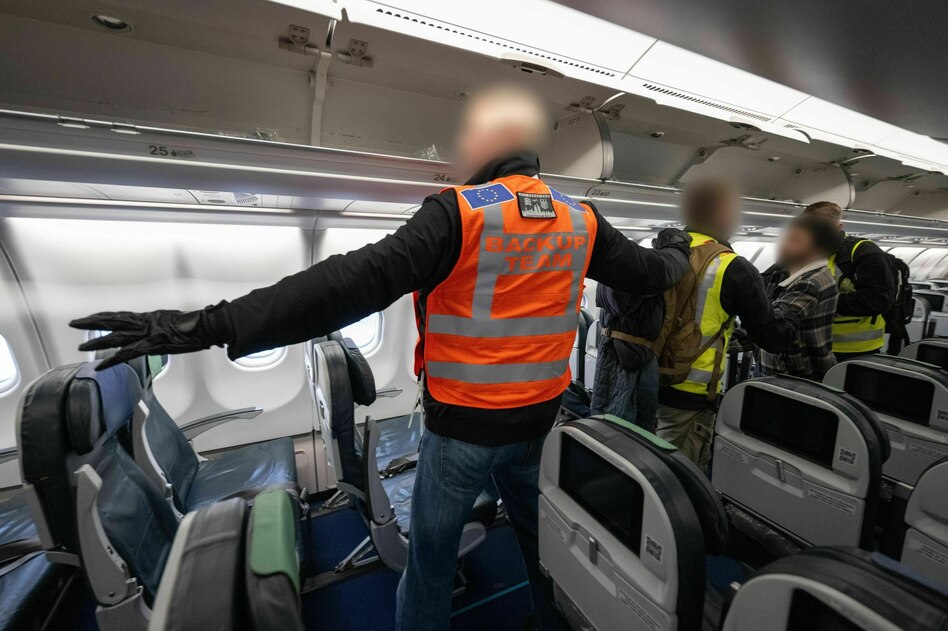
The deportation of 33 people to Pakistan cost Germany 518,110 euros in May 2026 - 15,700 euros per person. 75 federal police officers accompanied the collective charter flight. The whole thing was paid for by the EU border protection agency Frontex. Since 2016, the authority has had an expanded budget for such returns. She spent around 182 million euros on this in 2025. In doing so, it mostly did what it was originally founded to do: help the national authorities - in the case of Germany, the federal police and the immigration authorities.
If the EU Commission had its way, things would be different today. For a long time she has been working towards building Frontex into a fully-fledged EU border police with the broadest possible powers. In the past, the EU member states have always viewed this with skepticism. For them, deportations were part of the core of national sovereignty and therefore not one of the tasks that were handed over to Brussels.
And so the EU approached the expansion of Frontex primarily with services: the refinancing of deportation flights, for example, as in the case of the Leipzig flight to Pakistan, but also cross-border coordination. The first charter flight organized and financed by Frontex itself took off in 2010: 56 people from Georgia were deported from Warsaw to Tbilisi. They had previously been arrested in Poland, France, Austria and Germany. At that time, the member states applied for Frontex help on their own initiative - otherwise the agency would not have been allowed to take action.
Several mandate extensions later, there was the first deportation flight initiated and fully organized by Frontex itself in January 2022: 40 Albanians were deported from Madrid to Tirana. Frontex chartered the plane and took over contact with the Albanian authorities. However, the legal return decisions continued to be made by the responsible national authorities.
The “central EU deportation agency” with its own “deportation coordination center”, which EU Interior Commissioner Magnus Brunner now wants to expand Frontex into, is essentially nothing new. The agency should be able to enable member countries to carry out more deportations and take over the entire process, such as organizing and financing the flights. But she was already allowed to do that.
In this respect, the deportation agency is probably a code that is as innocuous as possible to make a gradual expansion of competencies attractive to the member states. How far the Commission gets with this depends primarily on the extent to which the member states are prepared to tolerate a police-like structure above the national level. Very few national interior ministries will probably want to hand over the decision about the repatriation itself in the future. In any case, the opportunities for refugees to legally defend themselves are likely to become worse for the foreseeable future.
From an EU perspective, the new powers outside of its own territory should be undisputed. The EU has long since concluded so-called status agreements with Albania, Moldova, Bosnia-Herzegovina, Montenegro and Serbia. These originally served primarily to better monitor the Balkan route in order to intercept people on their way to the EU. The agreements enable joint operations in the territory of the partner states. Frontex officers can also exercise executive powers - for example, checking people or preventing border crossings. They are not allowed to make their own arrests, decide on asylum applications or deport them.
The Commission now wants Frontex to be able to organize and carry out deportations between two non-EU countries. To achieve this, further agreements would have to be concluded with these countries. These would also have to regulate whether the EU or the third country bears responsibility for such an operation.
This new authority is important for the development of the planned return hubs. These are deportation camps that the EU wants to set up in third countries. Those who are obliged to leave the country are to be brought there if the EU cannot or cannot yet deport them to their own country of origin. It is still completely unclear how long and under what circumstances the people will be held there. But if some of them can be sent back to their country of origin after a certain period of time, Frontex should take on this task.
In addition, the commission wants to expand the units that have long been prepared as “standing corps” into “rapid reaction forces”. At the request of a member state, it should be ready for use within 24 hours in the event of a crisis. Federal Interior Minister Alexander Dobrindt (CSU), among others, suggested this with a view to the events in Ceuta. However, it is questionable whether the member states would leave Frontex in charge in such cases. At the beginning of October, Frontex director Hans Leijtens declared that the idea of taking over operational management did not make sense. The member states are still responsible for protecting the external borders. Frontex can support them, but cannot take on their responsibilities.