
Germany · taz · · 3h
EU accession candidate Montenegro: Europe at the heart
Deutsch (original) · Auto-translated to English
I would never fight for you. I'm already tired of your lies - Za tebe nikada ne bi' se borila. Od tvojih laži već sam se umorila
The song is booming, half the room is singing along. “Muške priče” is the name of the title, in German: men’s stories, by DJ Shone, a producer from Serbia. It's about what men say when they want something. In the song he offers her: Cuba, Ibiza, Mallorca. She listens to this and doesn't believe a word he says.
Western luxury as a promise: In a country where the average wage was recently 1,037 euros net and prices are rising faster than salaries.
It's a Tuesday evening in September. In the Desetka restaurant, in the middle of the campus of the University of Montenegro's technical faculties, there are flirting couples in their early twenties. During the day the Desetka is a cafeteria and café, and in the evening it is a bar with live music.
On Thursday, that country's parliament will vote on whether he should be allowed to remain president for mourning a convicted genocidal murderer.
Ratko Mladić died in The Hague prison on August 27, 2026 at the age of 84. The former commander of the Bosnian Serb army was legally convicted: genocide in Srebrenica, crimes against humanity, war crimes. He was buried in Belgrade on September 7, with military honors, the coffin covered with the flags of Serbia and the Republika Srpska, the autonomous republic of Bosnia-Herzegovina.
In Montenegro, which together with Serbia formed the rest of Yugoslavia during the civil war of the 1990s, Parliament Speaker Andrija Mandić expressed his condolences to the Mladić family. The pompous funeral sparked widespread criticism abroad, but also at home. Montenegro's Foreign Ministry distanced itself, and the opposition called for Mandić to be voted out.
The government of Prime Minister Milojko Spajić, however, remains silent. Without Mandić’s pro-Serbian party, it has no majority. A recall could bring down the government.
That's why most people at the party in Desetka are rather pessimistic when the taz asks them about the vote: He won't go. Those up there stick together.
Miljan is 26 and studying law. “I study this to understand what politics is not implementing correctly.” Sitting next to him are Ognjen, 19, and Maya, 18. Both have just finished school and are starting their business studies in a week. All three want to go abroad. For studying, for more opportunities. “Finding a good job here is difficult.”
For many people, a good job is with the state. It offers security. “But getting in there without connections is almost impossible,” says Ognjen. “It shouldn’t be like this.”
“Montenegro is so small,” adds Maya. “Everyone knows everyone.” That's why nepotism is a problem. Then comes the sentence that will be spoken often this evening: But soon we will come into the EU, then things will get better. Everyone nods. Joining the EU is what Montenegro needs, they say. “And the EU needs us,” says Ognjen. As proof that expansion is still possible.
In 2013, Croatia became the last country to join the union. It took North Macedonia almost seventeen years before negotiations even took place. Turkey has been negotiating since 2005, the process has been at a standstill since 2018. Montenegro would be proof that the goal is achievable. But what if it doesn't work?
"Here in Montenegro we like to think in extremes. Either everything is really great or everything is really bad." Miljan laughs. “We are all optimistic about joining the EU.” What particularly concerns young people: inflation. It is “very noticeable”.
There are reasons for that. Montenegro has around 620,000 inhabitants, produces little itself and imports almost everything: exports of goods cover just 12 percent of imports. There is a lack of land for agriculture and a lack of know-how for industry.
What the country does have, however, is coast. Montenegro earned 1.48 billion euros from tourism in 2025. Almost 29 percent of the economy depends on it, one in ten employees works in hotels and restaurants. The sector is booming and is also one of the few sources of income the country has.
Montenegro has been a candidate for EU membership since 2010 and the country is considered the next in line. The government advertises a year like a promise: 2028. By then, 15 of 33 negotiation chapters are still open, including those on justice, corruption and minority rights. Actually, they should be finished negotiating by the end of 2026 so that the accession treaty can be completed in 2027. Membership will follow a year later.
Joining the EU, many said this evening, would be a reason to stay in the country as new perspectives would open up. And it would bring progress in the fight against corruption. The only question is whether the calculation will work out.
The Netherlands has requested that the process with Montenegro be suspended; Croatia, Estonia, Latvia and Lithuania have joined. They demand a more consistent implementation of European standards. When it comes to corruption and organized crime, the EU demands more legally binding judgments. Diplomats in Brussels say the reactions of Montenegrin politicians after Mladić's death also influenced the attitude of some member states. And with Croatia, disputes from the wars of disintegration remain unresolved to this day. In the end, all 27 member states must agree unanimously.
“We are so divided in this country,” says one party guest, “but we agree on this, and so do all the political parties: We want to join the EU.”
What divides the people in Montenegro, as the Mladić scandal has shown, is the question of identity and their ethnic affiliation. It's a big question, say Maya and Ognjen. Montenegrins, Serbs, Bosniaks, Albanians, Croats… “We are a multicultural country.”
In the 2023 census, 41 percent described themselves as Montenegrins, 33 percent as Serbs, almost 10 percent as Bosniaks and 5 percent as Albanians. This works well in everyday life, says Ognjen. You just shouldn't talk about politics. "For example, my childhood friend is Serbian; we grew up here together. But to this day we avoid political topics."
Miljan says it's all mixed up anyway. His father is Serb, his mother is Bosnian, and he himself is Montenegrin. That's how it is in most families here. Almost everyone has relatives in Serbia. Language doesn't separate either. Montenegrin, Serbian, Bosnian, Croatian: you understand each other effortlessly. The next Serbian song is playing in the background. Nobody thinks about that here either.
The problem begins where the neighbor's politics take a different direction than your own. Although Serbia is also formally negotiating to join the EU, it is pursuing a course that does not offend Moscow, does not support the sanctions against Russia and has been under pressure for years from protests against corruption and concentration of power. Montenegro, on the other hand, has adopted the EU foreign policy, has been a NATO member since 2017 and wants to prove that it belongs.
The fault line that also runs through Montenegrin families runs between these two courses. It cannot be understood without the Serbian Orthodox Church. It is by far the largest religious community in the country. Although there is a separate Montenegrin Orthodox Church, it is not canonically recognized. Anyone who is Orthodox in Montenegro usually prays in a church whose headquarters are in Belgrade.
David Vukićević sits at a table that he is visibly proud of. A separate office, provided by the city, in the center of the capital Podgorica. The 24-year-old is chairman of MOACG, the network for youth activism in Montenegro, founded in 2021 and financed primarily by the EU and the city. There is an open youth club, workshops on prejudices, media literacy, environmental protection and the European Court of Human Rights.
Podgorica will have the title of European Youth Capital in 2028, and MOACG was also involved in the application. What young people need is education and employment policy, not a dispute over identity, says Vukićević, who studies economics and has also taught. He wants to pursue this career, become a professor, and open up perspectives for young people. He doesn't want to go into politics.
He speaks fluent German and was in Stuttgart for an exchange in the tenth grade. "Sometimes I think that young people in Germany are doing too well, that's why they don't have the energy. They are unsettled when planning security is lost. We believe here that we can improve our country." And that's why he wants to stay.
He definitely sees the division: in religion, in the relationship with Russia, in the relationship with Serbia, in the question of whether this country is multicultural. He himself has many relatives in Serbia, but clearly sees himself as a Montenegrin.
His organization is also working towards joining the EU in 2028, and he doesn't want to imagine what will happen if it doesn't work. “It works, we’ve been working towards it for so many years,” he laughs.
Outside on campus, in front of the student dormitory, it is quiet. Only a guitar can be heard, Tadija sings and plays “Layla” by Eric Clapton. He is 23, born in Serbia, grew up in Bosnia, came to Montenegro to study. He actually wanted to study acting, but his parents didn't allow it. Now he is studying entrepreneurship and business and still hopes for an acting career. Mihailo next to him comes from the north of Montenegro.
In the Desetka, the party guests argued about whether it mattered who was Serb and who was Montenegrin. They don't want to know anything about it out here. “This is more of an issue for the older generation,” says Tadija. “We grew up with an independent, multicultural Montenegro, we take it for granted.”
When Montenegro separated from Serbia in a referendum on May 21, 2006, those studying here today were in kindergarten or not even born yet. The country has been independent for 20 years, the ethnic division is a thing of the past. “Politicians try to divide,” says Tadija. “The population has much less of a problem with it.” The political calculation is simple: As long as there is a debate about origin, there will be no debate about corruption.
In recent years, Montenegro has tackled corruption. In June 2024, the government decided on an anti-corruption strategy until 2028, and in the same year parliament passed a law on corruption prevention and new rules on party financing. A year and a half later, the responsible agency for corruption prevention is working with around half of the intended staff, and proceedings against high-ranking suspects often end in acquittals or drag on. The country is ranked 65th in Transparency International's ranking, just two places behind Croatia.
NGOs criticize that Montenegro has long been ready for the EU. Especially since other countries were not ready when they joined: Spain, Romania, Bulgaria, the Baltic states. Accession is not the end of the process, but rather its most effective driving force. Only then, under the influence of the Union, would the changes really get going.
The President shares this criticism. Jakov Milatović is 39 years old, he studied economics in Podgorica and Oxford, was Minister of Economy and has been in office since May 2023. “Reforms are worth it, and European political culture is worth it.” That is the message that Montenegro can send by joining the EU. And: They want to be a role model for a multicultural state that works.
He identifies the biggest challenges in which Montenegro is furthest from the EU in four points: firstly, an effective fight against corruption and organized crime. Secondly, a more effective court system: proceedings must be completed. So far, appeals courts have repeatedly overturned verdicts, cases have to start over, and a final guilty verdict is rarely reached. Thirdly, the infrastructure, the capital is at a high level, the country behind it is not, funds are needed for that. And fourthly, ecological standards.
Former Prime Minister Dritan Abazović formulates the argument from the other side: The EU needs Montenegro as a success story. For too long nothing like this had happened; for too long, enlargement only looked like a standstill.
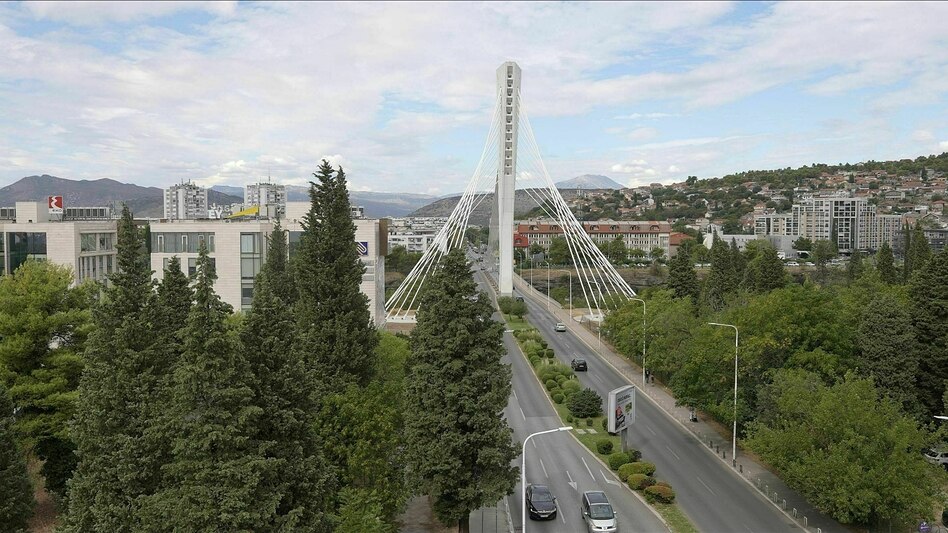
In the center of the city, the Most Milenijum stretches over the Morača. A cable-stayed bridge opened on July 13, 2005, the national holiday and almost a year before independence. It quickly became the capital's landmark: a visible promise of modernity and connection to Europe.
A taxi drives by. “Idem preko zemlje Srbije” – “I’m moving through the country of Serbia” – blares from the loudspeakers. It remains to be seen whether the promise of the bridge will be fulfilled in 2028. Many here believe it. Support for accession has been between 75 and 80 percent for years.
For many Montenegrins, accession also means securing their own sovereignty. It's about securing what you've built up over 20 years. And what many fear is that people in Belgrade still consider it to be negotiable.
The music in the Desetka has become louder, the room is fuller. “We have the most beautiful country,” Maya is convinced. "We have the sea and the mountains. And a lot of sun. I will always come back here because my family is here." And the next song sounds.
Read the full story at the source
Source: taz