
World · taz · · 3h
First aid in the Ukrainian war: Faster than the emergency doctor
Deutsch (original) · Auto-translated to English
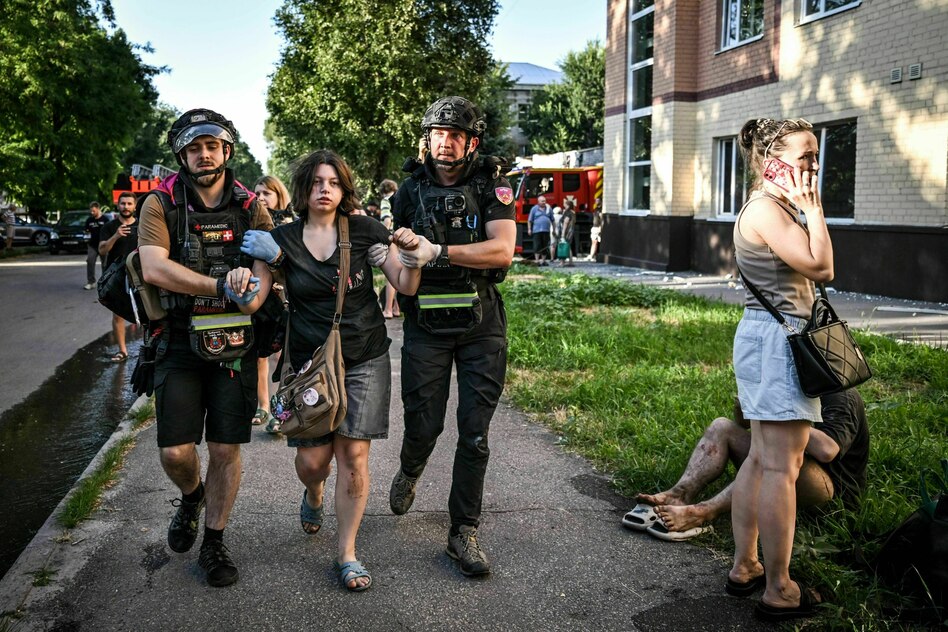
When one of Russia's new Geran reactive drones hit the Ukrainian SBU building in September, 33-year-old Stanislav did not immediately realize he was injured. The warehouse worker, from Brovary, was in the center of Kyiv at the time of the explosion. The blast knocked him to the ground and stunned him. Only after a few seconds did the man realize that he was bleeding profusely. Metal fragments from the drone hit his head and arm. Passers-by who happened to be there rushed to his aid.
"A young man ran up to me. He said he could give first aid. I was taken to a nearby café. There were a few people there. Some had bandages with them, others a tourniquet. They called the emergency services and treated my wounds," says the man, who had lost a lot of blood.
12 people were injured in this attack on Kyiv. Such situations are becoming part of a new reality. Since the Russian side changed its tactics in the attacks on the Ukrainian capital, air alarms have also been sounded during the day.
Drones have become faster and are being used in successive waves. This has increased the risk of being injured in a café, on the way through the city or at work. This presents Kyiv residents with a new challenge: they must be prepared to provide first aid.
“Tourniquet, gloves and bandages,” says Sergei Efimchuk, a 40-year-old instructor in first aid and emergency and emergency medicine. He counts on his fingers the items of equipment that everyone in Kyiv should have with them when leaving the house. Sergei has been training military personnel and civilians in first aid since 2014. Over the past month, he has seen an increase in demand for such courses in Kyiv.
"We are increasingly being asked to conduct corporate training for the workforce of Kyiv companies and companies. The situation has worsened. People feel that this knowledge has become indispensable. It can easily take 10 to 20 minutes for the emergency services to arrive in a big city with traffic jams - and during this time a person can die from massive blood loss," explains Sergei. He has had to apply tourniquets himself several times and provide first aid to injured people after Russian shelling.
Sergei is convinced that taking courses and a simple set of items to carry with you at all times can save the lives of Kyiv residents in the new reality of war. “It is best to choose gloves in contrasting colors so that traces of blood on them are clearly visible,” says Sergei.
The instructor adds that the war “significantly expanded the knowledge of Ukrainians in the field of first aid.” While he often has to explain what a tourniquet actually is when speaking to foreigners, in Kyiv it's more about demonstrating practical moves.
First aid kits, tourniquets and first aid equipment have become part of Ukrainians' everyday life. Tourniquets in Kyiv are no longer sold only in gun stores or tactical medical equipment stores, but also at gas stations, hypermarkets and even at the checkouts of children's supply stores.
Next to toy cars and teddy bears are black and pink tourniquets, which are available for the equivalent of 15 euros. They are purchased both for personal first aid kits and for equipping cafes, business centers and offices - because attacks on civilian infrastructure can occur at any time.
Also in September, a Russian combat drone struck a business center where the television channels My - Ukraina and My - Ukrayina + are based. The impact occurred during the day while My - Ukraina was live on air. The greatest damage occurred in the newsroom and in the journalists' work rooms. 6 people were injured.
"These are attacks that you can't prepare for. Because you don't hear the drone coming, and the explosion happens in a second," says 38-year-old journalist Oleg Bilezki, who was live on the radio at the time of the impact. "The blast wave threw me into the air and I felt pressure on my ears. I knew that the explosion must have taken place very close by, but since I was on the air, I couldn't estimate the extent of it. When smoke came into the broadcasting room, I realized that the television building had been hit," remembers Oleg.
It later emerged from surveillance camera footage that the drone was specifically aimed at the business center. The rescue service arrived at the scene of the bombardment quite quickly, but by then the journalists had already given their injured colleague first aid, says Oleg.
"In Kyiv, unfortunately, you never know when a shelling might occur. That's why I'm taking a tourniquet with me now. And I plan to take another course in tactical medicine," says the presenter, adding that his television station's building was attacked for the second time this year.
Stanislaw, the warehouse worker from Brovary, was released from the hospital after a few days. "The doctors removed the splinters and said: 'You will survive!' My arm can be moved. From that point of view, everything turned out well. But I am very happy that I met helpful people who supported me," says Stanislaw. He had just experienced an additional birthday.
Read the full story at the source
Source: taz