
War & Militarism taz
Success for Musk's space travel: SpaceX catches the giant Starship rocket for the first time
Elon Musk wants to explore Mars with the largest rocket system ever built. Now Starship has completed a test – with one success and one setback. more...
Deutsch (original) ·Auto-translated to English
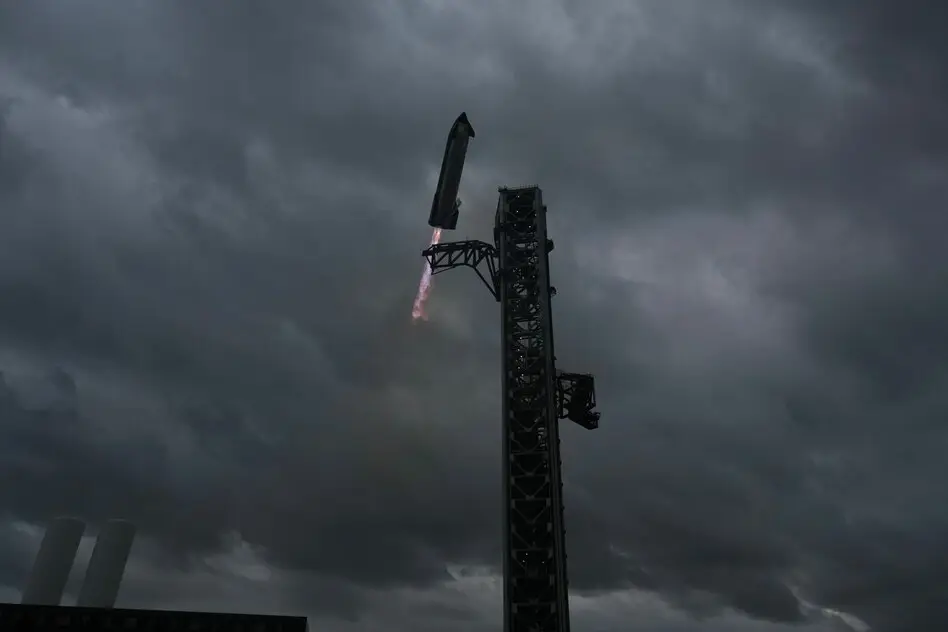
dpa | For the first time, the US space company SpaceX has recovered the upper stage of the giant Starship rocket system on Earth after a test flight into space. Around 20 hours after launch, the Starship returned to the Starbase spaceport in the US state of Texas and was picked up there by gripper arms on the launch tower. It was the first time SpaceX had attempted such a capture - and represents a major step forward in rocket reusability.
SpaceX spoke of an “incredible success”. The space company's owner, tech billionaire Elon Musk, praised the achievements of his "incredible team." NASA boss Jared Isaacman congratulated on a “spectacular launch” – catching the upper rocket stage was “almost like magic”.
However, there was also a setback for SpaceX on the 15th test flight: the lower rocket stage should actually have been picked up again by gripper arms on the launch tower, but that didn't work.
The booster, called Super Heavy, returned to Earth shortly after launch, but crashed into the sea in a controlled manner and burst into flames. SpaceX initially did not provide any information about the possible cause of the failure. In three previous test launches, the lower rocket stage had been successfully intercepted.
The upper rocket stage, called Starship, entered Earth orbit shortly after separating from the lower rocket stage and deployed satellites for Musk's Starlink Internet service. She then circled the earth several times.
The last test flight of the Starship was in September. The largest rocket system ever built made it into Earth orbit for the first time and then crashed into the Pacific in a controlled ball of flames around three hours later.
The Starship rocket system is huge, even larger than the Statue of Liberty in New York. It consists of two parts that separate after launch: the approximately 70 meter long booster Super Heavy and the upper stage - also called Starship - which measures around 50 meters. Both parts are designed so that they can be reused after returning to Earth - which has primarily logistical and financial advantages.
The rocket system was tested for the first time in April 2023 - but then it exploded completely after a few minutes. The further tests were met with varying degrees of success.
The US space agency Nasa wants to send astronauts to the moon with the Starship, while SpaceX also aims to reach Mars one day. Other space companies in the USA - including Rocket Lab and Amazon founder Jeff Bezos' Blue Origin company - as well as other countries are also working on reusable rockets. In the summer, China retrieved the stage of a launch vehicle in a controlled manner for the first time.