
World · taz · · 1h
Enric Mas before victory in the Tour of Spain: Late reward for the all-time second place
Deutsch (original) · Auto-translated to English
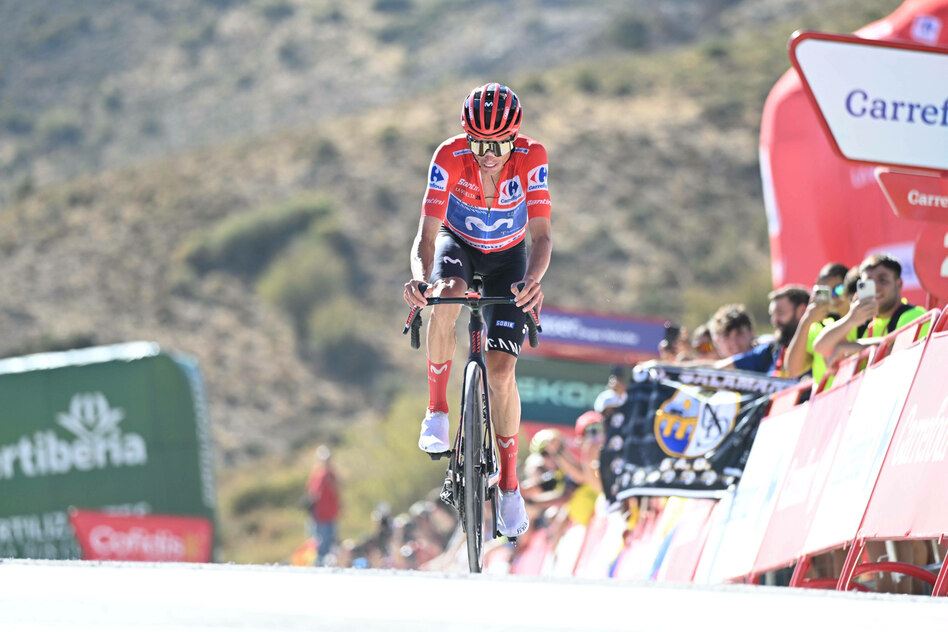
Just hold on – that was Enric Mas’ motto on the penultimate stage of this Vuelta a España, which was decisive for the overall classification. On the final climb up to the Collado de Alguacil - the maximum gradient was 22 percent - he was no longer able to accelerate. He remained seated in the saddle as if glued to his seat, but continued to concentrate on his program. “To be honest, I was just counting the kilometers recently,” he admitted at the finish. Visibly exhausted and unable to even celebrate, he crossed the finish line.
However, a proud smile spread across his face. The Austrian Felix Gall had taken a few seconds off him. But his worst rival Primož Roglič remained behind him. He had solidly defended his lead in the overall ranking and looked like the sure winner of the tour before the final stage around Granada in the evening.
The Mallorcan tried for eight years to crown his career with overall victory on his home tour. In 2018 he came second. The then 23-year-old was celebrated by the Spanish media as the legitimate successor to greats like Alberto Contador, winner of all three Grand Tours, and Miguel Indurain, five-time champion at the Tour de France.
But Mas did not live up to public expectations. Injuries and falls repeatedly set him back. Fear of speed on downhill runs emerged as another competitive disadvantage, as did his relative weakness in time trials.
Still, it was often enough for remarkable performances at the Vuelta. He came second overall three times and third once. “I don’t know what the cause is, but this time of year just seems to suit me,” he himself remarked.
However, he was still criticized as a perpetual runner-up, as a racing driver who simply cannot win. "He was probably the most criticized Spanish cyclist. For me, this was completely wrong," said ex-professional and Eurosport reporter Contador during the Vuelta.
But on this tour of Spain everything fell into place for Mas. He was the undisputed captain of his Movistar team. His form was good, as he proved with a fifth place in the Tour of Burgos shortly before the Vuelta after a long break from racing. “I trained well and feel better than ever in my career,” he confessed. The most important building block for his current success was the failure of top favorite Tadej Pogačar after a fall on the 8th stage. As second in the GC, Mas automatically received the red jersey. At the winner's ceremony in the evening, he didn't want to put it on yet out of respect for the Slovenian.
The day after, he won the mountain stage to Alto de Aitana in a superior manner. "My first victory in the red jersey," he beamed, and in reference to the long-time winner Pogacar, he stated: "Now I know how Tadej feels. A leader's jersey like that just gives you wings."
He didn't strap on the really big Pogačar wings afterwards. There was no further stage win for him. His team controlled the race more defensively and allowed large groups to escape. But day after day he transformed from a “kind of substitute leader” – which the competition from Visma – Lease a Bike had initially ridiculed him as – into the patron of the tour. “The history of this tour must be written with Enric Mas,” the Spanish newspaper El País aptly analyzed.
A key moment, in addition to his stage win, was his good performance in the time trial. The Spaniard only lost 33 seconds to the specialist Roglič, who was rated at least a minute better. He even won on Gall. Looking back, Spanish media saw Mas, in his red jersey, striding like a bullfighter on his way to the start ramp of the time trial in the middle of the massive bullring of El Puerto, strong, focused and confident in himself.
All of these eulogies are later rewards after years of sometimes biting criticism. On the drive through Granada at night on Sunday, Mas benefited from the fact that the majority of the teams advocated neutralizing the classification times at the beginning of the last city lap in order to minimize the risk of a crash. The race management complied with this request and neutralized the stage before the last lap.
Read the full story at the source →
Source: taz