
World taz
Recommendations from a former senator: Practice, practice, practice
Hamburg's former school senator Ties Rabe wrote a book on how schools should work better. You don't need any structural reform, just a lot of teaching. more...
Deutsch (original) ·Auto-translated to English
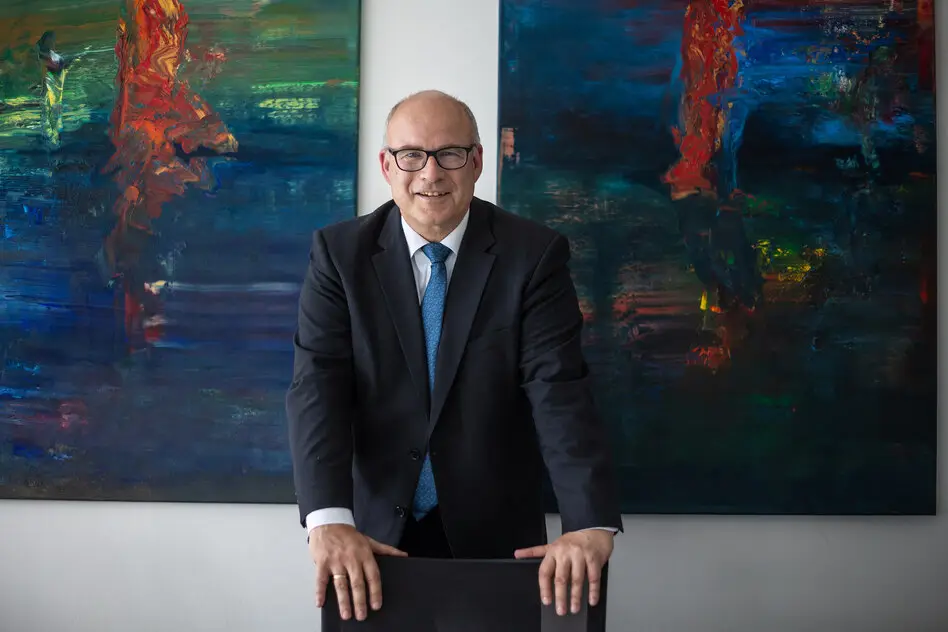
He was a school senator in Hamburg for 13 years, and now he has written a book to give Germany advice on how to emerge from its recent education crisis. As a local journalist in Hamburg, reading “Finally Get Started – What Children and Schools Really Need to Secure Education” reminds you of Ties Rabe’s earlier press conferences. The SPD politician and high school teacher used to be the editorial director of a weekly newspaper and knew how to put his politics into quick sayings. For example, when asked whether third graders should bring their own smartphones, they will not “only allow wooden toys” in elementary school.
The SPD politician, who always appears in a suit, was a surprise candidate to become school senator under then mayor Olaf Scholz in 2011 and was seen in this position as almost a provocation in the education scene. As an opposition politician, he had previously fought the green school reform of a modern six-year primary school. With the perspective of a high school teacher, he didn't have much to do with the new learning culture. But he remained in office for over a decade and, before leaving in 2024 for health reasons, made a name for himself nationwide as the coordinator of the SPD-governed states for education policy. So now he has written a book.
The second chapter is devoted in detail to the corona pandemic, which Ties Rabe experienced as a very difficult time because the schools were closed for a long time and education ministers opposed it. Of all people, professional teachers' associations, which did not want to engage in clientele politics, repeatedly called for stricter closures. Rabe writes that he felt like he was at a tribunal at some press conferences, and that he also missed the retroactive self-criticism of the media here. The lack of teaching time had a devastating effect on learning success.
Ties Rabe: “Finally getting started”, Rowohlt Berlin Verlag, 24 euros
Without question, Germany did poorly in the PISA surveys after the Corona period, like many other OECD countries. According to PISA 2022, one in five school children in Germany can read and calculate so poorly that they cannot actually graduate from school. The numbers from the latest Pisa study are similar. So there is a need for action.
Ties Rabe now recommends that the rest of the Republic proceed as Hamburg did. The city-state has caught up significantly in the national surveys that the Institute for Quality Development in Education (IQB) carries out on behalf of the federal states. While Hamburg's ninth graders came 12th out of the 16 federal states in mathematics in 2012, they made it to 4th place in 2024.
But in his 250-page book, the SPD politician vigorously opposes all efforts to rethink the education system or to call for a “restart”. Because structural reforms would bring nothing or at best “a lot of effort for little effect”. Rabe advises improving the quality of teaching and giving the children as much of it as possible. He even goes so far as to say that schools should forego excursions so that children have more learning time to learn the important basic skills in German and mathematics.
The author relies on the large meta-study by the New Zealand researcher John Hattie. He has proven that “the school system is not that important,” writes Rabe and adds: “Incidentally, neither are most educational fashions and methods.”
What the former school senator does not reflect in his book: Hamburg owes its educational success - the details of which could still be debated, because the number of weak students there also increased, just less than in other federal states - to structural reforms. Since the first PISA study in 2001, the high selectivity of the structured school system has been an issue again, which is why there has been a strong movement in Hamburg for a nine-year common school followed by a sixth form.
In their slipstream, Hamburg's “two-pillar model” emerged around 2010. Since then, there are no longer any secondary or secondary schools in the Elbe metropolis, instead there are only high schools on one side and district schools on the other. The latter basically function like a comprehensive school, with the special feature that each has its own upper level and teachers who are qualified to orient the students towards the educational goal of a high school diploma.
The school system in Hamburg, which Rabe sees as exemplary, did not come about without structural changes. And many smaller reforms, such as the assessment of language proficiency among four-and-a-half-year-old children, the primary schools, which are particularly socially burdened with an upper limit of 19 children, with a comparatively small class size, regular learning proficiency surveys across all grades and targeted support for reading and mathematics, were already introduced by Rabe's predecessors.
The book has the character of a school political reckoning. Rabe, who was the longest-serving minister of education with 13 years in office, has an enemy image, and that is the “educated public”. They are hardly interested in reading and arithmetic and instead demand things like school fruit, anti-bullying initiatives or gender-equitable education from the ministries. The schools and ministries would then have to form working groups for implementation. All of this takes a lot of time, complains Rabe. “It’s then missing somewhere else.” School stress and pressure to get grades were also “spiritually criticized” by those involved in the education scene, but hardly anyone was interested in declining performance.
Rabe doesn't say anything good about the modern methods of individualized learning at your own pace. Because children from educationally disadvantaged families would be overwhelmed by this.
But these are precisely methods that are intended to help children who otherwise switch off and understand nothing in order to prevent school failure. Individualized learning is also very much about how it is done. Whether a teacher only lets the children fill out one worksheet after the other and doesn't let them explore any of the world.
Here, too, Rabe relies on the Hattie study “Visible Learning” and the list derived from it in Germany of things that work and do not work. So-called “open lessons” are one of the things that do no harm and do not help, and a small class size only helps “a little,” wrote Die Zeit in 2013.
But according to another study called “German English Student Performance International” (DESI), class size does have an effect on the quality of teaching because students get to speak more often and thus learn faster.
The New Zealand researcher did not investigate such interactions. But Hattie herself writes that one reason for the small effects of small classes is that teachers there often use the same methods as in large classes and do not take advantage of the advantages.
Hattie also made negative comments about the structured German school system and castigated it as a “waste of talent”. Ties Rabe mentions this briefly in his book, but doesn't go into it in more detail. In addition, Hattie identified the change of school as a negative factor. Even in Hamburg, hundreds of children are still being “de-schooled” from high school – meaning they are moving to a district school. But Rabe doesn't want to go there.
The school researcher and former Hamburg State Councilor Ulrich Vieluf has read Rabe's book and says: "The book works much better as an educational policy essay than as an empirical analysis of the causes." A former school senator can say which reforms he thinks make sense. However, empirical research uses this too selectively to check the plausibility of an already established reform program.
Rabe's appeal not to abandon the left-behind students and instead support them with more lessons is quite sympathetic. Learning from Hamburg could, for example, mean foregoing secondary and secondary schools throughout Germany and offering every student a district school that has an upper level and paves the way to the highest school leaving certificate.