
Housing taz
Agreement on expropriations in Berlin: From exploration to socialism?
Beaming faces from the Berlin Left, the Greens and the SPD. The three parties will start coalition negotiations. What exactly they agreed to. more...
Deutsch (original) ·Auto-translated to English
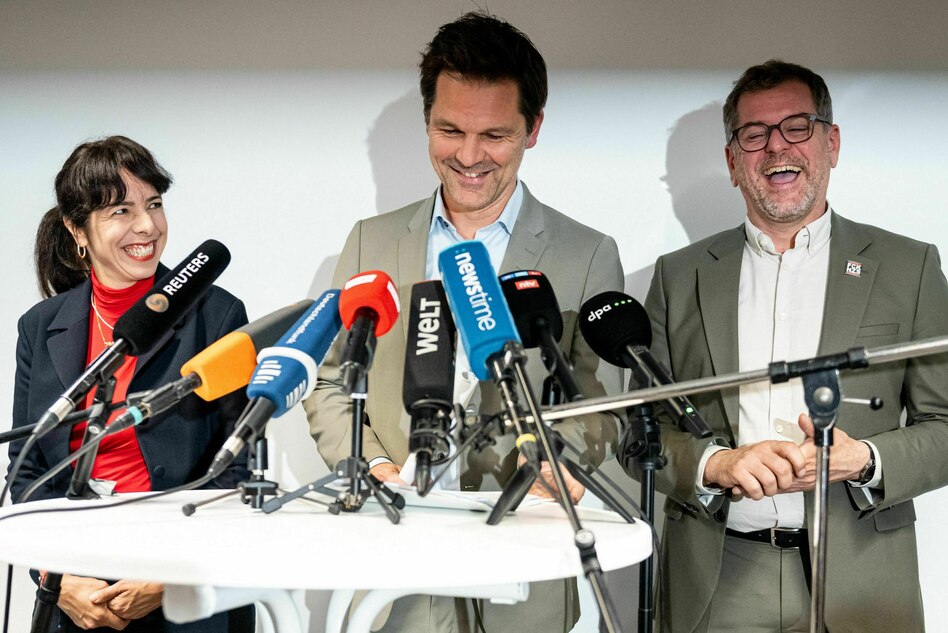
They announce their vision on the tenth floor of the House of Statistics on Berlin's Alexanderplatz. At 5 p.m. on Saturday, the negotiators from the Left, the Greens and the SPD, Elif Eralp, Werner Graf and Steffen Krach, will appear in front of the press to share details about their agreement. What is surprising is that there is also a compromise on the controversial issue of the socialization of large housing companies.
The left-wing election winner Eralp is the first to speak: “Together we strive for an affordable, climate-friendly and economically strong Berlin.” Werner Graf adds that the “question of democracy is at the center,” and Steffen Krach adds: “It’s important to all of us that we bring this city together.”
According to Eralp, the central concern of the three parties is to solve the rent crisis. The Left Party prevailed on the controversial issue of socialization. “A socialization law will be presented to the House of Representatives in mid-2028,” Eralp promised. The socialization is to be completed a year later, possibly after a review by the Federal Constitutional Court.
Contrary to what has been discussed so far, the limit for the transfer of private portfolios should be 10,000 apartments. The companies Vonovia, Heimstaden, Covivio, Adler and probably DVI would be expropriated. That would be fewer apartments than the referendum had planned, but a total of around 160,000 apartments - almost 10 percent of the total in Berlin.
SPD leader Steffen Krach, who has repeatedly spoken out against this step, speaks of an “absolutely justifiable compromise” that he could represent as a “democrat” with a different opinion. This includes that compensation should be capped at 16 billion euros without putting a strain on the budget, and that apartments that are newly built from 2021 onwards will not be socialized. According to Krach, a signal that everyone who wants to build in Berlin is welcome.
The common thread is the common thread that runs through the exploratory paper. It is entitled “More Together, More Berlin”. “Right now we need a unifying policy that brings people together,” it says.
The first section is about housing and socialization - which was the big sticking point. The three parties now agree “that the application of Article 15 of the Basic Law is a contribution to expanding the municipal housing stock and overcoming the crisis on the housing market.”
Eralp calls the promise of 100,000 new apartments by 2031 “very ambitious”. SPD man Krach is satisfied with the agreed triad of “new construction, law and order on the housing market and capping rents”. The latter is promised for the state-owned apartments, whose rents should only be increased by a maximum of 2 percent per year. A new authority is to be set up to control rents.
Neighborhood canteens, cheaper social tickets, free museum Sundays – the list of individual measures that have been agreed upon is long. But Krach emphasizes: The paper “does not contain promises of billions and has been calculated seriously.” In view of a budget deficit of 5 billion euros, a consolidation course was agreed upon. New income from taxes and fees amounting to 400 million euros annually should also help.
Their representative Werner Graf also has a lot to offer for the Greens: from the goal of a “climate-neutral metropolis” with a net zero seal from 2030, investments in the cycling infrastructure, the priority of buses and trains, the consideration of a packaging tax or the rejection of the development of Tempelhofer Feld and an extension of the A100.
The exploratory paper has 25 pages. The document also contains the Berlin Declaration on the Fight against Anti-Semitism, which the Left, the SPD and the Greens had already signed on October 8th. One appendix is also about the fact that all three parties find organized crime stupid. “Even proactively contacting or responding to individual people represents a serious violation of our principles,” write the three parties, because there were allegations of contacts in the milieu after the election.
The topic of anti-Semitism is mentioned in a total of 7 places in the document. One says: "For peaceful coexistence in Berlin, it is clear that we are fighting anti-Semitism with all our might. Palestinians also experience racism in Berlin, which we are fighting." They want to resolutely counter violence, hate speech, conspiracy narratives as well as the denial and relativization of the Shoah. “We clearly identify Israel-related anti-Semitism.”
The police and the Office for the Protection of the Constitution should be strengthened “in their mission to protect Jewish life in Berlin”. They should be given the equipment and expertise to identify and combat anti-Semitic crimes and threats at an early stage. The protection of Jewish institutions and communities should continue to be guaranteed. The prevention of anti-Semitism should also be promoted more strongly.
Now Krach says that an agreement was reached “relatively quickly” on the hot topic of internal security. It is a “primarily social question that people can move freely and safely on the streets”. The police should be strengthened, police stations renovated, a State Security Council introduced and the Office for the Protection of the Constitution given better parliamentary control.
However, the three negotiators have had little to say about the debates of the past few weeks. Werner Graf even speaks of a “very strong trust” that was created and of a “great spirit” in the discussions.
Whether coalition negotiations would begin at all was in question for a long time. After the Left on Tuesday decided on their own paper on dealing with anti-Semitism and the inclusion of Neukölln MP Vanessa Emde in the parliamentary group, the SPD and the Greens initially interrupted the negotiations.
As the probes continued, a statement from Emde caused a stir in which she made it clear that she did not want to compromise on her position on the Middle East. The left-wing faction leadership then reacted quickly and distanced itself from Emde. A decision on whether the MPs will remain in the group will be made on Tuesday.
The start of coalition negotiations is still subject to party approval. A small party conference for the Greens is scheduled to decide this Monday. The SPD wants to present the exploratory results to its state executive board, also on Monday. The Left is taking more time because of the two-week autumn holidays in Berlin. She has scheduled her party conference for October 31st. The negotiations could start at the beginning of November.
There is a comfortable majority in the House of Representatives for a coalition of the Left, the Greens and the SPD: the three parties together have 91 seats - 14 more than are necessary for an absolute majority. An alliance between the CDU, the Greens and the SPD would also be mathematically possible. However, with only two seats, it would only have a narrow majority.
When asked about Chancellor Friedrich Merz's (CDU) renewed warning against a left-wing alliance, Krach becomes clear: "Merz should get his own government and his party under control. That would help the country more."