
Housing taz
Agreement on expropriations: three winners for Berlin
What the Left, the Greens and the SPD are planning in the capital gives hope: for a more social city and a change in politics that radiates beyond Berlin. more...
Deutsch (original) ·Auto-translated to English
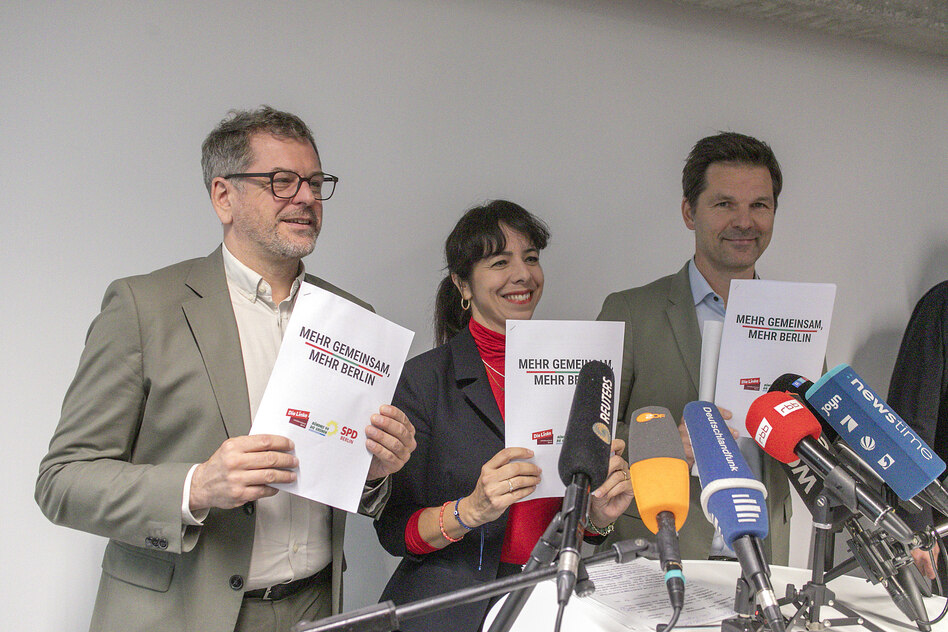
One would hardly have thought it possible what Elif Eralp (Left), Werner Graf (Greens) and Steffen Krach (SPD) announced late on Saturday evening in a small, unrepresentative room in the House of Statistics on Berlin's Alexanderplatz: The leaders of the three state parties have successfully concluded their exploratory talks and are now aiming for coalition negotiations for a new Berlin state government.
There was no sense of jubilation in the statements of the three negotiators, no air of triumph in view of the fact that they had withstood the enormous pressure from a right-wing campaign, but also from the federal parties of the Greens and SPD. Instead, the result, which is historic especially given the agreement on socialization, was announced in a decidedly sober manner. Getting out of the excitement and concentrating on the content remained the common message.
Just two days earlier there had been fears that a video from Neukölln's left-wing MP Vanessa Emde could finally deal the final blow to the talks. In it, Emde criticized the left-wing faction's commitment against anti-Semitism, which she had signed, and repeated her position that states, i.e. Israel, have no right to exist. But the Left leadership reacted quickly and sharply, thereby creating the trust that enabled the Greens and the SPD to keep their feet still.
The realization finally prevailed: a stable majority of 14 seats for red-green-red and the chance of a federal political flagship project against the threat of fascism cannot and must not fail because of one individual.
What the Left, SPD and Greens said on 25 pages in their exploratory paper entitled "More Together. More Berlin." have presented is much more than the result of a defensive struggle. Even in view of the turbulence in the explorations, it is a success that all three parties can now find each other with their core concerns. On the other hand, it heralds a change in policy that radiates beyond Berlin's state politics.
The agreement to pass a law in mid-2028 that will combine the real estate companies' holdings with ownership of more than 10,000 apartments in the city is outstanding. The fact that the compromise - the successful referendum five years ago called for socialization of 3,000 apartments or more - was achieved is a breakthrough, not only for the Left Party, but for left-wing politics that makes a difference. This is particularly courageous for the SPD, at least its party leader Steffen Krach, who until then had always spoken out against it.
Krach himself confidently spoke of an “absolutely justifiable compromise”, and that also because his party has achieved successes. This includes an ambitious new construction program for 100,000 affordable apartments and the same number of new building permits by 2031 and the stipulation that, contrary to what the Left wants, the state-owned housing companies will be allowed to continue to increase their income through rent increases in the future - capped at two percent annually. In addition, there is a business-friendly program for industry and start-ups, securing police staffing levels and sticking to the application for Expo 2035.
The Left can look forward to being able to back up its promise of an affordable and livable city: neighborhood canteens and free museum Sundays, free bulky waste collection, strengthening collective bargaining, lowering the price of the social ticket for public transport, more community schools or supporting tenants against illegal landlord practices. The list of their successes is long and has the potential - apart from the very dogmatic ones - to convince the majority of the party base.
Last but not least, the Greens have ensured that the path to a climate-friendly city with a focus on buses, trains and bicycles is another focus of the agreements. This includes the joint rejection of the further extension of the A100 pushed by the federal government. In addition, the edge of Tempelhofer Feld should not be built on.
The planned joint effort for a wealth tax and a reform of the inheritance tax, for the examination of a ban on the AfD and the protection of commercial tenants are important left-wing signals to the federal government. And last but not least: Red-Red-Green wants to strengthen social cohesion and democracy. A democracy promotion law should, for example, help to promote initiatives longer than once a year. In times when things are getting darker politically everywhere, all of this is a real counter-offer. If the three parties hold firm and transfer these agreements to a coalition agreement in November, this government under Elif Eralp will be more than a glimmer of hope.