
Germany taz
Genghis Khan Exhibition Berlin: Genghis Diplomacy
An exhibition commemorating the 800th anniversary of Genghis Khan's death opens on Berlin's Museum Island. Without the title hero, but with European-Asian geopolitics. more...
Deutsch (original) ·Auto-translated to English
There has been so much talk about stirrups in the last few weeks that people have almost forgotten the efficient elegance of the thing itself. You can now catch up on this in a new exhibition on Berlin's Museum Island. Stirrups in all shapes from several centuries have been in the display cases since this week, even in miniature in gold as grave goods, telling of the close relationship between nomadic steppe peoples and their animals.
So many stirrups, so few holders. Maybe because the high medieval Mongolian cavalry warriors, unlike German fascists, got on horses quite well without help.
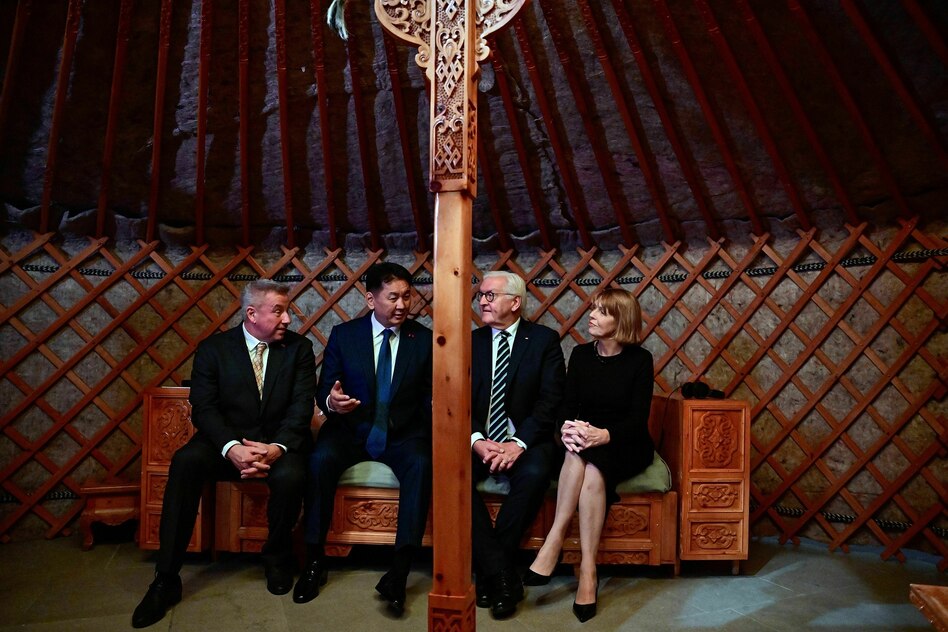
“Genghis Khan and the World of the Mongols” is the name of the exhibition in the James Simon Gallery, which opened on Tuesday with a ceremony as part of the state visit of the President of Mongolia, Uchnaagiin Chürelsüch - the title hero, of all people, is discreetly absent. “We have nothing,” admits the state archaeologist and director of the Museum of Prehistory and Early History, Matthias Wemhoff, in his opening speech.
“Genghis Khan and the Mongolian World”. James Simon Gallery, Berlin, until April 18, 2027.
There is nothing - the grave is undiscovered, there is no authentic portrait showing the legendary general and founder of the largest land empire ever to exist in world history. The posters are adorned with a golden monumental statue from the Genghis Khan National Museum in Ulaanbaatar - from 2025. But Genghis Khan's death anniversary is 800 years ago in 2027, and in general: If a name from Central Asian history attracts an audience - then it's probably this one.
The nomadic chief's son Temüjin from the valley of the Onon River, who was later called Genghis Khan - "ocean-like ruler" - first united the tribes of the Mongolian steppe before founding an empire in 1206 that stretched from the East China Sea to the Caspian - his successors were even supposed to expand it significantly to the south and west.
His power can even be proven in historical climate data: The fact that the Mongols massacred up to a third of Asia's population lowered the CO2 content of the atmosphere. However, he is not just the brutal butcher that he is remembered as in Europe - on the contrary, he pacifies contested areas, enacts religious freedom and creates equality before the law.
Not least Europe benefits from the “Pax Mongolica” - the wealth of the Italian cities is based primarily on free trade between the Far East and the Crimea. Without the supposedly evil Tartars, who stood on the border with the German Empire in 1241, there would probably be no Renaissance.
But today the collective association is above all a hit. "On brothers! Drink brothers! Fight brothers! Again and again!" it says. The exhibition starts with the cliché right from the start: monstrous armies of cavalry gallop once again in video projections in a practiced, antiquated “Terra
Like the remains of destroyed monasteries, which are also on display. Europe is almost defenseless against the attackers. But the armies unexpectedly turn away, the Mongol storm ends a good 250 kilometers from Berlin - the Great Khan has died in the Far East and a successor must be chosen.
The exhibition then takes a leap through time and space. You could call it old school, as the makers rely on the magic of setting the scene to depict the empires and ethnic groups from the steppe. The path into the hall leads through a reconstructed grave corridor with magnificent grave goods from Shoroon Bumbagar (7th century). Of course there is also a yurt.
The focus then moves via Genghis Khan's environment to his capital Karakorum - the nomadic ruler suspected that such an extensive empire could not be managed on the back of a horse and centralized the economy and administration here. Finds show the extensive trade network and also the religious diversity of this city.
A special highlight is a fragment of the founding stele that the curators were able to borrow from Ulaanbaatar - its inscription is bilingual, in Chinese and in the Mongolian script developed on behalf of the Khan. Overall, however, it is not an exhibition of overwhelming objects - although many of them can be shown outside Mongolia for the first time. Everyday objects dominate, particularly rare objects such as golden passports can only be seen in copies.
What makes the exhibition exciting is how it raises awareness of connections and breaks in history and reorganizes historical spaces: The Uyghurs are currently perceived primarily as victims of a suspected ethnocide - here they appear as an imperial power from the steppe, predecessors of the Mongol Empire.
Contemporary Eastern European history, says regional archaeologist Wemhoff in the press conference before the opening, is also shaped by the Mongol Empire: The fact that Ukraine and Russia developed differently is also a consequence of the inconsistent influence of the Mongolian Golden Horde.
Wemhoff's opening speech in the presence of the Mongolian President now leaves out the field, perhaps out of consideration for the guest - Chürelsüch made a negative name for himself in 2024 when he received his internationally sought-after Russian counterpart. As the only relatively stable democracy in Central Asia, Mongolia is geopolitically in the most thankless position: it borders only two countries, the authoritarian superpowers Russia and China.
It is obvious that Chürelsüch speaks at the ceremony of Genghis Kahn as a bringer of peace who ended “centuries of war between East and West” and because of whom “Europe and Asia could live together peacefully”. “This time the Mongols have actually come to Berlin,” said Federal President Frank-Walter Steinmeier, ironically volleying the whole thing in his previous speech.
Basically, Mongolia is practicing Genghis diplomacy with an exhibition that is so heavily supported by the state - similar to China with its pandas. The National Museum is sending golden miniature stirrups, and in return a few ancient sculptures from the museum island of Ulaanbaatar will soon be visiting.
In the background, Germany is securing raw materials in the Mongolian steppe and Mongolia is gaining a little security in the “close, values-based friendship” invoked by President Chürelsüch and, one would hope, remains part of the democratic axis. Genghis Khan, the war criminal with the golden touch for the power of organization and cohesion, would certainly have approved of this.