
World taz
Drone training in Ukraine: The front is holding out – but Ukrainians fear for their cities
Against the background of the talks between Vladimir Putin and Steve Witkoff, Ukrainians fear even more violent attacks on their major cities. more...
Deutsch (original) ·Auto-translated to English
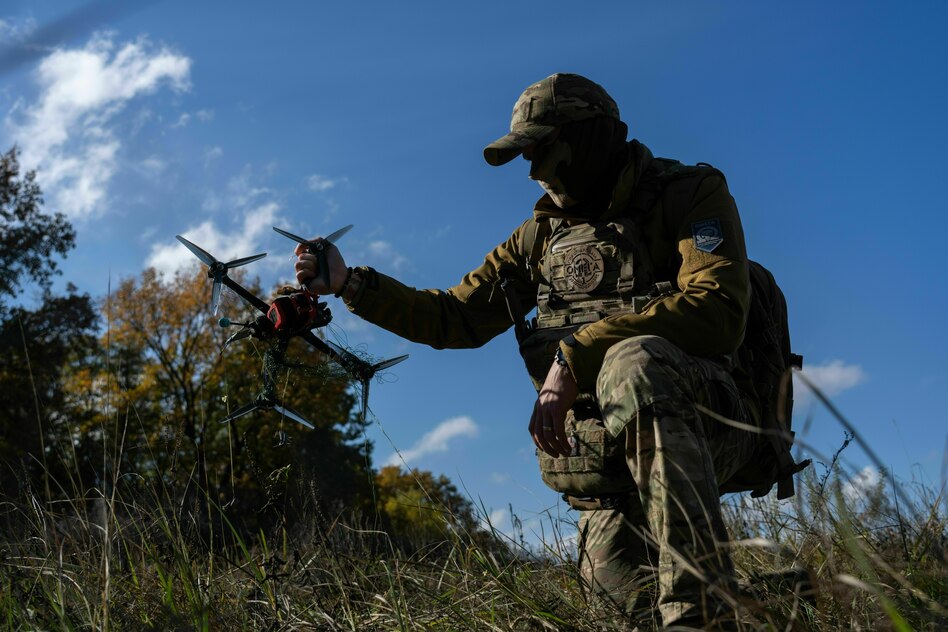
A group of Ukrainian soldiers moves under the cover of a forest edge when their drone detector reports an attack. Two of the soldiers hide in the bushes, the third allows the drone to come within 15 meters of him, then shoots it with a net-throwing device. The net unfolds in the air and gets caught in the drone's rotor blades, causing it to crash.
Drone detectors and net launchers from Ukrainian manufacturers are being tested at a military training area in central Ukraine. Soldiers from the “Omega” special unit practice here in case of an emergency. Soon they will need these skills in real combat conditions.
Over the past month, both fighting on the front lines and Russian shelling across the country have intensified. Against the background of deteriorating relations with the USA and the resumption of economic relations between Moscow and Washington, Ukrainians are preparing for an intensification of the war.
After training, the 32-year-old soldier with the call sign “Poljak” shows off his net shooter. The black disposable device resembles a pistol and works with pyrocartridges. With the net fired in this way, Russian FPV drones can be intercepted at a safe distance from people.
"This war is a drone war. That's why we're using everything we can: drone detectors, pump guns, and now each of us has net launchers like this. Technically, we're always looking for new solutions," says "Poljak."
His net thrower comes from the Ukrainian manufacturer BlueBird, which wants to expand and expand production. “Over time, such net launchers can be enlarged so that they can also be used against heavy bomber drones,” says the soldier.
The device is not officially considered a weapon, but according to the Ukrainian certification as a means of personal protection, “Polyak” adds. That's why civilians are also allowed to use them. A net launcher like this costs around 60 euros on the market.
"Everyone can use these devices: farmers in the Kherson region, volunteers and everyone who transports food to the front. So almost everyone who is near the death zones, the so-called 'killing zones'. And these zones are getting bigger and bigger, the drones are flying further and further into them," explains "Poljak".
Not only are the death zones increasing, but also the range of Russian bombs and rockets: Russian guided bombs, previously a danger primarily in cities close to the front, destroyed residential buildings in the large city of Dnipro on October 19th.
And on October 17, President Zelenskyj had already declared in an online conversation with journalists that Russia would now probably increasingly attack western Ukraine. Which is why Ukraine is also strengthening its air defense there.
Against the backdrop of Donald Trump's decision to ease sanctions against Russia, Kyiv continues to face massive attacks. Within 35 days, the city was attacked four times with various ballistic missiles.
"My friend in Kyiv no longer makes it to the shelter in the three minutes between the air alert and the Russian attack. This is because the American partners no longer sent us reconnaissance data before the last attacks on Kyiv," says soldier Vitaliy Ovcharenko, who is currently fighting in the Donetsk region, to the taz on the phone. “Here at the front, morale is still very high, the front is holding up, but I worry that our cities in the hinterland are not holding out.”
He and his comrades are shocked that the US President wants to force Ukraine into an unjust peace: "America used to be a symbol of freedom for us. Clinton said that the Americans would always be at our side because we renounced nuclear weapons as part of the Budapest Memorandum. And now this country is forcing us to surrender and allying itself with Russia, the dark, totalitarian evil."