
Germany · taz · · 2h
Documentary film “Sternbrücke Forever”: Under the tracks
Deutsch (original) · Auto-translated to English
The kebab shop was lucky: it's a little set back from the Sternbrücke intersection, otherwise it might be gone. Like the café across the street; like the clubs that were located over under the tracks; like the kiosk on the corner that always took the bars down late.
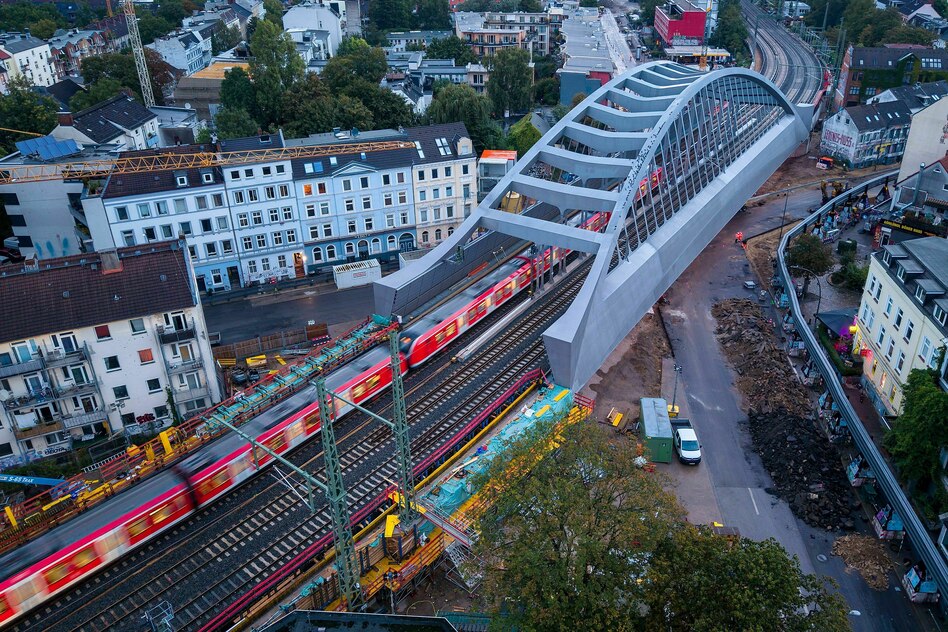
The old Sternbrücke itself has also disappeared, a listed structure from 1926 made of riveted steel, around whose supports cars had to drive around. Instead, its successor, which some just call “the monster bridge,” has been standing there since the end of August: a gray colossus that rises above the intersection and has replaced everything that was once there.
Right at the corner, in the small Astra room, the audience stood tightly packed on good evenings and listened to friends performing with their new band. If it got too hot inside, you could sit on a bench outside and drink beer, Astra of course.
On the other side of the intersection was the lost and found office and around the corner to the right was the scale building, where electric was running, and the rattling of the tracks could be heard through the booming bass. On the weekends, lines formed in front of the doors and the audience sat on the curb, very close to the traffic.
Because it was always narrow under the bridge and also shoddy. The riveted steel of the bridge piers was covered with many layers of posters, dirt and soot, and at night the signs glowed in the dark.
That was what passers-by and the nightlife crowd saw from the Sternbrücke. The documentary “Sternbrücke Forever”, which is now in cinemas, shows what it was like to live (and work) there.
And that's a completely different view. The demolition plans were already known when the film crew arrived, and so there is a certain melancholy about the scenes. “I think the new bridge looks like a coffin,” says the chain-smoking operator in the kiosk on the corner, that’s her statement.
Cars drive past outside, sometimes from one side, then from the other, depending on the traffic light phase, the trains roll by on top of them, and regular customers stream into her shop. She knows them all, sells alcohol, gives out a cigarette because it's you, for free.
Smoking, being silent, looking out the window.
The film gives the people under the bridge space, as if through a magnifying glass, it shows how its protagonists are at the mercy of the changes that are announced and then actually come to pass. There's nothing you can do about it.
The two men in the house next door, who sit in a tiny room with their parrot, have lived here for a long time. “For 10 years,” says one, “no, for 13!” says the other. They had to get used to the sounds of the trains passing behind their house, especially when falling asleep. But there's always something in Hamburg, and it's better than the highway.
The car repair shop around the corner, next to the scale building, is also a neighborhood meeting point; the owner repairs an old man's electric wheelchair. How was that again? Oh yes, put the seat down and then it's your turn. The workshop is under the tracks, in a vault, the cars just fit in.
This text first appeared in wochentaz, our weekly newspaper from the left!
Every week, wochentaz is about the world as it is – and as it could be. A left-wing weekly newspaper with a voice, attitude and the special taz view of the world. New every Saturday at the kiosk and of course by subscription.
He's sorry that it's so messy here, he apologizes, but he didn't know he would be staying so long, otherwise it would look different here. And then, towards the end of the film, when the lights slowly go out everywhere: It's strange, "now that I know that I can only stay for another six months, one thing after another is breaking." As if things knew their time was up.
He doesn't know what will happen next with his workshop; customers are now bringing him photos as a souvenir. At the very end, the representative from Deutsche Bahn comes and removes the vaulted cellar in which “his existence,” as he says, was housed. It's empty now.
Director Christian Hornung worked on the film for five years, from 2022 to 2024 he repeatedly put in weeks of filming and of course also recorded what was happening outside during this time: the demos, the protest concerts, the meetings of the demolition opponents of the Ini Sternbrücke, who want to file an injunction before everything is too late.
It is the document of a world that has just ended. The film looks at this from the perspective of those who have to leave. And in the credits it shows how the new bridge rolls in: centimeter by centimeter it pushes forward, just past the house walls, before finally taking up its final position, across the intersection.
Their steel surfaces shimmer slightly in the light, and you might even find them beautiful, just not here, in the middle of the narrow residential development, where the streets and tracks squeeze between the houses.
Even Deutsche Bahn seems to suspect that something is wrong. “Why does the new star bridge have to be so big?” she asks in an FAQ on the topic. The answer: "The new star bridge is 108 meters long and has a height of over 20 meters. We are aware that the structure is very large." The city of Hamburg is to blame because it wanted more space for road traffic at this intersection, and unfortunately there was no other way.
Not only the S-Bahn trains roll over the bridge, but also train traffic from Hamburg to the north, so it is important. However, there was never an open competition, architectural alternatives were rejected, and public participation only took place long after the plans had been finalized.
Hamburg's Transport Senator Anjes Tjarks (Greens) stated in the Abendblatt that he didn't think the bridge was too big. The area is rather too small and high-rise buildings might be a solution.
In order to save what can be saved, the city and railways are currently considering whether the bridge could be opened up for graffiti. At night, disco lighting has already been experimented with to remind us of the clubs in the past.
The protest concerts at the intersection also continue; they now see themselves as a kind of pop-up open-air replacement club. The Sternbrücke initiative also still exists; it is fighting for the return of club culture. Perhaps, it is hoped, there will be space under the bridge again? Or at least near her?
Some of the clubs from before, including the Schwimmbau and the Fundbureau, have now found a new location behind the Deichtorhallen, again under the S-Bahn tracks. The future of the Astra-Stube has not yet been clarified. She asked for donations on Go Fund Me to pay off the deficit from the Corona period.
Without ongoing operations, no more money came in, but life goes on. Yes, I have to. Or, as the kiosk operator in the film says about a regular customer who finds it difficult to say goodbye: “He’ll get over it.”
“Sternbrücke Forever”, the documentary film by Christian Hornung, will be in cinemas on October 8th. From October 4th he will go on a premiere tour with his director.
Read the full story at the source
Source: taz