
Germany taz
The Federal Government's digital summit: Where Germany could score points with AI
With its AI summit, the federal government wants to create momentum in the industry. However, experts advise Germany against a race. more...
Deutsch (original) ·Auto-translated to English
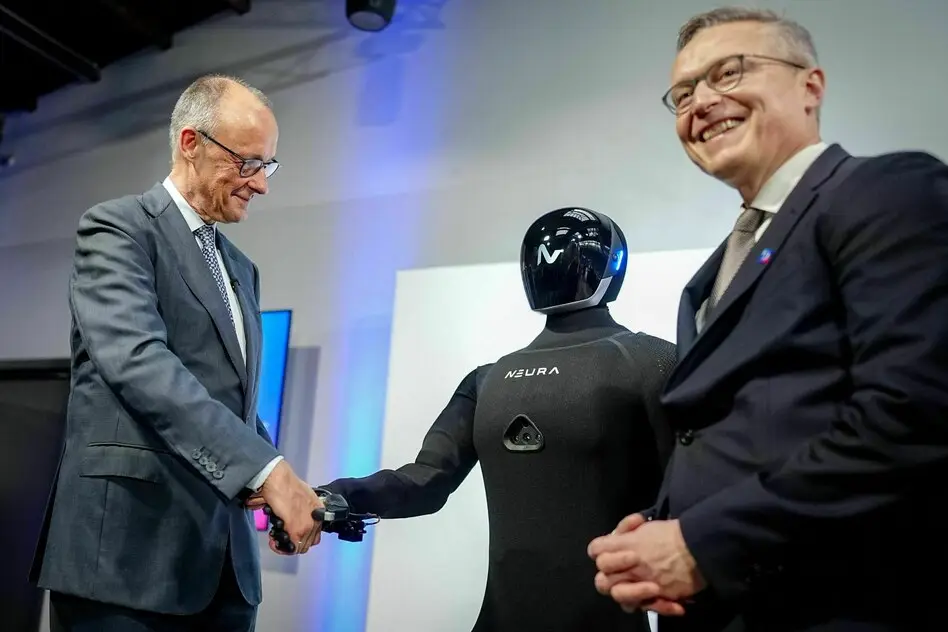
At the Federal Government's digital summit, Digital Minister Karsten Wildberger and Chancellor Friedrich Merz (both CDU) called for more speed in artificial intelligence. “We in Germany and Europe have to become much faster in developing and using digital technologies,” said Merz on Monday in front of a national and international industry audience. “Bold decisions for energy infrastructure and investments” are necessary, said Wildberger. And: less regulation. It requires “fewer obligations and more space to test and expand ideas”.
The federal government had already announced a significant deal two weeks earlier at its investor summit: the economics and research ministries signed a declaration of intent with Nvidia. Nvidia is the world's most important manufacturer of high-performance AI chips and one of the most highly valued listed companies.
According to the federal government, the cooperation will primarily serve to develop AI models for industrial use. Not only large corporations should be included, but also small and medium-sized companies and research institutions. The cooperation should ensure Germany's competitiveness and technological sovereignty. Merz now explained at the digital summit that they also want to develop European frontier models. Frontier models are the most powerful AI models currently coming from companies like Anthropic and OpenAI.
But when it comes to these large, particularly powerful language models, a race for Germany and Europe is likely to be difficult. The USA is currently the leader in this area, closely followed by Chinese providers. A European open source AI model is being planned through the SOOFI project. But in order to catch up with the performance advantage of the USA, for example, Europe not only lacks the immense amounts of risk capital, but also the large amounts of data that US companies have and which they use - partly legally, partly at least in the gray area - to train their AI models.
Experts therefore do not see the German and European potential in entering into a race with the USA and China. “Sovereignty does not come about by chasing after the largest language models and retraining them with our own data,” says Björn Ommer, head of the Computer Vision & Learning Group at the Ludwig Maximilian University of Munich, according to the Science Media Center. A more promising strategy is to “create the infrastructure and operating system for tomorrow’s value creation in strategically important, previously underrepresented fields such as physical and industrial AI that make a difference in the real world.”
This could also be an advantage from an ecological perspective: “Developing your own frontier language models is much more resource-intensive than developing models for other modalities,” explains Ommer. The Frontier models are the most powerful AI models from companies like Anthropic and OpenAI. The difference in resources is not only evident in training, but also in use.
The consumption of resources, especially with regard to water and electricity, as well as emissions are points that are causing increasing criticism of the technology: “Chip production consumes huge amounts of electricity and water, produces millions of tons of CO₂ - and on top of that there is the resource consumption of the data centers,” criticized Benjamin Stephan from the environmental organization Greenpeace after the Nvidia deal.
In Germany, the AI boom will probably lead to lower standards for data centers. The federal government's data center strategy envisages a significant expansion of the IT infrastructure. Capacity for AI alone is expected to quadruple by 2030. At the same time, the Bundestag is expected to pass the new Energy Efficiency Act in the coming weeks. It contains a significant weakening of the requirements for data center operators, for example when it comes to energy efficiency.
Stefan Heumann, managing director of the Agora Digital Transformation think tank, believes it makes sense for the federal government to focus its spending on AI on areas that are in the public interest - and that are neglected by big tech companies. “For example, open AI models, but also those for administration or the health sector.” In other words, areas where sensitive data is processed, for example. However, such investments require budgetary reallocations in the medium to long term.
According to a current analysis by the think tank, the largest part of the budget for the Digital Ministry continues to come from the special fund - if this were to run out, the ministry and the projects would be on a cliff, according to Heumann. The expert criticizes the federal government: “At the moment there is a lot of AI in the shop window and little in the engine room.” Agora analyzed the items in the federal budget by title: As a result, only 0.15 percent of the core budget is AI-related expenditure.