
Germany · taz · · 52m
“Reunification” in literature: The people are silent
Deutsch (original) · Auto-translated to English
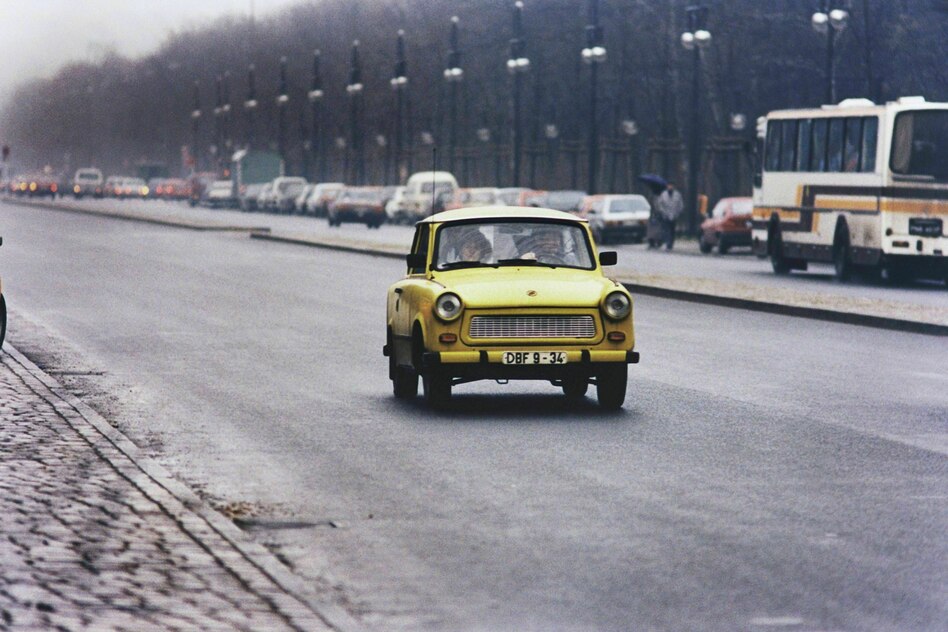
There are contemporary historical events that are repeatedly translated and discussed in literature. Events that, through constant processing, contribute to the debate about the self-image of a society and its present. But there are also contemporary historical events of great importance that go surprisingly untold. The so-called reunification of the GDR and FRG is such an event - at least as viewed from West Germany.
In recent years, a large number of books have been published that tell the story of life and everyday life within the GDR or on its former territory. The upheavals of 1989/90 always represent one of the central events in the lives of the characters appearing - whether explicitly or implicitly, the changes they bring about make them a center of the narrative.
As gratifying as this increased interest in the realities of life in the GDR and its people is, it makes one exception in contemporary literature all the more clear: reunification from a West German perspective. 36 years after the end of the GDR, there is currently apparently no need to recount, address and reflect on the events and their context again.
You will look in vain for positions that deviate from the corresponding anniversary speeches in politics and that assess or classify the events differently. The fact that this event had no influence on the realities of life for people in the West is one of the false assumptions linked to it. Above all: From a literary perspective, it could be precisely this supposedly insignificant aspect of the historical moment that creates the appeal of storytelling.
If you look at the literary history of the past 36 years - and a few years further back - there are quite a few titles that take on German-German history from a Western perspective. The “reunification” as a historical event does not play a role in everyone, but is told, especially in the literature of the 1990s, as a turning point, a turning point, a break or banality.
Above all, as an opportunity to question the Federal Republic of Germany's system and to exercise political influence: Günther Grass' "A Wide Field", Sarah Kirsch's "The Simple Life" or Peter Schneider, who emphasized early on that the post-war period came to an end in 1989, but unity is not an inevitability. "You can tear down the wall, but that wouldn't eliminate it. Only the wall maintains the illusion that the wall is the only thing that separates the Germans." A good overview of this can be found in Arne Born “Literary History of German Unity 1989–2000”.
What connects the texts from the 1990s is a curiosity about the (former) GDR and, based on this, a questioning of one's own location. In Andreas Neumeister's novel "Ausdeutschen", for example, the description of the West German perspective on "reunification" becomes a double experience of strangeness: "I never thought that I would leave the transit highway at the first exit and turn onto a normal Thuringian country road." Descriptions of irritation and the willingness to move into unknown territory - including narratively - diminished in the early 2000s. The end of the GDR is gradually disappearing from West German literature.
The story of the fall of the Berlin Wall in “Herr Lehmann” by Sven Regener is remembered by many as an insignificant disruption to everyday drinking. The normality of the characters is hardly disturbed by the epoch-making event. More important and central to the characters' motives and emotions is that their beer is empty. In 2009, “The Best We Had” by Jochen Schimmang was published, one of the few examples in which a novel describes the history of the Federal Republic of Germany as a lead up to the upheavals of 89/90. Society is conceived here as a product of human action, not as a supposedly natural inevitability that inevitably trickles down to the East and absorbs every idea of a different form of society.
With “remember disturb”, edited by Lydia Lierke and Massimo Perinelli, an anthology was published by Verbrecher Verlag in 2020 that attempted to make previously rarely heard perspectives on the years of change visible, namely migrant and Jewish ones. And the volume “Kaltland” by Karsten Krampitz, Markus Liske and Manja Präkels was published in 2011, which attempted to identify some of the gaps in the stories surrounding the upheavals of 1989/1990: “The West Germans, for their part, have largely accepted that they do not need to remember the living conditions in their Federal Republic of Germany because they were 'the victors' and today's, larger Germany is still the state in which they live grew up.”
It has become clear in recent years that by no means all stories have come to an end in this state. West German history has also been told many times. As a rule, however, as closed milieu narratives, only in absolutely exceptional cases in relation to the upheavals of 89/90.
One problem with the lack of a West German perspective on reunification may be the question of what perspective is actually meant. A uniform West German cannot be constructed. At the same time, there are authors in contemporary literature to whom their origins are attributed as a label. Accordingly, they are expected to express themselves primarily on their subject area.
While the label East German author is certainly in use, there is no author who can be labeled as a West German author without contradiction. At the same time, if one looks at the reception of current stories that are located in the GDR, they become simplistically exemplary stories for the dictatorship system as a whole.
Texts of West German stories do not experience this level of abstraction and advocacy position. Authors of such stories are rarely invited to explain, interpret and vicariously save or condemn the West as an overall construct on talk shows, newspapers or on podiums. While the West is certainly granted a plurality of pasts, texts about the GDR are regularly narrowed down - as if nothing had happened between 1948 and 1989 that did not necessarily lead to “reunification”. It is all the more striking that these pivotal years remain untold from a West German perspective.
If one understands literature as a medium of self-assurance and that of others, then this gap points to one thing above all: there are no questions whatsoever regarding reunification from a West German perspective. It goes without saying that this is not true, even in view of current discourses about the economic consequences of political upheaval and the increasing electoral success of right-wing radical parties. All authors have the freedom to tell the story of reunification from a West German perspective. But this story hardly seems appealing.
What about the freight forwarder who brought tons of erotic products for Beate Uhse to the New Federal States in the early 1990s? What about the families who tried to get back land in the east of the republic that had been confiscated from them by the Soviet administration forty years earlier? What about the employees of the Treuhandanstalt?
There has been debate in recent years about the invention of the East as a homogeneous entity. The West, whatever that means, did not lead this dispute and never had to lead it. The Federal Republic of Germany as normality is the undisputed basis of every further discourse.
Stories about “reunification” from a West German perspective offer the opportunity to grasp the BDR system in its contemporary historical demarcation. The limits of the Federal Republic of Germany (and of economic growth) have rarely become as visible as in the years 1989/1990. (Perhaps the summer of 2015 had a similar effect, which has also hardly been told to this day.) Instead, the upheavals of 89/90 are becoming more and more a one-sided story. It currently seems as if these were historical events that only happened in one part of the country. As if they were historical events that could only be discussed in the clichéd image of run-down, empty villages in the East.
Read the full story at the source
Source: taz