
World taz
The Truth: Money, Faith and the Mother of God
The economy and Marian devotion are booming in Poland. That's why statues to the holy mother of good credit are erected there. more...
Deutsch (original) ·Auto-translated to English
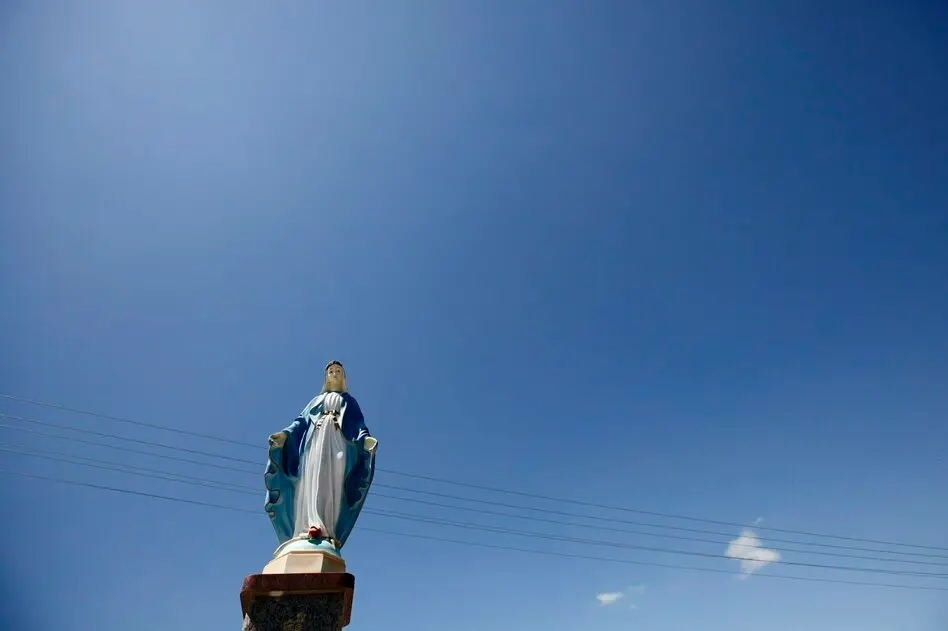
We are just breaking out of the tree-darkness of the forest in this sea of fields when she appears to us on the southern Polish horizon: the Mother of God. Or at least her stone doppelganger, a gigantic statue of the Virgin Mary.
“And a very special one,” proudly explains to us the pilgrim Paweł Ziebetzki in a casual business outfit, whom we picked up as a hitchhiker two villages earlier. Because this statue of Mary here does not watch over the spiritual well-being of the Silesian rural population, but rather over that of the regional economy of its entrepreneurs.
The construction was made possible by Poland's economic boom. Over the decades, he created business people who were concerned about the future and wanted to convert their wealth into salvation according to old Catholic custom. The statue of the Virgin Mary, which has just been built in the not far away village of Konotopie, is the highest at 55 meters and therefore, according to canon law, the most divinely graced statue in Europe, and is the pinnacle of this construction boom. But what the cross holds will be set up throughout the land.
However, size is no longer everything. “This statue of the Virgin Mary is the only one that is explicitly dedicated to the economy – so far,” explains the knowledgeable Paweł, looking longingly at the figure, which is made of “the finest Silesian marble”, i.e. plain granite, and built into the flat landscape not far from a modern biogas plant.
“We Poles have experienced an economic miracle,” he continues, as we stand at the feet of the statue, which is almost blasphemously small at 25 meters. The profits from this should now be dedicated to the miracle of the immaculate conception. “But of course we expect further economic miracles in return,” Paweł concludes this trinity.
“Look there, for example,” he points out to a few believers who, like us, are circling the statue and, with their eyes closed, are reverently patting Mary’s left big toe. “Touching your left foot saves you from defaulting on personal loans.” A prayer on the right foot ensures particularly good creditworthiness.
Only Catholics can probably tolerate the contradiction of debtors and creditors praying devoutly side by side for opposite goals. “And whoever throws money into the water at the fountain can even choose a KPI, i.e. a key performance indicator!” Paweł pulls us out of our thoughts about religion and double standards. The desired success indicator then increases by up to 20 percent – per assessment period!
He himself regularly prays for the recovery of his real estate investments, Paweł tells us after the tour while browsing through the souvenir shop, which is full of all sorts of bobblehead Marys, Ark of the Covenant piggy banks and pilgrimage wallets. But he also understands why more traditional Poles mocked the local statue as “Mammon Maria.” This is precisely why he supports the Polish government's plan to only allow statues of the Virgin Mary dedicated to business to be built next to existing ones. "Then those who want to remain poor can pray at the old Mary. And everyone else at the new, larger one."
Paweł Ziebetzki humbly explains that this also gets young people excited about the Catholic world of saints. “In the past, people prayed to St. Camillus for health and to St. Margaret for fertility, but today that’s what health insurance and fertility clinics are for.” Now there were places of hope for modern problems like crypto crashes and dwindling click rates.
One development, Paweł confesses to us at the end as we stow an old white stuffed man we had just bought into the car, is “too modern” for him: the disintermediation called for by Catholic economists, i.e. the exclusion of middlemen. Instead of erecting images of saints like statues of great economists, he believes it is wrong.
"Okay, Adam Smith was at least a real Christian, but Karl Marx? No thanks. I prefer Helmut Kohl." After all, he helped bring Poland into the EU. "I ask you: a German rebuilding Poland? A few decades after the war? If that wasn't a miracle, I don't know what is."