
Germany · taz · · 3h
The scattered art of Anna Oppermann: In the rabbit hole of thoughts
Deutsch (original) · Auto-translated to English
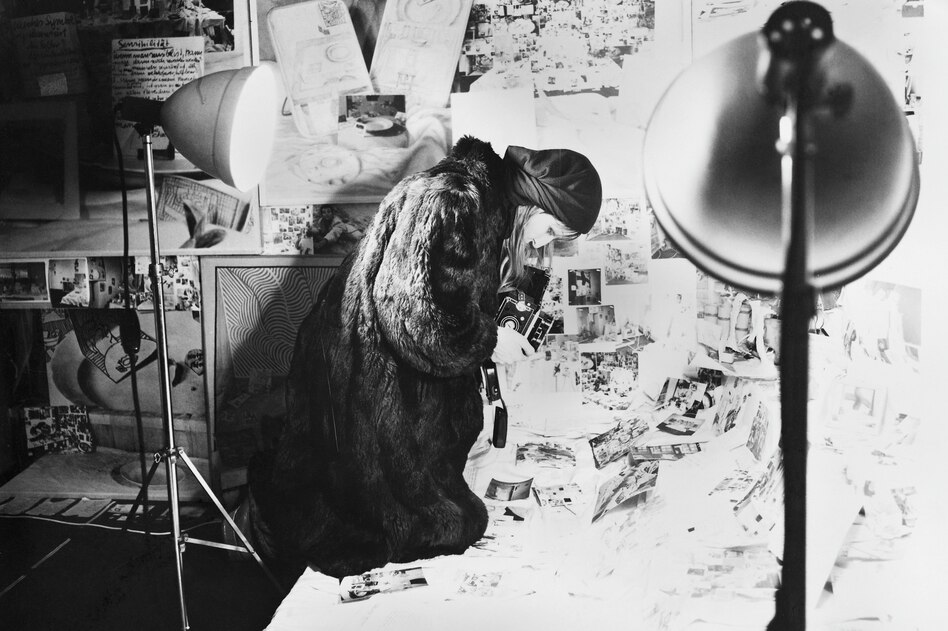
Anyone who goes against the usual logic of visiting and first climbs the steps down to the basement before touring Anna Oppermann's exhibition may find the right preparation for the show here. An absolution given by the artist herself. Some exhibition visitors think that they have to read everything through or become frustrated by the amount of material: “That’s terrible!” Basically, you can pick out individual things that particularly interest you, says Anna Oppermann in an old TV report that has now been shown again.
A difficult but stimulating exercise is her task when one stands between her exuberant ensembles of countless written images, notes, pieces of paper, photographs, collages, objects, drawings and houseplants: The saasfee*pavillon in Frankfurt am Main is showing “The Blue from Heaven”, a solo exhibition by Anna Oppermann. (The artist's son, Alex Oppermann, is a founding member of saasfee �� this doesn't play a direct role, but you can find references to the mother-son relationship in the installation).
A not so unusual place is the art space run by a collective for this Hamburg artist with close connections to Frankfurt. In particular, the large-format “The Blue Lying Down from the Sky 1988–1990,” which stretches across an entire exhibition room glazed into the green, including a view around the corner, wins here over the classic white cube.
“Anna Oppermann: The blue from heaven”. saasfee*pavillon, Frankfurt am Main, until November 29th
Design, Goethe or proverbs about truthfulness – Anna Oppermann created highly subjective association chains from these rough collections of themes, which she presented in the form of contemporary altars with the most wonderful (self-)references. The artist goes deeper and deeper into the rabbit hole of thoughts that increasingly eat into physical space.
But is such a structure artistically legitimate, when Anna Oppermann's works could actually only be rebuilt again and again by herself and supplemented by views of the previous installation? When Anna Oppermann died far too early in 1993 at the age of 53, she left no wish as to how her work should be dealt with after her death, explains curator Anna Schäffler.
Museums had exhibited their work but not purchased it. The majority of the ensembles were owned by the artist at the time of her death. "Oppermann's partner Herbert Hossmann, who assisted her with almost all of her constructions from the end of the 1970s, developed the so-called 'installing reinterpretation' together with a group of estates. This practice took Oppermann's open ensemble method as its starting point." Instead of an exact reconstruction, each structure is adapted to the respective spatial conditions.
What is remarkable today is Anna Oppermann's unusually critical look at product design, or better yet, at the claim to healing with which this discipline is used for all possible areas of social policy. Anna Oppermann's smaller ensemble “Antidesign” seems to be mocking something and objecting to an overly linear understanding of design. Her art also gets a feminist broadside in sketches for the “Concept Shelf” with its considerations about how the female lower body could be used to find form.
Oppermann seemed to want to first get an idea of things, to work through the arguments, the pros and cons, including those of his own thoughts. Search and find paradoxes. But - and this is where Oppermann's art differs vehemently from the passive, apocalyptic doomscrolling of these days - not to let it be overwhelmed in the literal sense. It is a great joy to be able to watch the artist get lost in her fantastic work.
Read the full story at the source
Source: taz