
Politics · taz · · 2h
The most dangerous woman in Germany: Who is afraid of Elif Eralp?
Deutsch (original) · Auto-translated to English
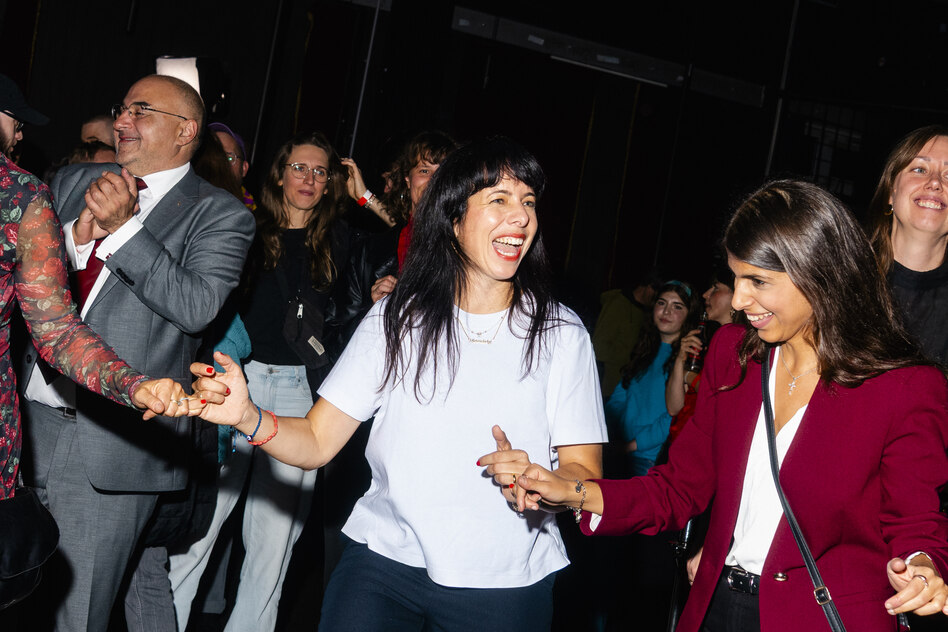
The descent continues. Vonovia shares are still falling days after the election. Germany's largest housing company is trembling in front of a woman who hardly anyone knew a year ago. Her name is Elif Eralp, 45 years old, mother of two children and perhaps soon the governing mayor of Berlin.
The authority of this office alone has not yet made anyone afraid. But Elif Eralp won the election to the Berlin House of Representatives last Sunday as the Left Party's top candidate. This has never happened before. Above all, she wants to incorporate large private real estate groups like Vonovia. The fear of Vonovia shareholders is justified.
There's a ghost around again, not all over Europe, but in Germany. With socialization, Eralp wants to keep its most important election promise and “make Berlin affordable”. Rents in the capital have been exploding for years; politicians have not been idle, but ultimately remain powerless. With socialization, which almost 60 percent of Berliners voted for in a 2021 referendum, Eralp and the Left Party are raising the question of ownership. No ruler has ever done this before. And no ruler.
Since Eralp's election victory, not only the Vonovia Group fears the downfall of the West, but also political Germany from the SPD to the AfD. SPD leader Bärbel Bas warns her party friends in Berlin against entering into an alliance with the Left Party and the Greens. AfD leader Alice Weidel raved about a “hard-left alliance with shooting the rich, taking away capitalists, expropriating, capping rents.”
So is Elif Eralp the most dangerous woman in Germany? The election victory that has become the nightmare of all righteous citizens concerned about their property - far beyond the Berlin city limits?
Review: At their party conference in April, the Berlin Left not only decided on its election program. It is also the stage for a coronation mass. Elif Eralp, born when her socialist parents fled Turkey, grew up in Hamburg, studied law and has been a member of parliament in Berlin since 2021, promotes a “red metropolis” and is not afraid of pathos. “We want to be a light and a beacon for all people,” she calls out to the 175 delegates at the end of her speech. “It’s about opening a new chapter in Berlin and writing history together.”
This performance seems almost American. At the beginning of her speech, Eralp runs onto the stage to Hildegard Knef's catchy song "Berlin, Berlin, the pearl on the Spree", at the end a confetti cannon is fired and dozens of comrades parade past their front woman.
American was also the model for Eralp's election campaign. Immediately after the election victory of the socialist candidate Zoran Mamdani as mayor of the metropolis of New York, a delegation from the Berlin Left traveled to the Hudson River. The question they had with them: Can Mamdani's recipe for success be transferred to Berlin? Can the man who was stylized by Donald Trump as the most dangerous man in America be a role model for the Left's election campaign in Berlin?
With great euphoria, the party's election campaigners are implementing the strategy of their role model in Berlin - concentration on a few core issues, an approachable candidate with a unifying story, highly professional social media work. And the party members, whose number in the city has doubled to more than 19,000 within a very short time, flock to more than a quarter of a million front doors in all districts of the capital during the election campaign weeks.
The candidate Elif Eralp succeeds, more credibly than anyone else, in embodying the great hope of being able to really do something about the rental madness. An arc of success leads from the coronation mass in April to the election last Sunday. With almost 26 percent, the Left secured victory - seven percentage points ahead of the CDU.
But the left-wing euphoria disappeared just a few days later. It's no longer just the listed housing companies like Vonovia that are afraid, but also federal politicians like Friedrich Merz and Markus Söder, who want to ban Berlin from socialization by law.
An expert commission appointed by the Senate has long since determined that the socialization of large private real estate portfolios, a total of around 220,000 apartments, is legally permissible. It is still unclear whether it would hold up before the Federal Constitutional Court. A lot probably depends on the question of compensation. The Expropriate Deutsche Wohnen & Co (DWE) initiative and the Left Party are insisting on a passage in the Basic Law according to which this is based on “weighing up the interests of the general public and those involved”. This means that compensation can be paid below market value.
There was support for this on Friday through a study by the Institute for Macroeconomics and Business Cycle Research (IMK) of the trade union-affiliated Hans Böckler Foundation. The authors led by the economist Sebastian Dullien calculate that Berlin could pay compensation of 13.5 billion euros without any subsidies from the budget. The opponents of socialization, on the other hand, generally fear that the city will go bankrupt. And now the federal government is threatening to stipulate that socialization must take place at market value; The plans for such a regulation are also highly controversial from a legal point of view. In any case, things will take time.
As a more acute measure, the Left wants to impose a rent cap on the seven state-owned housing associations. She also wants to force private landlords by law to rent out some of their apartments affordably - and she is the only party to have made concrete suggestions as to how the city's housing companies could increase the number of new buildings they build. In principle, no one has questioned the feasibility of these projects; they would probably also be possible with the SPD and the Greens.
But some of the potential coalition partners' fear of Eralp's left wing has increased over the week. And voices against cooperation are increasing, especially at the federal level.
This text first appeared in wochentaz, our weekly newspaper from the left!
Every week, wochentaz is about the world as it is – and as it could be. A left-wing weekly newspaper with a voice, attitude and the special taz view of the world. New every Saturday at the kiosk and of course by subscription.
In a current hour in the Bundestag entitled "Cases of anti-Semitism, hostility to the police and proximity to Islamists, left-wing extremists and clans among the Left in Berlin", requested by the AfD, the right-wing extremists spread the narrative on Wednesday that the Left is deliberately spreading anti-Semitism in order to abolish democracy and the rule of law with the help of Muslim voters. The representatives of the democratic parties in the Bundestag beyond the Left also largely agree that a government under left-wing leadership poses a threat to internal security - and to Jews.
Can Elif Eralp still capture it all? Is her authority great enough to keep not only the district association in Neukölln at a distance, but also those in her party who don't want to govern in the first place? Because of concerns about having to lead an austerity Senate from the Red City Hall in the next few years because of the billion-dollar hole in Berlin's budget.
In order to prevent questions like these from even arising, Elif Eralp and her state executive sought professional help from Thuringia, where the Left Party under Bodo Ramelow ruled successfully and remarkably quietly for ten years. Apparently Eralp also knows that the election campaign is now followed by the next tough stage. Initial discussions must be held with the Greens and SPD, compromises must be explored, and trust must be created. The professionals from Thuringia are certainly opening the door to the Greens and the Berlin SPD, which is also thinking loudly about going into opposition after its historically worst result in Berlin of 12 percent. In addition, the SPD's top candidate Steffen Krach has already drawn a red line. With him, he says, there will be no socialization.
Elif Eralp is probably not just the most dangerous woman in Germany at the moment. She is also someone on whose shoulders the greatest burden rests. It cannot only fail because of the anti-Semitism debate. It can also fail because of the unwillingness of one's own party to compromise. Above all, however, it could fail because of the campaign that is currently being carried out against a left-wing alliance in Berlin.
But giving up is not her thing. Elif Eralp's success story includes her ambition - and the ability to inspire other people. Because the image of the most dangerous woman in Germany also includes the other side: As the first politician on the left and the first woman with a migration background, she could now make history herself. And it could reconcile party politics with the voters.
If, on the other hand, Berlin is not affordable under red-green-red, there will be great disappointment - and the alienation between politicians and the population will only grow.
Read the full story at the source
Source: taz