
Germany taz
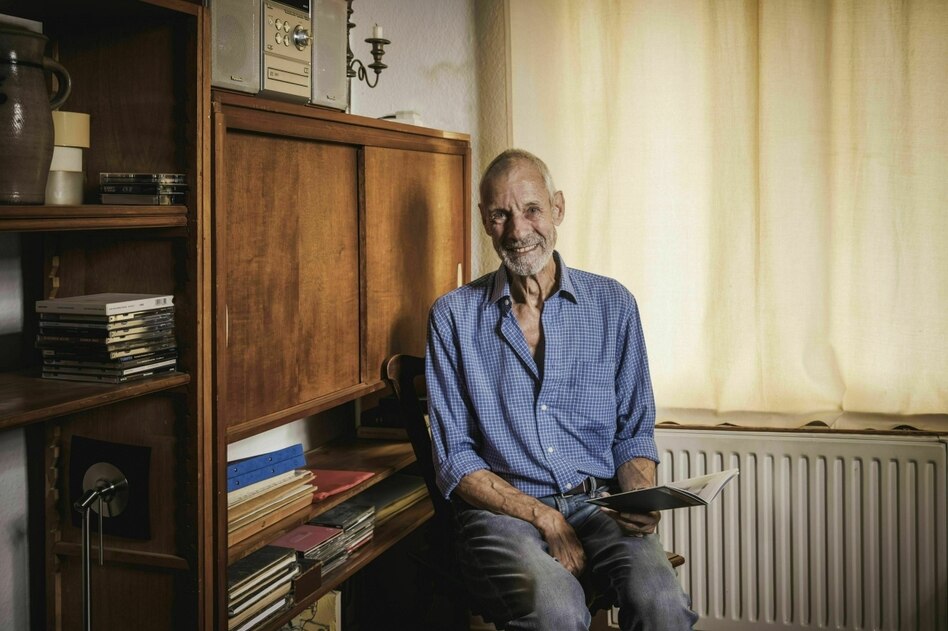
Poet Eberhard Häfner in a portrait: When someone arrived, they found a gap in their happiness
How does he, the former GDR underground, the “Prenzlauer-Berg Connection” live? A visit to the poet blacksmith and “Berlin’s last bohemian”, Eberhard Häfner. more...
Deutsch (original) ·Auto-translated to English
Poetry, said the philosopher Hannah Arendt in “Vita activa,” is the “most unworldly of the arts.” This cliché is still in effect today, evident in what is priced and what is ignored. Examining art for its craftsmanship is completely unproblematic in Germany, as long as it is not poetry. In this sub-sector of the literary world, this is considered offensive, or at least flashy.
Eberhard Häfner, born in the Thuringian province in 1941, grew up there, fled from there to Erfurt and then to Berlin, rhythm was not administered in the form of metric funnels. His sense of rhythm when writing comes not just symbolically, but actually from the craft of the silver and coppersmith. With the two new publications, the handicraft domain is now clearly visible. His recently published book of poems “Corinthian Ore” is brimming with graceful lines about life lived and is full of sad defiance: “Once someone arrived, they found a gap in their happiness,” the line already gives a hint of an elegy that is being prepared.
Häfner's wife, the artist Magdalena Häfner, died two years ago. The two had been married since 1965. He repeatedly and emphatically emphasizes the influence of their art on his literature. The apartment is full of her figuratively surreal images. The view from the old building's double window on the fourth floor shows a church tower, now and then a tram; Next to the entrance portal, perhaps just by chance, there is a goldsmith, and around the corner there is a silversmith; One block further you walk past the birthplace of the showmaster Hans Rosenthal, who was legendary in the Bonn Republic. Everything seems a bit too proper to really be in Berlin. I take a few private snapshots of a quaint shoemaker's shop and am immediately shouted at in the local idiom. Aha, this is Berlin.
Eberhard Häfner: “Corinthian ore. Poems”. Klever Verlag, Vienna 2026. 76 pages, 20 euros
Eberhard Häfner: “Hammer blow”. Distillery Press, Berlin 2026. 20 pages, 9 euros
Eberhard Häfner, tall, with paws on his hands and a keen eye, wishes to be addressed as a poet. It has nothing to do with laurel: “The first poets were blacksmiths.” He associates his poetry with the “hammer blow”. A somewhat carelessly edited volume with the same title with photos of his blacksmithing for sacred purposes was published by Distillery Press at the beginning of the year. There are no additional texts, neither about the materials used nor about the editorial intention. More would have been possible.
The disarmingly open way the soon-to-be 85-year-old explains how the publication came about makes me smile inappropriately. Häfner doesn't seem like a spiritualized Eleve at all, even though the apartment looks exactly like a poet's home: creaking floorboards, a wall of books full of poetry and poetry, and the sign "Writing Room" in the living room. He wanted to show it off at the time.
who writes poems, prevailing spirit
not in the writer's sense, if possible
from: Eberhard Häfner: “Corinthian ore. Poems”. Klever Verlag, Vienna 2026
During the conversation, the energetic craftsman steps forward, a glass of water is always at hand, he turns it, moves it, and now and then gently taps it on the tabletop. It was similarly odd for the attentive observer that Häfner did not return to the audience after his poetry recital in Silent Green this summer, but instead sat bolt upright on a tree stump two meters behind the next person performing in order to listen carefully to Mirko Bonné and others.
It seems to me that it is most accurate to describe Eberhard Häfner's likeable, shirtless manner to describe him as a poet who was socialized in a scene based on solidarity in Prenzlauer Berg. After the death of Büchner Prize winner Elke Erb and Bert Papenfuß, revered as an underground poet; the scene was christened “Prenzlauer Berg Connection” by Adolf Endler, Eberhard Häfner is the last bohemian in Berlin.
By the way, he doesn’t want to know anything about a “connection”. Listing a whole series of negative experiences, he is concerned with de-mystification. He never read his Stasi file. He felt left out relatively quickly when “certain people came along.” Names of one or two envious dwarves and would-be rivals are mentioned. Everyone it affects has already died.
Surprisingly, the proximity of one's own poem (including portrait photography) in the often-quoted "Text+Kritik" special volume "The Other Language. New GDR Literature of the 80s", published in 1990, to the portrait of Sascha Anderson including the poem, did not trigger any reactions in the person I was talking to. The old man, who is otherwise consistently relaxed and friendly and endlessly patient in providing information, only becomes emotional when I show him a vignette written by a pseudonym (“H. Gurwizz”) from the same magazine issue: “The Häfner (…) called the Palaver Bird (…) Its diet consists of grains, grasses, beetles, butterflies and spiders, which it grabs from all sides while running from the ground or from the air (…).”
The fucked-up nature of this “Bestiarium literarium”, in which other well-known GDR authors (“Der Wawerzinek” as “Poltergeist” or “Das Grünbein” as “Bridge-walking Bird”) are also slammed, only causes foreign embarrassment today. I ask, can't you take a few lessons with you despite the misguided people within the Prenzlauer Berg scene? Häfner says no. I stick to my opinion.
In view of the imminent introduction of “patriotism clauses” by a single or co-governing AfD, the view of today's affected independent scenes on the historical non-literary scenes is likely to change again significantly. Their artistic stubbornness, especially the living room performances culminating in the “Zersammlung” (Elke Erb), to simply reduce them to being disavowed by colluding poetasters, erases the style-forming impulses and the solidarity of artists in the face of state repression.
Very soon after the end of the GDR, a self-diminution began, especially by those in the scene at the time, who prompted them to use market clichés: they had made nothing of themselves. I listen again to what Elke Erb said to me on tape with amusement 15 years ago: "What is success as a writer? What do you mean by that, huh?"
Personally, the Prenzlauer Berg scene seems to me to be no less than the vanguard of today's Berlin Free Literature Scene network, just as the Leipzig Literature Institute, newly founded in 1995, would be unthinkable without the Becher Literature Institute, which existed from 1955 to 1993. Häfner considered studying there, but preferred this option to a correspondence course at the Burg Giebichenstein Art Academy; He always stayed away from popular “Writing Workers” courses as part of the Bitterfelder Weg. During his time in the NVA, he admitted that he shot “deliberately badly,” which cost him his place at university.
Poet blacksmith Eberhard Häfner is now, willy-nilly, the nestor of this historical community of solidarity, whether you call it Connection or not, he takes a large part in the activity of the younger generations of poetry, he is a conversation partner and friend of well-known contemporary poets such as Ron Winkler, Karin Fellner and Björn Kuhligk. The poet Birgit Kreipe even gave him the laudatory nickname “minister of poetry”; Be a rogue if you think of Johannes R. Becher, the real GDR culture minister and ex-expressionist...
As editor of the important art magazine Herzattacke, Eberhard Häfner provided contacts to a group of colleagues who were still up and coming at the time; But you can also get advice yourself. Häfner's starting conditions were good: in 1989, the German journalists rallied around him when he was awarded the 3sat prize in Klagenfurt. Before and after, his poems were published in renowned anthologies, such as the Yearbook of Poetry 1986 and following.
His poems about the turning point in the collection “In this better country” edited by Michael Lentz are also particularly striking. Between Hacks and Hahn there is Häfner's "Big Ben has struck seven o'clock", which is unfortunately missing from every school textbook: "I look at the verses.../ cut lines in stubbly rows (...) one who moved out and moved in again/ is having a hard time and doesn't want to log in/ the seeds of the language are still from the hand/ into the mouth."
The poem could easily be a figurehead for the streamlined overall work; typical moves often come together: poetic poem meets flippant confessionalism; Sayings based on fairytale formulas that are deformed: “Nothing found except Linden” or: “Constant dripping hits the nerve” or: “No Limerick, really liver hard”. When the man celebrating his birthday turns 85 on Saturday, October 24th, it's not just connoisseurs who are celebrating. Eberhard Häfner turns words into the “only peaceful language of all: poetry”.