
Politics taz
DGB makes counter-proposals to the government: pension reform with a difference
The pension system can be saved without cuts, says a commission from the trade union federation. Employers and wealthy people should pay. more...
Deutsch (original) ·Auto-translated to English
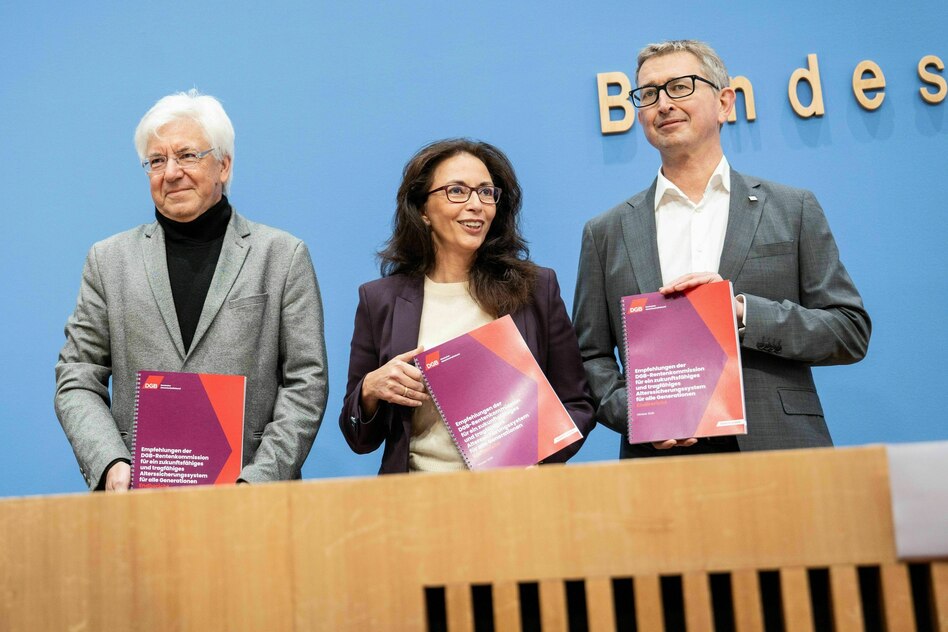
The pension reform could also be done differently: That is the message that the DGB sent out on Wednesday with a 125-page report. In the morning, the trade union federation presented the long version of the recommendations of its own pension commission. They form a counter-model to the plans of the government and its Old Age Security Commission, which provide for some improvements for employees and pensioners, but even more deteriorations.
According to DGB boss Yasmin Fahimi at the presentation, the results showed “that a stable pension, reliably and fairly financed, is possible without shifting the costs unilaterally to the detriment of the employees or reducing benefits”.
Since the beginning of the year, working groups had been developing the basis for the DGB positions. It was mainly scientists who sat there. However, the actual commission selected the final recommendations. The majority of these were trade unionists, including Peter Weiß (former CDU MP), Kevin Kühnert (former SPD MP) and Ricarda Lang (current Green MP).
The most obvious difference between the DGB concept and the government's plans: the trade union federation wants higher benefits from the traditional pay-as-you-go pension.
Currently, the central legal figure for pension levels is a holding line of 48 percent. However, according to the government's wishes, it should expire in 2031. After that, pay-as-you-go pensions will probably rise more slowly than before.
As compensation, Black-Red envisages long-term returns from a new capital pension, in which employees and employers should pay additional contribution points in equal shares. In addition, the government would like to see company pension schemes for as many employees as possible in the future (the returns from which are often also generated on capital markets). However, it does not provide a binding path to get there.
The DGB would like to do it differently. The level of the classic pension should not decrease, but increase - initially to 50 and in the future to 53 percent. The trade union federation does not want a capital pension like the government is planning. To this end, he is making a binding proposal for company pension schemes for everyone. Employers are required to pay two percent of gross wages, while employee contributions would be optional. Details should be specified in industry-specific collective agreements and would also be mandatory for companies without collective bargaining agreements.
In addition, the DGB recommendations provide even more advantages for employees and pensioners: unlike the government's plans, for example, the retirement age should not increase beyond 67 years. The early pension without deductions after 45 years of contributions (often incorrectly referred to as “pension at 63”) should remain.
Possible compromise lines for this point of contention can be found in the working group recommendations in the appendix to the report. The scientists there suggest, for example, differentiating the discounts.
So far, they have been a flat rate of 0.3 percent for every month that an employee retires before the standard retirement age. The proposal envisages reducing it to 0.2 percent for employees with 35 years of contributions and to 0.1 percent for those with 45 years of contributions. However, the idea did not make it into the actual DGB recommendations. At the presentation on Wednesday, Secretary General Fahimi did not want to talk about possible compromises when asked.
Higher pensions and earlier retirement naturally lead to higher financial requirements for the DGB plans than for those of the government. According to the report, the necessary performance level has just been determined and financing requirements have been derived from this. These are not limited to the additional contributions made by employers to company pension schemes.
Some proposals relate to measures outside the pension system proper. The government should take various measures to ensure that women's employment continues to increase, that more foreigners enter the labor market and that employees stay healthy longer. More workers ultimately bring more income to the pension insurance system.
For the DGB Commission, “slightly increasing contributions remain part of the solution” within the pension system. Employers should pay additional contributions for low earners. In addition, the self-employed and members of parliament should be required to pay into pension insurance, thereby further increasing their income. But not officials. The bottom line is that this is not worth it for the system.
And finally, the pension system is to receive an additional large subsidy from the federal budget. To provide counter-financing, the Commission is proposing new taxes on “high incomes, large assets and capital income”. The report speaks of 20 billion euros per year.
However, additional income of this magnitude is not so easy to achieve politically. And if it were to succeed, there would be other desires for its use than pensions. Climate protection, for example, for which there is currently not enough money, or military spending, which cannot be permanently covered by loans to the same extent as before.
However, Frank Nullmeier rejected this argument at the presentation on Wednesday. Saying that defense needs to be expanded at the expense of pensions is “a bit risky,” said the Bremen political scientist, who was also a member of the commission. Such an argument would certainly “generate social conflicts”.