
Germany taz
The home visit: Where the journey goes
Brigitte Sändig grew up in the GDR, Heidi Nandeko in West Berlin. Today they both live in Pankow and remember together. more...
Deutsch (original) ·Auto-translated to English
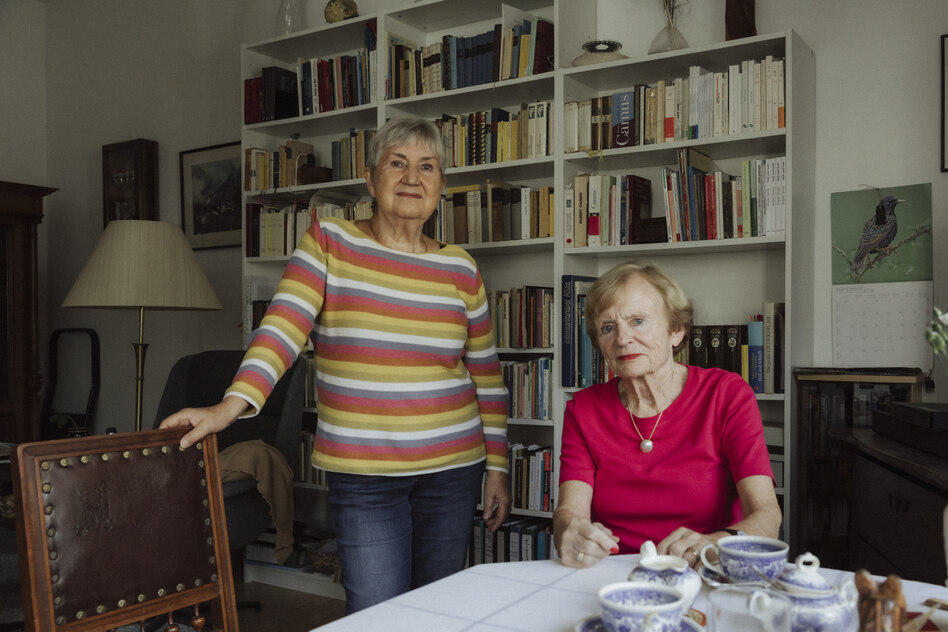
Why look for what separates when what connects is so much more interesting? That's what the two women who live in a residential complex where people are supposed to remain self-determined in old age ask themselves.
Outside: Five streets meet at the intersection near the town hall in Berlin's Pankow district. A path leads into a parking garage. People who travel on foot or by bike have to be very careful. And the same applies to drivers: This is for advanced drivers. Those who live at the junction avoid flowers on the balconies because they can't be used anyway. The Cajewitz Foundation's senior citizens' facility, which is based here, also looks more like an office from the street.
The inner courtyard: If you want to get to the entrance, you have to walk into the inner courtyard between the parking garage and the senior citizens' foundation. Trees are finally growing here and flowers are blooming on the balconies. There is a restaurant and a sauna opposite in the house. People come and go.
Inside: Modern art hangs in the hallways leading off from the apartments. Brigitte Sändig lives on the second floor; 45 square meters, one and a half rooms, kitchenette, balcony. An eye-catcher in the living room is the heavy round table by the window. And the bookshelf. The name of the writer Albert Camus is emblazoned several times on the spines of the books.
Participation: Brigitte Sändig moved into the Cajewitz Foundation house a year ago. Heidi Nandeko, who comes to the meeting, has lived here for three years. Neither regrets the decision “at all”. The previous apartments were too big, too full of memories. Here, in their new home, they are taken seriously as old people. “A lot is being done to make it possible for us to participate in society and to get involved,” says Nandeko. Cultural offerings, sport, discussions, art – the spectrum is wide. For this you pay a monthly event fee.
East/West: These two are not friends. They only know each other by sight. But they embody something that is important to the management and employees of the seniors' facility: that people with an Eastern background and people with a Western background can meet each other. Their lives begin similarly. Both were born in Dresden. Nandeko in 1943, Sändig a year later. The war and post-war brought one to the Federal Republic of Germany, the other grew up in the GDR.
Differences: Now they are sitting in Sändig's apartment and trying to name what made life in the East different than in the West. It's not that easy. Because in old age, what connects people plays a role. “When I meet someone here, I don’t ask myself whether they are from the East, but whether they are likeable,” says Nandeko, the West Berliner. Anyway, says Sändig, communication here is not as difficult as it used to be in professional life, “because the struggle for existence has been taken away.”
Two out of 160: unexpectedly there is a first difference. That of language. Sändig, the woman with an Eastern biography, believes that 160 inmates live in the Cajewitz Foundation. “That makes me think of prison,” says the West Berliner promptly. Sandy doesn't feel that way. Together they look for other terms: residents, co-residents, “but you shouldn’t gender everything,” says Sändig.
Playground Street: The post-war period was difficult. Nandeko was the youngest of four children, her father dead, her mother alone and overwhelmed. The girl grew up for a short time at a vegetable wholesaler in Tempelhof. People wanted to adopt her, but the mother didn't want that, so she came back to her, but was mostly left to fend for herself. The street was their playground. “You can call it freedom,” says Nandeko. However, women who spent their afternoons leaning on cushions by the windows in post-war West Berlin would have kept a keen eye on her.
War returnees: Sändig's father came from Soviet captivity in 1949. “After the ‘Nazi slip-up,’ in his words, he became a convinced socialist.” Her family life was also difficult. The father died at the age of 95. “We never talked about the bad things,” says Sändig.
School careers: Nandeko, the West Berliner, was unambitious at school. “There were lazy periods.” After the tenth grade she goes to the higher business school. “But I haven’t even started working.” Instead, she married in 1963 and had two children. "I was a bored housewife. Not unhappy, but not challenged either. What are you cooking today? - conversations like that." And Sändig: “Bored housewife – that didn’t exist in the GDR.” After graduating from high school, Sändig first does an apprenticeship. "Everyone in my year had to learn a trade. I became a library worker." She then studies German and Romance languages. Then something groundbreaking happens: “I was selected as a research student.” She is supposed to write a doctoral thesis on Albert Camus. That was fine with her. “Camus was interesting to many.”
Camus: Sändig also marries young. But in 1970 she lived without a husband in Algeria for a year as an interpreter for a “Friendship Brigade, a group of development workers in the blue shirt”. In Sändig's bedroom there is a black and white photo of the camp where they lived. Algeria suited her perfectly. Camus was born in Algeria and spent much of his life there. In Algeria she felt closer to him.
The book: Back in East Berlin, she soon has her son, gets her doctorate with her doctoral thesis on Camus and writes a biography about him. “After the fall of communism, my Camus biography was republished unchanged,” she says and shows the book. Unchanged – that’s important to her. Meanwhile, the West Berliner continues to try her hand at her role as a housewife – becoming increasingly annoyed and increasingly breaking out.
The second man: Be that as it may, both women's marriages fail and both find new partners. Nandeko now lives in West Berlin with a natural scientist who also looks after the children. Now she can train to become a religion teacher while working and will later work at the church university to train religion teachers. In East Berlin, Sändig, who is working after completing her doctorate at the Central Institute for Literary History at the Academy of Sciences, finds her second husband, who is a physicist and the head of a puppet theater. This relationship is also a departure because with him people think more stubbornly. Posters of performances hang in her apartment.
Die Welt: Both women also travel a lot with their husbands. One in western countries, the other in eastern ones. Today, when Nandeko thinks of Russia, the USA, Turkey and Israel, she feels uneasy. "Turkey, what a great country. But I can't think about it politically. And I don't want to go to Russia anymore either." “I do,” says Sändig.
This text first appeared in wochentaz, our weekly newspaper from the left!
Every week, wochentaz is about the world as it is – and as it could be. A left-wing weekly newspaper with a voice, attitude and the special taz view of the world. New every Saturday at the kiosk and of course by subscription.
A turning point: 1989, the turning point. It's a turning point for Sändig's career. Because their scientific work is coming under scrutiny. Many at the Academy of Sciences lose their jobs. Departments are being broken up; “unfolded” is the key word. Sändig is lucky and, after much back and forth, gets a professorship at the university in Potsdam. "But I had two friends who couldn't stand the new uncertainty. Social security was something you had in the GDR." The change was associated with so much hope. She adds critically: “Many people in the GDR have only seen the chocolate side of the West.” Then Nandeko chimes in: “The printing technology department at the University of the Arts in West Berlin, where my husband taught, was also closed down.”
Death: Nandeko's husband dies in 2004. She continues to live her life, works and travels a lot. Sändig, on the other hand, can now be on the move about Camus. Her husband dies in 2018. “You fight through the grief,” says Nandeko. The West Berliner met her current partner 15 years ago. Unlike her, he has a strong connection to the former GDR. He shows her the East. "It was only then that I realized how beautiful this country is. Dresden, which I saw again, is like London to me. I love this city."
Two Lives: What now? Both choose the present. Anyone who lives in a retirement home knows where the journey is going, says the West Berliner.