
Germany taz
The home visit: The knitted thing is political
Svetlana Nikitenko makes stop-motion films with crocheted figures. It is their platform to protest against racism and exclusion. more...
Deutsch (original) ·Auto-translated to English
Svetlana Nikitenko learned to knit and crochet from her grandmother because she wanted to make new clothes for her dolls. If someone asked back then what she wanted to be, she would say: “Fashion designer for dolls.” But it's not that simple.
Outside: If you want to go from the busy Frankfurter Allee in Berlin-Friedrichshain to Kreutzigerstrasse, you have to take the passage under a house. Behind it is a scenic idyll. Trees, a playground, the traffic noise dimmed. On one wall it says: “Women who fight, live!” Many of the houses are wildly painted, as if this were squatter land. And that was it after the fall of communism. The house where Svetlana Nikitenko lives also rocks in this way.
Inside: Old buildings in Berlin often have similar floor plans. Here, however, the wall between the trapped room, which faces the back yard, and the kitchen was torn out and it became a large eat-in kitchen. Nikitenko cleaned up. In combination with the dark green painted wall, the order appears cool. Only the crocheted deer trophy above the toilet door hints at hidden humor. Nothing more can be seen of Nikitenko's passion.
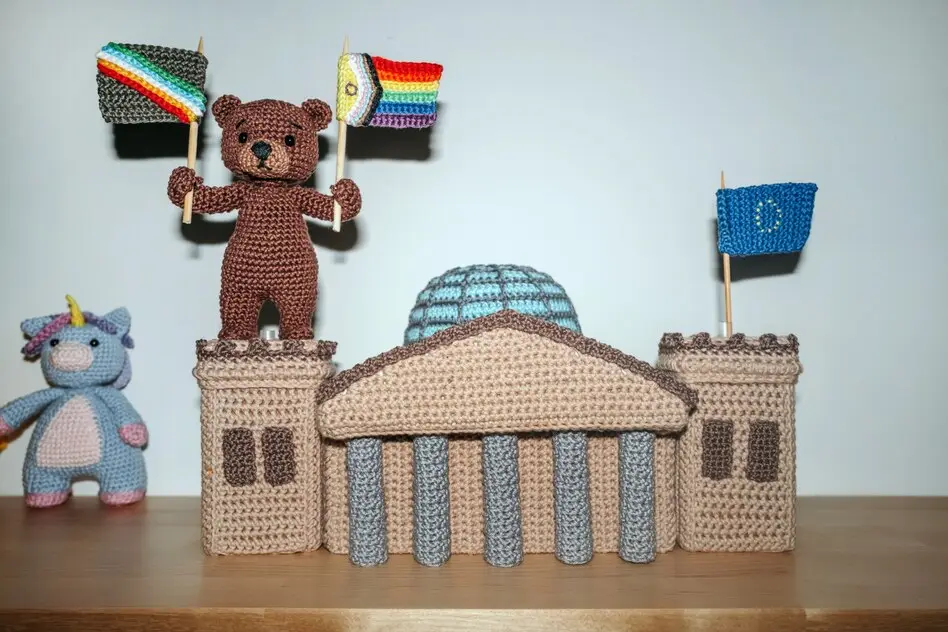
Excitement: Svetlana Nikitenko finds it takes getting used to showing complete strangers her apartment. And yet she enjoys attention. Especially about those for their work. She leads into the room opposite, which is also tidy. There are crocheted objects on the shelves, including the Red Town Hall, the Brandenburg Gate, a man in a wheelchair, a crocheted coronavirus, and a city pigeon riding a skateboard. The characters are cute and easy to miss except for the ball-sized virus.
Big in small things: Nikitenko doesn't just crochet figures; she crochets recognizable people. The man in the wheelchair can be identified as the inclusion activist Raúl Krauthausen with his glasses and beard; the two men with the starry glasses as the magicians Siegfried and Joy. A figure with his hood pulled up is Nico Semsrott, a cabaret artist and politician. A hobby - Nikitenko casually crocheted a rabbit for a friend's child or a drill for a portal where you can rent machines - has become her form of political protest.
Protest: On social media, Nikitenko's alias is “knits against”. Nowadays she is more into crocheting. With this technique she can better conceptualize her fragile and mobile figures. They have to be mobile, as Nikitenko now makes short stop-motion animated films with them, for example to announce demos for a ban on the AfD, to demand inclusion or to address homelessness. She also addresses queer topics. In one of the films, Siegfried and Joy conjure up a rainbow flag on the Reichstag after Julia Klöckner forbade it. Nikitenko's films are always created in consultation with those affected. “For me, those affected are experts who should have their say,” she says.
This text first appeared in wochentaz, our weekly newspaper from the left!
Every week, wochentaz is about the world as it is – and as it could be. A left-wing weekly newspaper with a voice, attitude and the special taz view of the world. New every Saturday at the kiosk and of course by subscription.
Gen Z: The lack of understanding of the youth protests also concerns them. "I don't like that the younger generation isn't being heard. Worse: they're being criminalized." She has already made a stop-motion film about military service, it has to do with “multi-purpose eggs”. Young people understand that. “It’s scary how the old white men sit there and make yesterday’s policies that so completely squander the future of people and the earth.”
Kursk: Nikitenko was born in Eberswalde. Her father was an officer in the Soviet army, her mother was a German. When she was seven months old, her father was transferred to Kursk; she spends her childhood there. She doesn't grow up bilingual; her father doesn't like it when her mother speaks German; but she understands a little. Her father also doesn't want her to choose German as a foreign language at school. “He said it was unfair because I had an advantage because of the mother.” How does she think today of Kursk, the Russian city where the war in Ukraine has now reached? “It’s good that you asked about it, when most people hear Kursk they just think: biggest tank battle in the Second World War,” she says. She finds Putin's attack on Ukraine bad; She no longer has any connection to Kursk itself.
Vilnius: In 1980, when Nikitenko was twelve, his father was transferred to Lithuania. Suddenly she lives in a city where everything is different. "The Lithuanians saw themselves as Europeans in culture, education, their ideas of freedom. There was this idea of the other world." She now realizes how “encrusted the Soviet Union was with the illusion of equality.” “Put a lid on everything,” she says. "The system has done a lot to me, namely that I want to function even when I can no longer. And then in Lithuania this experience that people dare to do something." She knows a bit of Lithuanian, “the language is really difficult”. Back then everyone spoke Russian anyway.
Chaos: In Lithuania, Nikitenko begins studying philology, becomes pregnant, continues studying, gives birth to his daughter in 1987, and lives with his parents. In 1988, the mother separated from the father and went back to the GDR, to Bernau near Berlin. Nikitenko also applied to leave the country and followed suit in February 1989. “From Vilnus, the lively city, to Bernau, which seemed boring and gray on brown.” She summarizes her new reality like this: “Destitute, single parent, no German.” Nobody here cares that she studied for four semesters in Lithuania. They don't even recognize her high school diploma.
Bernau: As soon as she arrived, she found a job as a technical draftsman. She took the subject at school and was good at it. She makes final drawings in the “laminate press factory”, that’s what the factory is called. “‘Laminated molding plant’ – I love that word.” She is learning German immediately. Many Russians live in Bernau. She quickly realizes that there is not much left of the German-Soviet friendship. She hears her colleagues talking about the “Russian women” during the break; They had newspapers on the windows instead of curtains, couldn't do laundry properly, and cleaned the stairs on Sunday instead of Saturday. “Hey, I can eat my lunch somewhere else,” she says. “That’s not against you,” is their answer.
The turnaround: With the turnaround, the laminate plant is wound down. Nikitenko then takes any job she can get near the apartment while her child is young. "Bad conditions, little money, with a foreigner's stamp. I can't even remember what I lived on." Plus bad experiences with Nazis. "I should fuck off. My apartment would be set on fire." She tried not to show that she was afraid. “The first year in Bernau I just cried.” Things get better when she is in a squat in Prenzlauer Berg for the first time and sees that there are people in Berlin who share everything with each other. She then moves to Friedrichshain. “But over time I also found great people in Bernau.”
Employment office: The job search continues. The employment office then only offers her further training as a hotel manager. "Of all people, I'm not the type to approach complete strangers." She goes through with it anyway, then works in bars, a bookstore and a sign-painting company until she finds work with the Berlin State Youth Association in 2003 because she is involved in her daughter's youth club. “Finally something meaningful.” Today she works for the Association for Democratic Culture, which provides mobile advice against right-wing extremism and projects against racism and anti-Semitism. “I work with great people.”
Future: Svetlana Nikitenko also knits and crochets. “But manual labor is considered by many to be a worthless female occupation.” It was her daughter who encouraged her to put her stuff on Instagram. Suddenly there was public response. One of her personal highlights: when her film for “Berlin car-free” was nominated in the ARD Kultur “Make it real” competition in 2025. “I still want to do so much, I have so many ideas and so much planned.”
On November 22, 2026, the taz Salon in Hamburg will celebrate its 20th anniversary under the motto “Doing Differently”. There, a knitting circle explores how knitting and politics fit together.