
Germany · taz · · 39m
Debate about the documentary “Naza”: Why are you doing this?
Deutsch (original) · Auto-translated to English
Since Yuval Abraham and Rachel Szor's documentary Naza premiered at the 83rd Venice Film Festival, a lot has been said and written about him. But only a fraction of those who have spoken out since then may have seen it themselves.
In Germany, this circle is primarily limited to visitors to the film festival on the Lido. Press screenings have only been announced for the opening week; as is usual with many films, there are officially no advance streams for journalists. Dealing with the film in advance indicates nervousness.
Which isn't surprising given the content of the film. Because “Naza” takes on a topic that has dominated public debate for almost three years: the war in Gaza. More specifically, it is about the military actions of the Israel Defense Forces (IDF) in the fight against Hamas in the Gaza Strip.
“Naza.” Directed by Yuval Abraham and Rachel Szor. United Kingdom 2026, 80 mins.
The word “Naza” stands for the accepted “collateral damage,” the number of civilian casualties that can be expected in targeted strikes against Hamas fighters.
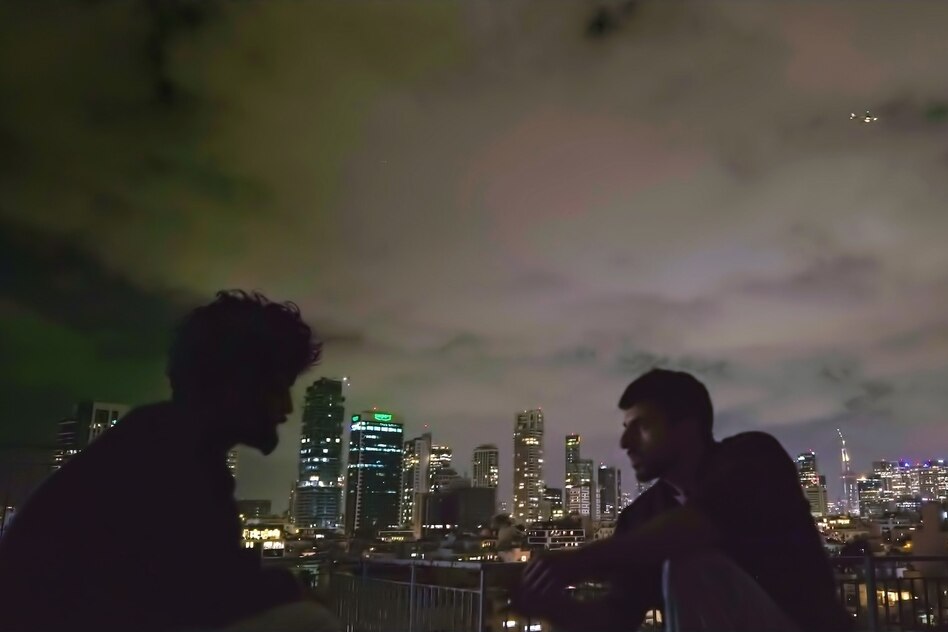
Abraham and Szor conducted interviews with a total of 24 people for three years after October 7, 2023, including members of the military and the secret service. They filmed at night on the roofs of high-rise buildings in Tel Aviv. In each of the interviews you can see Yuval Abraham with one of his interviewees.
Während Abrahams Gesicht im Bild zu erkennen ist, zeigen die Aufnahmen von seinem Gegenüber lediglich die Silhouette. The voices were electronically altered and the appearance of the interviewees was also digitally changed, it is said, in order to protect the source. If someone makes a drawing in front of the camera to clarify what is being depicted, the handwriting is also obscured.
The only other images in the film show high-rise facades in Tel Aviv. From a distance, the view falls into illuminated rooms with people in the kitchen, on the sofa, often sitting in front of the television. Meanwhile, the anonymous people talk off-camera about how, supported by a “Naza app,” they select buildings for an attack. Because it is always about strikes that are carried out from a distance; there is often talk of armed drones being used.
Some of the military members describe in detail how, by monitoring the smartphones of individual family members of Hamas fighters, they get a precise picture of how many people are currently in the apartment, what they are doing, what they are talking about, and whether they are watching television. Wenn sie sich die Fotos auf den Telefonen anschauen, bekommen sie zudem einen Überblick über das Innere der Wohnung. Die Kontrolle, die dadurch möglich ist, scheint umfassend.
According to the directors in their press statement for the film, some of the information in the film was published by the Guardian in collaboration with the online publications +972 Magazine and Local Call in the months following the attacks on October 7, 2023. Der Guardian ist einer der Produzenten von „Naza“, ebenso wie der Regisseur Jonathan Glazer („The Zone of Interest“).
Die Aussagen im Film erschrecken. For example, when a military sketches a building and dryly lists how many more people will be killed in a strike against a Hamas fighter at the push of a button. Or when someone else mentions that there were several hundred “Naza” in some attacks.
The business-like presentation of technical preparations for such weapons deployments and the casualness with which some of those interviewed describe this as their everyday life makes the fact that civilian casualties are being discussed all the more difficult to bear.
Another question is how to evaluate the information provided in the film. How should the audience judge what they learn from the faceless speakers? Beyond these anonymous sources, “Naza” does not cite any other material that could serve as evidence. Also, no outside voices have their say to assess the plausibility of the information.
Abraham and Szor previously worked together on the documentary “No Other Land” (2024), about everyday life in Palestinian villages under Israeli occupation in the West Bank. This film, which was awarded best documentary film at the 2025 Oscars, was recently criticized by the author Tuvia Tenenbom in his book "What do you call this country here? Among settlers" (Suhrkamp 2026).
His summary of the film: "From beginning to end, no Palestinian does anything bad and no Jew does anything good, with the exception of those Jews who see only bad things in their fellow Jews."
His biggest complaint against "No Other Land" is: "The main problem with this film on a factual level is that it nowhere mentions that Palestinians are constantly stabbing, shooting and ramming Israelis with cars. Those acts are far more cruel, senseless, hateful, murderous and numerically far more common than anything shown here."
In other respects, too, he accuses the directors of working in a way that distorts reality. During his research trip through the West Bank, he found individual houses that were supposedly demolished in the film intact.
Tenenbom's criticism of “No Other Land” cannot be transferred to “Naza”. However, it gives rise to suspicion about Abraham and Szor's way of working. Sharp criticism of individual depictions in “Naza” came from the IDF. The military announced that it would consider legal action against the filmmakers because false information was made in the film.
Contrary to what one source said, according to the IDF there was no operation with 500 deaths. It is also not true that military targets were selected by artificial intelligence.
The film's reduced approach reveals an internal contradiction on this point: all of the 24 respondents are introduced as whistleblowers. Since they speak anonymously for their protection and because they are suspected to be military secrets, their statements are difficult to verify. This applies to all statements in the film. It is therefore impossible to judge whether the military operations mentioned are war crimes or not.
The word “genocide” is also mentioned at one point in connection with the military’s actions. Mind you, the respondent does not express this directly; rather, he confirms this assessment after Abraham puts the word into his mouth with his question. From a journalistic point of view, this is a leading question.
Since the film, with its uniform setting, creates the impression of simultaneity and gives no indication of when the individual conversations were held over the course of three years, its information appears to be a single document of the unabated, massive violence that the IDF is exercising against the population in the Gaza Strip. The film does not mention that there was also a development here in which the strikes were significantly reduced after the ceasefire of October 2025.
Abraham and Szor say in their director's statement: "We made this film out of a sense of obligation to use our position as Israelis to investigate the systems behind the mass destruction of Palestinian civilians for which our country is responsible."
Meanwhile, the liberal Israeli public doubts that they are taking effective action against the government of Prime Minister Benjamin Netanyahu, which they criticize. The film's whistleblowers have long been used in Israel for a right-wing conspiracy theory around October 7, 2023, according to which Hamas' terrorist attacks were made possible by treachery among security officials.
This could help Netanyahu in the parliamentary elections in October. This is also an effect, albeit unintentional, of “Naza’s” hermetic approach. Enlightenment is hardly served in this way.
Read the full story at the source
Source: taz