
World taz
Daniel Barenboim in conversation: “Our message of peace must be louder than ever”
Given the current situation in Israel and Gaza, how can there be reconciliation? Star conductor Daniel Barenboim on working with Palestinian and Israeli musicians. more...
Deutsch (original) ·Auto-translated to English
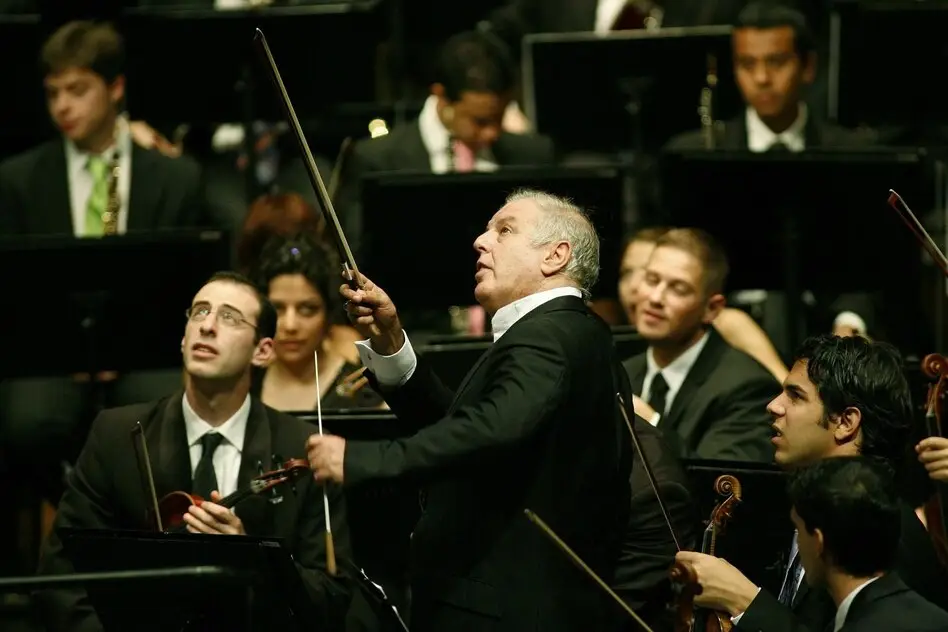
taz: Daniel Barenboim, in 1999 you founded the West-Eastern Divan Orchestra (WEDO) with the Palestinian-American pianist and literary scholar Edward Said and the then director of the Weimar Art Festival, Bernd Kaufmann. A symphony orchestra made up of equal numbers of Israeli and Arab musicians. As a symbol of hope for dialogue and a peaceful solution to the Middle East conflict. Given the current situation, this seems far away. In your opinion, what role can music play in this conflict?
Daniel Barenboim: In the current situation, we are of course asking ourselves about the meaning of our joint work in the orchestra. The mere fact that Arab and Israeli musicians share a desk and make music together at every concert is of immense value to us.
taz: In 2004 you criticized Israel's occupation policy in your acceptance speech on the occasion of your award with the Wolf Prize in the Knesset. You donated your prize money to the early musical education of Palestinian and Israeli children. How can there be reconciliation given the current situation?
Daniel Barenboim, born November 15, 1942 in Buenos Aires, is an Argentine pianist and conductor. He led, among other things, the Chicago Symphony Orchestra, La Scala in Milan and the Berlin State Opera (1992–2023). In 1999 he was a founding member of the West-Eastern Divan Orchestra, which advocates peaceful solutions to the Middle East conflict; In 2012 he founded the Barenboim-Said Academy in Berlin. Barenboim is the only publicly known person to have both Israeli and Palestinian citizenship. In 2025, Barenboim announced that he had been diagnosed with Parkinson's disease.
Barenboim: Our message of peace must be louder than ever. The greatest danger is that all the people who so desperately want peace will be drowned out by extremists and violence. Any analysis, any moral equation that we set up must have this basic understanding as its basis: There are people on both sides. Humanity is universal, and recognition of this truth on both sides is the only way. The suffering of innocent people, regardless of side, is absolutely unbearable.
taz: Your West-Eastern Divan Festival will take place in Berlin for the first time next week. With what aim?
Barenboim: With this festival we would like to bring the vision and values of the West-Eastern Divan Orchestra and the Barenboim-Said Academy to a wider audience. People are hungry for analog, positive experiences and concerts are a great way to bring people together - on stage but also off. We show the diversity of our work and motivate the audience to join our vision and continue to fight for humanity, peace and community.
taz: In April 1990 you conducted the Berlin Philharmonic on your first tour of Israel. In 2001 you played Wagner's “Tristan and Isolde” with the Staatskapelle Berlin as an encore, with which you are now opening your festival. It was a scandal at the time because Wagner was not listed as an avowed anti-Semite in Israel. Why did you, an artist with Jewish roots yourself, choose Wagner and why “Liebestod”?
Barenboim: Prelude and the Liebestod from “Tristan and Isolde” were played as an encore after a 40-minute panel discussion. I gave people who wanted to leave free to do so. 20 to 30 people who did not want to hear Wagner music then left the hall. The rest applauded the orchestra so enthusiastically that I felt like we had achieved something positive.
West Eastern Divan Festival. November 11th to 18th, 2026 in the Boulez Hall, Philharmonie and Berghain in Berlin
Barenboim: What fascinates me and also fits the complex contexts you are asking about: Probably no other composer in history has attempted to combine such obviously incompatible elements in their works. The qualities that so excite Wagnerians are often the same ones that deter his opponents: for example, his tendency to extremes in every aspect of composition.
Barenboim: Wagner's music is sometimes simple, but never complicated, but rather complex. This is a subtle difference. In this sense, complexity means the use of unnecessary mechanisms or techniques that could obscure the meaning of the music. These are not present in his work. Complexity, on the other hand, always shows itself in Wagner's music in the form of complexity. That's why I keep coming back to him.
taz: Your festival ends with a concert in Berlin's Berghain. What exactly is planned?
Barenboim: Berghain is of course one of the most famous techno clubs in the world and therefore a natural home for electronic sound worlds, whether created by DJs or classically trained musicians. Ben Goldscheider and Bilal Alnemr, long-time members of the West-Eastern Divan Orchestra and graduates of the Barenboim-Said Academy, as well as Martin Adámek will interpret works for solo instrument and live electronics by Pierre Boulez and Mark Simpson - it will certainly be exciting.
taz: You were born in Buenos Aires in 1942 to Jewish parents, you became an Israeli citizen in 1952 and in 2008 you received symbolic honorary Palestinian citizenship for your contribution to reconciliation in the Middle East conflict. How important are terms like “home” and “identity” to you?
Barenboim: I believe that in our century you not only can, you should have multiple identities. I have been very connected to Argentina since I was a child. Israel anyway. And Palestine too, because I am deeply convinced that the Israeli and Palestinian people have a common destiny. Berlin is my home – and the music.
taz: You were celebrated as a child prodigy at the piano. At the age of 7 you performed publicly in Buenos Aires, at 13 you performed in London and Paris and at 16 with the New York Philharmonic. Looking back, what was that like for you?
Barenboim: It was completely normal for me. You know, I gave my first concert in August 1950, so I've been on stage for almost 80 years now. Of those 80 years, I probably didn't feel like practicing for about 60 years. It was a burden to me - there were many things I would have preferred to be doing. But making music with others has always given me great joy and it still does.
taz: Music was never an apolitical retreat for you. Does art have a political responsibility?
Barenboim: Music and art are an organic part of our world and our being and cannot exist in a bubble. Every artist must decide for himself or herself to what extent he or she wants to express themselves politically. However, art and music should not be exploited for political purposes.
taz: Students and young musicians from the Barenboim Said Academy will perform at the festival. What would you like to give to young people who are working in a politically and socially polarized world today?
Barenboim: I am convinced that we have to move on and to do so we have to keep an eye on the larger context of the conflict. Our musicians in the West-Eastern Divan Orchestra, our students in the Barenboim-Said Academy, almost all of them are directly affected. Many of the musicians live in the region, and the others also have many connections to their homeland. This strengthens my belief that there can only be one solution to this conflict: on the basis of humanism, justice and equality - and without armed force and occupation. We must, want and will continue to believe that music can bring us closer to our humanity.
taz: At the beginning of 2025 you announced that you had Parkinson's disease; but also that you conduct for as long as possible. What else would you like to achieve?
Barenboim: I don't have to achieve anything personally anymore, but I want to make music as long as I can.