
Germany taz
The popularity of the CSU is plummeting: the fringes are also gaining ground in Bavaria
Shortly before the CSU party conference, party leader Söder received bad news: a survey paints a specter on the wall: black-green. more...
Deutsch (original) ·Auto-translated to English
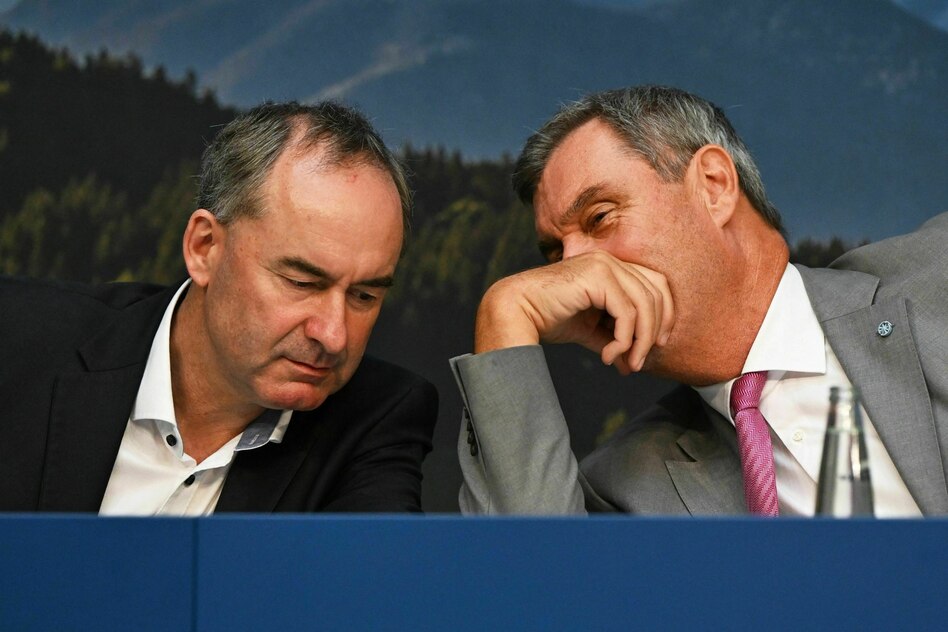
There are still two years until elections take place in Bavaria. Predictions about the outcome of the election are far premature. And yet the Bavaria Trend, the big survey by Infratest dimap for Bayerischer Rundfunk, is particularly informative this time, perhaps more than just a picture of the mood. Because if it actually reflects a trend, it doesn't look good at all for the current government made up of the CSU and Free Voters.
Certainly: The CSU is likely to continue to be the strongest faction by a wide margin and with some justification can still claim the title of people's party - which the sister party CDU has long since had to say goodbye to in some federal states. But the margins are also increasing in Bavaria, the AfD achieved its best result ever in a major Bavarian survey: with 21 percent of the vote, it would make massive gains compared to its result in the 2023 state elections. And the left, which only got 1.5 percent in the last elections, would be approaching the five percent threshold. Although still from below (at 4 percent), entry into the state parliament seems more likely than it has been in eight years.
The CSU achieved 36 percent in the survey, three percentage points less than in the last Bavaria trend from January. This makes it the only state parliament party to lose in the survey. The Greens gained two percentage points and reached 15 percent, the Free Voters remained at 9 percent and the Social Democrats at 8 percent. As things currently stand, parties like BSW, FDP, ÖDP and Bavarian Party are unlikely to play a major role in the state elections, but they will ensure that the “other” bloc is correspondingly large.
After the local elections in March, which were disastrous for the CSU, such a result in the state elections would be a setback for Prime Minister Markus Söder's party, but it is particularly important for another reason: it would therefore only narrowly achieve the continuation of the current government of the CSU and Free Voters. The two parties together would have 45 percent, the opposition parties 44. Even a change in one per mille could tip the black-orange majority. In any case, no decimal places are shown in the survey.
In the past, an absolute majority was always considered the CSU's clear goal. From 1962 to 2003 she was able to reach the party every time. And even in 2013 – back then under Horst Seehofer. During the reign of Markus Söder, however, people have long since come to terms with the fact that absolute majorities are outside the realm of possibility. The pure CSU was replaced by the alliance with the Free Voters, who were already considered the “flesh of the CSU”. Since the political differences with them are very manageable and they have proven to be a fairly easy coalition partner despite various escapades of their boss Hubert Aiwanger, it was quite easy to govern with them.
So what if there is no longer enough for this alliance? If one assumes that no democratic party would make a pact with the AfD, the CSU would only be left with a three-way alliance with Free Voters and SPD or - the most obvious solution - black-green. That would get Söder in particular into trouble. Hardly any other Union politician has distinguished himself in recent years with such violent Green bashing as he has. The CDU Prime Ministers Hendrik Wüst and Daniel Günther, who govern with the Greens in their states, also have to endure regular taunts from Söder.
There are exceptions to the rule, such as Winfried Kretschmann and, more recently, Cem Özdemir and Dominik Krause, with whom Söder maintained and maintains a good working relationship. But they confirmed the rule; The CSU leader never made a secret of the fact that he had a deep dislike for the Bavarian Greens in particular.
Among the Greens, there is great sympathy for the black-green coalition as the only realistic power option, although it is difficult to imagine cooperation with a CSU under Söder. For many in the CSU, the mere thought of a possible collaboration with Katharina Schulze causes physical pain. The parliamentary group leader is the strong woman in the Bavarian Greens and is likely to lead them into the next election campaign as the top candidate.
Despite all his dislike for the Greens, Söder is considered a very adaptable pragmatist. Unlike in the 2023 election campaign, this time he is unlikely to commit to the Free Voters as a coalition partner at an early stage. He has also noticeably scaled back his attacks against the Greens in the recent past. Currently the attacks are more towards the left.
Of course, you can also read the Bayern trend numbers in a completely different way. What are three percentage points? Especially since it is only 1.2 percentage points if you do not take the previous Bayern trend as a reference point, but rather the CSU election result in 2023.
And the Frankfurter Allgemeine Zeitung reminds us of a rule of thumb according to which the CSU can usually only be a maximum of ten percentage points above the national trend. If you take them into account, the newspaper calculates, then the 36 percent in the survey, compared to the 18 to 21 percent for the Union in the federal government, is “clearly more than some feared and others might have hoped for.” The Munich Merkur also sees the survey results as reason for joy for the CSU and its boss. “CSU defies the national trend,” is the headline and attests to Söder: “He is firmly back in the saddle.”
In any case, the delegates are likely to go into the party conference, which begins on Friday in Munich, with mixed feelings. Söder himself can at least point to his personal popularity ratings there. Almost half of those surveyed rated the Prime Minister's work positively. But there is a downer here too: for the first time since 2018, the number of those who are dissatisfied with Söder's work is 49 percent, higher than that of those who are satisfied (48 percent).
Only Ilse Aigner can be completely happy: according to 59 percent of those surveyed, the CSU state parliament president would be a good choice to succeed Federal President Frank-Walter Steinmeier. Only 22 percent think it is not a good choice.