
Germany · taz · · 2h
CO₂ capture in Schleswig-Holstein: Gas turns into chalk
Deutsch (original) · Auto-translated to English
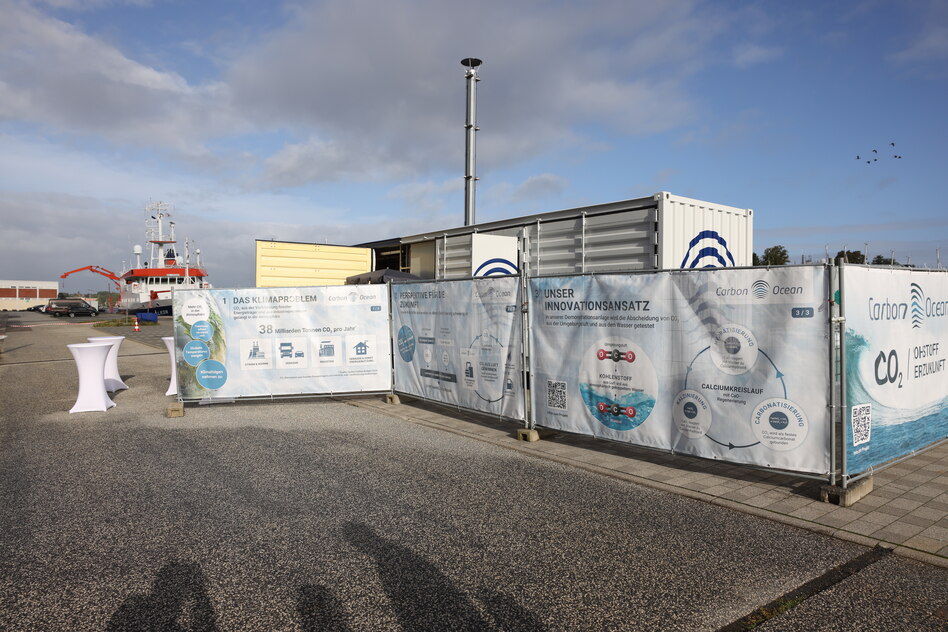
Climate-damaging gas is becoming a new raw material: Swiss Carbon Ocean AG – supported by experts from the Geomar Institute in Kiel – has developed a process to suck the climate gas CO2 out of the air and chemically bind it. The resulting white, crumbly mass can be processed into pure carbon, which various industrial sectors urgently need. The test facility is in Kiel, and large-scale production in Morocco is to follow.
The gray container is located on the edge of the harbor in front of the building of the Geomar Helmholtz Center for Ocean Research. Inside the container it hums and hums as if a large vacuum cleaner were in operation. Outside, a digital display shows two values: 424 at the top, 62 ppm (parts per million) at the bottom. The unit measures the CO2 content of the air - and this has fallen significantly in the exhaust air.
Anton Eisenhauer, an expert in maritime bio-geochemistry and professor at Kiel Geomar, shows where the carbon has gone inside the container. It looks somewhat unspectacular there: gray cabinets, displays and a pipe with a white mass oozing out of it. When dry, the mass looks like crumbly chalk. The test system can produce a good one cubic meter of this chalk per day and thus relieve the air, says Eisenhauer. “Simple and ingenious: gas becomes a solid.”
When the chalk mass is heated, lime and pure carbon separate. And it is needed: “We don’t have too much carbon, just too much from fossil sources and in the wrong place,” says Benedikt Brambs, Managing Director of Carbon Ocean. Because CO2 will continue to be important for the chemical industry or as a component of fuel in the future: “I can’t plug ships or airplanes on the Atlantic.” But if less and less fossil oil or gas is burned, another source is needed. “The market will grow,” Brambs is convinced. “We are talking about the raw material of the post-fossil age.”
If an idea becomes a company with the help of science and innovation, that is also an opportunity for Schleswig-Holstein, said Economics Minister Claus Ruhe Madsen (CDU), who came to the presentation at Geomar. The black-green state government wants to make Schleswig-Holstein a climate-neutral industrial state, so it is “cool if such an issue is pushed forward here”.
Financially, the state is only indirectly involved in the project: “Geomar receives state funding,” emphasizes Madsen. But the investors behind Carbon Ocean AG paid for the development of the test system, which cost a high six-figure sum.
This facility should only be the beginning, says Brambs: “We will make everything that is here big, and then it will be multiplied.” All components of the system have already been tested in other industries, and for the measurement technology and control it does not matter whether a cubic meter or a ton is produced.
But large-scale production will not take place in Schleswig-Holstein: “We are planning a plant in Morocco,” says David Decks. The Swiss is one of the company's investors. The CO2 factory in Morocco is scheduled to start operations in 2031 and construction will cost a three-digit million sum, says Deck. The decision for Morocco was made because there is plenty of cheap electricity there thanks to huge solar systems.
Schleswig-Holstein also offers electricity from renewable energies. But the price per kilowatt hour is too high, says Deck: "For laboratory operations, it's all well and good if we pay a few thousand euros for a ton of CO2. But that doesn't work economically." He believes that in the future the large oil companies could enter the business of producing carbon in a climate-neutral manner - even if they themselves currently assess this differently.
The idea of capturing CO2 from the atmosphere is not new: numerous companies and institutes around the world are working on such techniques. The process is used as a preliminary stage for compressing greenhouse gases under the sea. Bremen wants to install a separation system at a power plant and transport the liquefied exhaust gas by ship to a storage location in the North Sea.
David Deck sees no problem with competition because there is more than enough demand. And given the over 40 billion tons of CO2 that humanity releases into the atmosphere every year, “thousands of Carbon Oceans are just a drop in the ocean.”
Read the full story at the source
Source: taz