
Germany · taz · · 3h
CDU and fetish culture: All in black
Deutsch (original) · Auto-translated to English
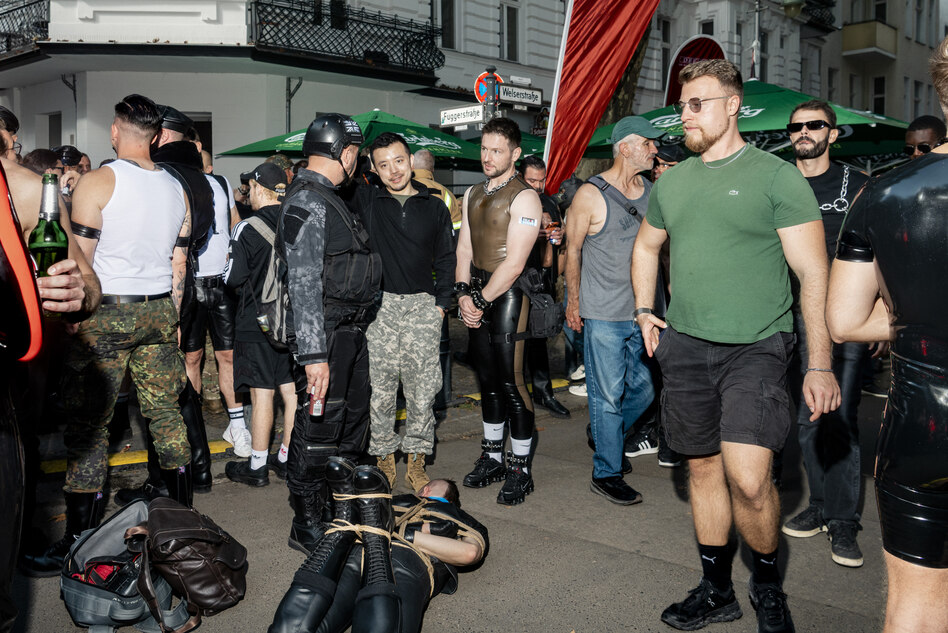
And suddenly there are screams. In the middle of Berlin's Fuggerstrasse, a man in a police uniform brings down his whip, crack, crack, on the naked, red butt of the guy in front of him on the pavement. A scream, a moan. Then again: zrapp. “A little break, please,” gasps the kneeling man. He grins, the uniformed man's boot still on his neck.
Welcome to Berlin-Schöneberg, to brutality and bratwurst, to the traditional fetish festival “Folsom Europe”, a “visible sign of self-determination, acceptance and the protection of diverse lifestyles,” as René Powilleit from the CDU calls the street festival.
All around the man with the whip: men with beer glasses, just men far and wide, thousands. Leather vests, paint, dog masks, bare skin. They observe torture, look at dildos, leather harnesses, intimate items at market stalls - and the gay CDU candidate for the elections on September 20th laughs down from the election poster.
The Left Party and the CDU were roughly equal in the last polls for the election of the Berlin House of Representatives. A red-green-red majority seems possible, but the CDU could also become the strongest force again. Berlin is left-wing, it is often said. But hundreds of thousands of Berliners vote conservatively - in the outskirts, but also here in the central Bavarian Quarter, where the CDU is promoting the district elections that are taking place at the same time with the slogan “The Rainbow District will be a matter for the boss”. Here, where people like to torture, dance and fuck even beyond the September festival, the CDU has been sending Jan-Marco Luczak to the Bundestag since 2009.
It's the conservatives who matter right now. All over Germany. Are they falling for the right-wing extremists? Do you copy their themes and strategies and help them gain power? Or do they manage to resist with a conservatism that wants to be decent and humane and liberal. What that is, liberal conservatism, can be observed in Schöneberg.
There is a loud crackling sound at one stand, where someone in an army uniform is handling electrodes. He electroshocks the nipples of a half-naked man, then connects a guy in a dog mask to a power regulator and turns up the voltage. “No pain, no gain” is written on the shirt of the person being tortured. When the pain becomes too great, he twitchingly raises his arm, stands up and hugs his torturer. Next one, please.
The present is uncertain; people are looking for community and fixed conventions. Last but not least, both are conservative values - and the leather fetish scene offers both. Everyone who comes here knows exactly what to expect. There are clear codes of belonging and strict rules. Because without consensus, without a safe word, there is no whipping, that is completely clear to everyone here. And on the eve of the street festival, the community even becomes a community at the “Classic meets Fetish” concert in the Church of the Twelve Apostles.
René Powilleit, jeans, leather vest, beard, 37 years old, is now pushing his way through the crowd. He has been a party member for 17 years and is also the Berlin state chairman of the Lesbians and Gays in the Union (LSU), a front-line association of the CDU. The fetish festival, says Powilleit, is about defending spaces in which everyone can show their own identity without fear. The fear is actually still in the bones of many queers since the Berlin CSD ended with an Islamist attack over in the Tiergarten at the end of July.
Bollards and a large contingent of police are supposed to protect the fetish festival. Two young officers are standing at a food truck, eating currywurst. They watch as the people around them are beaten and tortured. Do they sometimes get confused among so many people wearing uniforms here? “Nope,” says one, but sayings come sometimes. “Because you’re so cute,” a leather man calls out as he passes by.
If René Powilleit had his way, there would be more police in the Rainbow District, not because of the sexy uniforms, but for more security. He also calls for emergency call boxes, and Norbert Gisinger-Daubenberger, board member of the “Berliner Leder und Fetisch” association, sees it very similarly. In fact, the CDU Berlin promises more police and video surveillance in its election program.
Stefan Evers, the Union's gay candidate for Berlin's mayor, was out in the neighborhood right after the CSD attack to collect votes in the fetish bars with this law-and-order promise. “With all of this, the Union has had a long journey,” says LSU boss Powilleit.
When Klaus Wowereit came out in 2001 with "I'm gay - and that's a good thing," a certain Friedrich Merz added: "As long as Wowereit doesn't come near me, it doesn't matter to me." And the then CDU parliamentary group leader in the House of Representatives warned of Wowereit’s “deformed character”. For decades, the Union blocked adjustments to tax and adoption law, and in 2015 the Berlin CDU association voted against “marriage for all”.
The fact that the CDU top candidate is now alluding to Wowereit with the slogan "I'm conservative. And that's a good thing." That's why many left-wing queers see it as presumptuous. Because if progressives hadn't paved the way, conservatives wouldn't be able to come out as gay as easily today - and gays wouldn't be able to come out as conservative as easily.
Preservation means preserving, but not turning back time. At least that's what today's Berlin CDU seems to think. According to the motto: We are not rushing forward, but we are also not abolishing what queers have achieved in terms of social progress and with them social democrats, liberals, greens and the left in terms of legal progress.
This text first appeared in wochentaz, our weekly newspaper from the left!
Every week, wochentaz is about the world as it is – and as it could be. A left-wing weekly newspaper with a voice, attitude and the special taz view of the world. New every Saturday at the kiosk and of course by subscription.
For the cousin, it is a bonus in the election campaign that Stefan Evers “comes from the family”, i.e. is gay. Nevertheless, she doesn't entirely trust the Union's new gay-friendliness. The cousin sits at a beer table with her husband and three friends, a wheat beer glass in front of her, and watches pee games on the other side of the street. The cousin didn't know that the Green Party's top candidate, Werner Graf, was also gay. He is unknown to her.
The cousin is called that by everyone, but is actually a man, 68 years old, born “an der Plumpe”, i.e. near the old Hertha stadium in the poor district of Gesundbrunnen, grew up in Charlottenburg and has been at home here in the Regenbogenkiez for a long time. “The main thing is West Berlin.”
“Scared,” says the cousin when asked about the Berlin election, but then corrects herself. “Not fear, but tension.” The cousin has been with her boyfriend for 40 years, he is sitting here in a leather outfit, she is in a polo shirt, she has already voted, in the postal voting office, for the SPD, with a stomach ache.
Then the aunt intervenes, leather cap, heavy silver chain, friends with the cousin for 30 years. “If you don’t want the Left, you have to vote for the CDU!” The aunt is 67, also a man, was once an “engineer” and is now retired. The aunt grew up in Leipzig, has had “enough of communism” and never wants to see the left in power again.
In Andreas' pub here in the neighborhood it used to be written on the toilet wall: Gays who vote for the CDU are crazy, says the aunt. And it is true that Ms. Merkel did not vote for “marriage for all” either. Still, they have the most experienced people. “And the main thing is not the blue ones!” replies the cousin.
A man with black boots and a brown shirt walks past, his uniform is confusingly similar to that of the SA, the Nazi fighting force that crushed queer activity here in Schöneberg in the 1930s. Is this outfit okay? Can this guy wear it because he's a gay American with an Asian background? The fetish scene discusses such questions intensively. When uniforms with swastikas appeared at the festival in the past, the organizers intervened.
A little further down the street, the Kita Fuggerstrasse market stall with crumble and poppy seed cakes, muffins and coffee. “The proceeds go to the daycare center,” says one of the mothers here, in her mid-40s. She came to the neighborhood from Montenegro more than 30 years ago and made six desserts herself for the street stand.
Isn't that strange, here among thousands of men, and at the stand opposite, leather boots are being cleaned with brushes and tongues and other body parts? “Nope,” she thinks it’s interesting to see what’s out there in the world. Her husband brought her and the desserts in the car in the morning, and her daughter correctly recognized: “Mom, a party where people dress differently.”
The family actually needs a larger apartment, says the mother, and the celebrated rainbow neighborhood is now far too expensive for the family budget. “But I don’t want to leave here.”
The police previously had to fork out 10 euros for their currywurst; the fetish festival is also a source of income for retailers and hoteliers. The economy, the performance principle, these are also “conservative structural values” for LSU boss René Powilleit.
The AfD has the fetish festival in its sights. She used the pretext that neighbors and daycare parents would feel disturbed to ask the House of Representatives about the city's funding of the festival.
The main thing is, no AfD, that's what most people here at the festival say. At the Quälgeist e. V. has a large banner hanging: “Against Nazis”, and at another stand it says “Fetish is limitless”. But the AfD also achieved around 18 percent in the polls for the Berlin election; in a non-representative survey by the dating platform Romeo for the 2025 federal election, the AfD surprisingly came in first place with 27.9 percent among gays.
When Klaus Wowereit sent a friendly greeting at the opening of the fetish festival in 2005, the Berlin CDU general secretary Frank Henkel complained that this was “incompatible with the office of government and clearly went too far”. The event was “beyond common decency” and “cannot be surpassed in terms of tastelessness”. The street festival “no longer has anything to do with tolerance, but is an act of self-staging a scene.”
In 2026, the CDU will not only send politicians over, but also writes in the section on queer life in its election program that it wants to secure “financial support for major events that create identity”. Because securing means preserving.
Read the full story at the source
Source: taz