
Germany taz
Cannabis made in Berlin: grass to go
Cannabis will soon be available as a recreational product at the Hemp Museum. Condition: You must become a member of the Lucas Green association. But that's easy. more...
Deutsch (original) ·Auto-translated to English
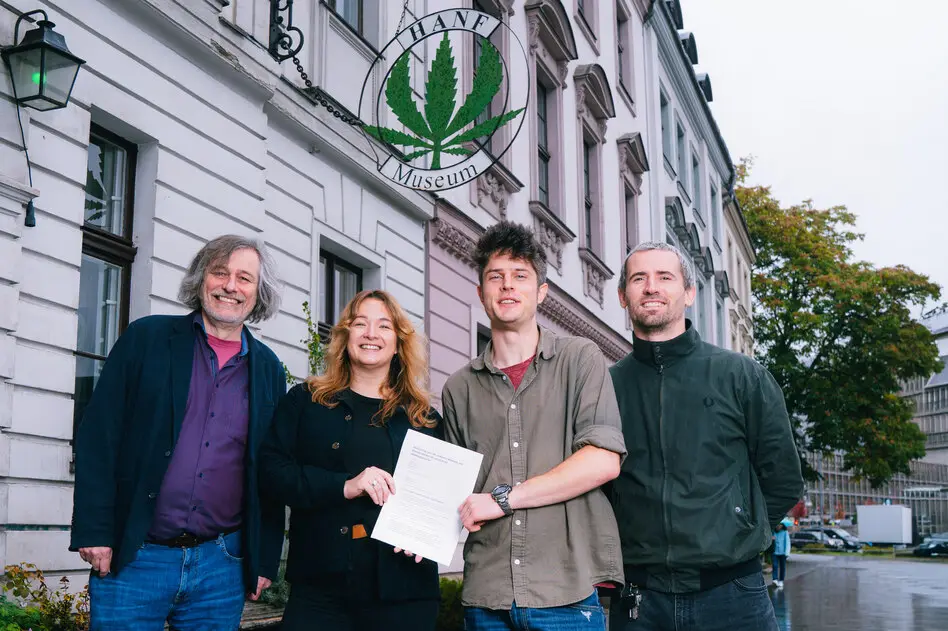
Lucas Green is well on his way to going down in hemp history. On December 12th at 12:12 p.m. the cannabis cultivation association in the Nikolaiviertel will open a dispensary. In the middle of the city, plus in the Berlin Hemp Museum. It couldn't be better, because the hemp museum comes full circle. The exhibitions about cannabis as a useful and cultivated plant show the long path from prohibition to partial legalization. And now you can also buy weed locally. “This is a big moment for Berlin,” say Madeleine Lengert and David Boldt, who run the business at Lucas Green.
Lucas Green is one of 15 licensed growing clubs in the capital. The so-called Cannabis Social Club (CSC) grows marijuana on a factory floor on a site in Weißensee that was formerly a Stasi ammunition depot, and members have only been able to pick it up there so far. The Consumer Cannabis Act (KCanG), which came into force in April 2024, allows up to 50 grams per month. Now the Berlin State Office for Health and Social Affairs (Lageso) Lucas Green, which is responsible for the growing associations, has approved a second delivery point in the city center.
There wasn't much to see when the taz took a look behind the scenes at the hemp museum on Tuesday. A small furnished room in the basement will serve as a distribution point in the future. This will be open regularly from January 7th, every Thursday, Friday and Saturday from 3 p.m. to 8 p.m. However, there are special opening times during the Christmas season. Cannabis is only sold to club members.
In front of the entrance to the museum there will always be a board with a QR code that you can use to register online as a new member and immediately shop for cannabis in the basement. Would it be Bananacoda, as one of the varieties is called, or Cap Junky or perhaps Purple Octaine? However, consumption on site is not permitted.
Lucas Green does not have to pay rent to use the room; they thank him with a donation in the form of a permanent admission ticket, says Boldt at the meeting with the taz, which was also attended by Lengert and the managing director of the Cannabis Museum, Ferdinand Siebert. Why does the museum offer this opportunity to Lucas Green of all people? In the cannabis scene, the club is “characterized by its exceptionally high level of reliability,” says Siebert. Of course, the museum also hopes that this will attract more visitors. The rush to the exhibitions, some of which seem a bit like a relic from the hippie times, seems to be rather manageable.
Madeleine Lengert, born in Luckenwalde in 1989, and Boldt, 40 years old, grew up in Lichtenberg, are a productive team. This was already noticeable in March when the taz visited the factory floor in Weißensee. The two of them run an event agency full-time. Quite successful, it seems, because they say they managed to invest in the club without going into debt. The indoor greenhouse, equipped with complex technology, and the security measures, which had to be approved by the State Criminal Police Office, cost 200,000 euros. The modern kitchen and the meeting room for “community building” are also impressive.
Lengert and Boldt were also pioneers when they were the first to apply to Lageso for approval to found a CSC in 2024. AG001 is the number of your application. They received permission in August 2025. Lucas Green has now brought in two harvests and the third is imminent.
Members pay 10 to 14 euros per gram of cannabis. On the labels of the portion packs with the variety names, the batch number and information on THC and CBD content ensure clarity and transparency. The management duo emphasizes that ecology is a top priority when it comes to cultivation. The entire harvest is tested by several laboratories.
“Our cannabis is more than made in Berlin,” Lengert said on Tuesday at the meeting in the Cannabis Museum, not without pride. “We can prove exactly what’s inside.” Boldt is certain that this is not the case with medicinal grass, which is available with a prescription in pharmacies. You can't rely on always getting the same material. There are patients who have therefore migrated to Lucas Green. The cannabis available in pharmacies is a mass product, and the managing director of the Hemp Museum, Siebert, confirms this. “Too dry, scratchy, and it doesn’t taste that good either.”
A CSC can have up to 500 members. In March, Lucas Green had 50 members, now there are 135. Growing clubs are not allowed to make a profit, but of course they cannot and do not want to be left with the high investment costs and fixed costs. Lucas Green's three gardeners, for example, are paid staff. Unlike telemedicine platforms, which have so far been able to aggressively advertise the sale of cannabis flowers for medical purposes without personal doctor-patient contact, CSCs are prohibited from advertising. You are now allowed to have at least one Instagram account, but only to distribute information, says Lengert.
Lucas Green is now hoping for a boost in membership from the location of the new dispensary. It's not just cannabis users with a handicap who find the route to Weißensee long and difficult. To get there by public transport, you have to change several times.
The hemp museum is ideal for this. Located at Mühlendamm 5, in the middle of Berlin, there is a connection to the content and there are neither schools nor daycare centers anywhere. According to the law, cultivation associations are not allowed to establish themselves within 200 meters of children's and youth facilities. “As a result, 80 percent of the city center area is excluded; there is always a facility somewhere,” says Siebert.
When asked, Lageso said that of the 15 approved cultivation associations, two had been granted permission for two delivery points. A further permit for a second delivery point has been applied for.
On December 12th, Lucas Green opened the second location, and shortly beforehand, on December 6th, the hemp museum celebrated its 32nd anniversary. Without taking a breath, Siebert rattles off the most important dates: “1994 museum opening, 1996 legalization of the cultivation of industrial hemp, 2017 medical cannabis available by prescription, 2024 cannabis for recreational purposes.”
With the delivery point in the basement, the many facets of hemp history would now be practically visible in the museum. Siebert emphasizes that he himself will of course also join the Lucas Green club. “I’m looking forward to receiving my flowers.”