
Politics taz
Bundestag changes animal protection law: video recording only for large slaughterhouses
The Bundestag only requires slaughterhouses to videotape their handling of live animals. How much does this benefit animal welfare? more...
Deutsch (original) ·Auto-translated to English
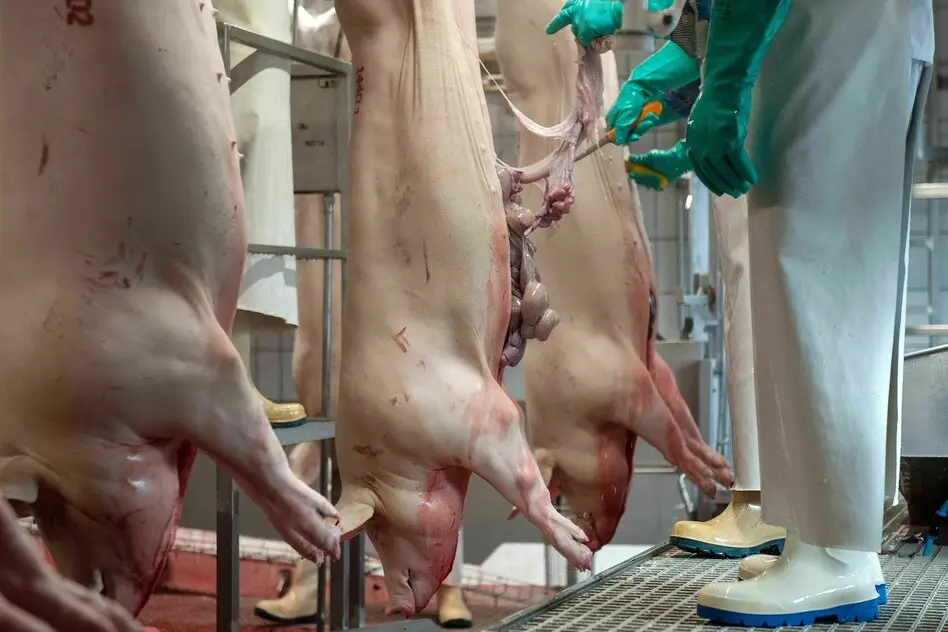
In the future, very large slaughterhouses in Germany will have to video record how they unload, stun and kill animals. With the help of the recordings, the authorities could more easily punish animal welfare violations, according to the justification for a corresponding law that the Bundestag passed on Thursday evening. However, the regulation initiated by Agriculture Minister Alois Rainer (CSU) only requires just under 6 percent of companies to record video. It is also unclear how intensively the authorities will evaluate the material.
With the law, the black-red coalition is reacting to several scandals that animal rights activists have uncovered in slaughterhouses. For example, secretly made recordings showed employees hitting and kicking cattle. Sometimes animals were incorrectly anesthetized and then killed with great pain. The video recordings are intended to act as a deterrent and thus reduce the number of violations.
According to the law, the recording and storage requirement for 30 days of slaughter does not apply to facilities that do not have to appoint an animal welfare officer. This means that everyone who slaughters fewer than 1,000 mammals per year - the equivalent of, for example, 1,000 adult cattle or 5,000 pigs - or 150,000 pieces of poultry is exempt. According to the ministry, only around 230 of the four slaughterhouses in Germany reach this threshold.
That's not enough for the Greens and the Left. “We need comprehensive video surveillance in all slaughterhouses without exception,” demanded the Green Party’s animal welfare spokeswoman, Zoe Mayer. "And of course someone has to watch the videos. Unfortunately, the government doesn't have a solution." The Greens had previously pointed out that the veterinary authorities were already overloaded. This is also why Mayer demanded that “everyone should have the right to see pictures of slaughterhouses.”
The CDU MP Anna Aeikens argued that the companies now obliged to record video were responsible for around 90 percent of the animals slaughtered in Germany. The rest is smaller and therefore excluded. The Union does not want to put too much financial strain on these companies. “If there are specific suspected cases,” the authorities could also order video recordings in small slaughterhouses in the future, said Aeikens.
The AfD MP Bernd Schattner, on the other hand, rejected the requirement to record even in the large slaughterhouses. The new regulation only causes “new costs, new documentation requirements and new bureaucracy” for the companies affected. Then it is no wonder “if more and more regional slaughterhouses disappear”.
In fact, the effort required for recording is limited: Rainer's ministry estimates in its draft law that the acquisition costs amount to "an average of 3,500 euros per company". If they are depreciated over the useful life of the system, together with maintenance and care it comes to 740 euros per year.
The change to the Animal Protection Act will come into force on January 1, 2027. However, the affected companies will be granted a one-year transition period for the technical implementation.
The Bundestag, also with votes from the coalition, again postponed the introduction of state animal husbandry labeling for meat. The chamber decided to postpone the start, which had already been postponed to January 1st, 2027, again to October 1st, 2027. The reason given was that more time was needed to implement the reform of the system agreed in the coalition agreement.
After several failed attempts, the state labeling was passed by law in 2023 by the traffic light coalition. It is intended to give customers more clarity about the conditions in the stables when buying meat. (with dpa)