
Germany taz
Botanical research: making music with plants
Whether tree or flower, plants generate electrical potentials that can be translated into sounds. Your communication skills go even further. more...
Deutsch (original) ·Auto-translated to English
The stories I want to tell here may sound a bit unbelievable. Because they are about flowers that make music, about roots that hear water, and about the fact that plants should even have their own personalities. A few years ago I would probably have thought this was a weird mix of esotericism and fantasy. Today I know that all of this has been under serious scientific study for a long time.
It happened in May of this year, I was invited to a Waldorf school in Cologne. The pianist Nikolaus Schardt sat at the grand piano and wired a cyclamen to a small device that translates electrical signals into piano tones. In front of it, around sixty students, teachers and scientists were waiting for something to happen. Schardt switched on the device. The first notes came out and they sounded like a stoned Brian Eno playing a single key at a time. Then Nikolaus Schardt improvised, and the room was filled with disbelieving amazement.
“When I heard the first sounds, a tear came to my eyes,” said a biologist who was also present afterwards. She was also convinced that the sounds changed when the pianist started. Unfortunately I didn't hear that. But that doesn't have to mean anything. Sometimes I don't hear so well.
It is now well established that plants react to sounds and tones. Researchers at the University of Western Australia tested this with the pea plant Pisum sativum. They built her a mini-labyrinth out of PVC pipes; the root had to decide in which direction it wanted to grow. Behind one of the corridors they ran water through a pipe. The result was that the roots grew in the direction from which the water sounds came.
But I find another experiment from Israel funnier: Here the researchers played the hum of a honey bee on the flower of an evening primrose for three minutes via loudspeakers. After the brief fake flirtation between the bee and the plant, the sugar content of the nectar increased by around 20 percent.
So maybe the biologist was right. Maybe the cyclamen had actually reacted to Nikolaus Schardt. Nevertheless, I would like to clarify a completely different question here: What are we actually hearing?
That's what I want to know from Max Moser, who is also at Schardt's concert. The chronobiologist and professor emeritus has spent his entire professional life studying what sets the pace of life. With heartbeats, with sleep cycles, the internal clock and so on. Now he is working on the rhythms of plants. He developed the device that allows us to listen to cyclamen.
“An artistic interpretation of vegetative rhythms.”
"Plants have two fluid streams inside. One transports water and nutrients from the roots to the leaves. The other brings the sugar produced there back down. These streams generate electrical potentials. Our device measures them. We have put these electrical resistances on a scale and translated them into sounds. This is called sonification."
This text first appeared in wochentaz, our weekly newspaper from the left!
Every week, wochentaz is about the world as it is – and as it could be. A left-wing weekly newspaper with a voice, attitude and the special taz view of the world. New every Saturday at the kiosk and of course by subscription.
And why does music keep changing?
"Because the plant is constantly changing. With the light, with the time of day, with its water balance, with its entire environment. The more the electrical potentials change, the more the music changes. The higher the electrical resistance, the higher the tones, the faster the fluctuations in the currents, the more rhythmic the melodic arcs are. I think that definitely has a tonal quality too."
I like the professor. He looks a bit like Dr. Emmett Brown from Back to the Future, and I appreciate that he doesn't claim that plants secretly compose songs. For him, this project is about something different: “Luring children back into nature, because they are really being sucked into this virtual and digital world with their cell phones.”
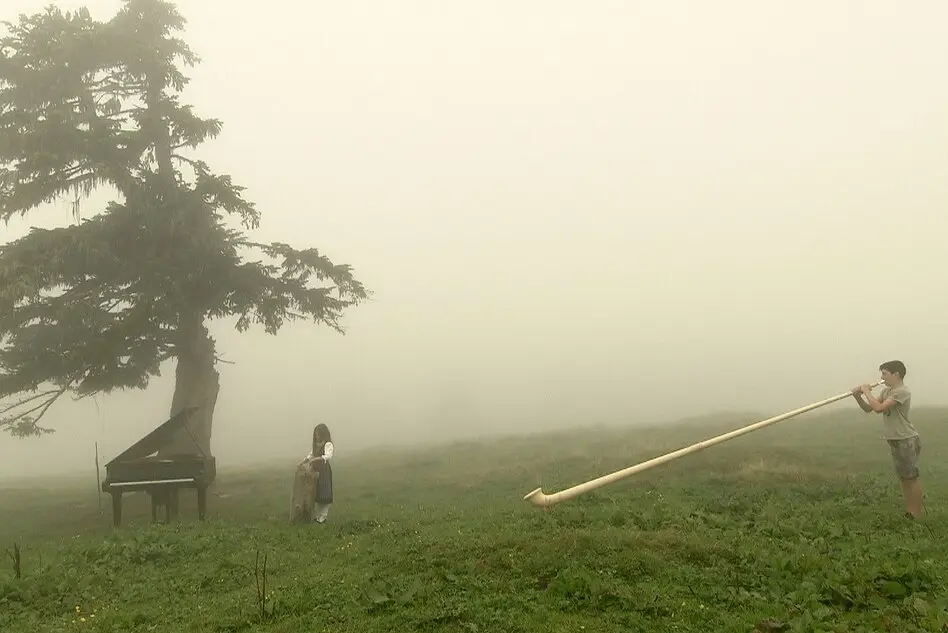
The story behind this sentence begins on an alpine pasture in Weiz, Austria, Max Moser tells me. For an art project there, he wired a two-hundred-year-old fir tree with his device and a piano. And then something unexpected happened, he says. The Weizer Music School came along and the students brought their own instruments. Violins, guitars and glockenspiels, and suddenly they were having a jam session with the fir tree.
The educational project “Re-Connecting with Nature” emerged from this encounter. Today, schools can borrow the devices. Like the Waldorf School in Cologne did.
The students were able to experiment with it in horticulture lessons. For example, an eighth grader first placed their plant in a bright and light-flooded classroom, then later in a dark basement. In the light she sounded faster and brighter, in the dark she sounded more like she was sleeping, with deeper tones and calmer rhythms. They ran the recordings of it before the concert.
A little boy next to me said afterwards, “That sounds weird.” A teacher raved about how she could listen to the cress she had grown herself. And a girl from the research class said: "I already knew that plants were alive. But I didn't think they could communicate like that."
Communicate. That's a big word, but maybe not entirely precise. It's not as if one mugwort is shouting to another that caterpillars are on the way.
Now let's look into the mountains of California's Sierra Nevada. There, in 2009, the American biologist Richard Karban scratched the leaves of a few dozen mugwort plants. He then placed plastic bags over the plants and waited 24 hours. Karban then took a hose, sucked the air out of the bags with his mouth, and then blew it into other bags that encased the branches of uninjured mugwort plants.
For comparison, other mugwort plants were breathed in by completely healthy conspecifics. After a while, Karban removed the bags and left the plants to nature. Caterpillars, grasshoppers and deer could feast on them as they pleased throughout the summer. The result: Those plants that got the air from the injured mugwort plants had significantly less damage from feeding than those that got the air from healthy mugwort. They were around 40 percent less likely to be nibbled.
How could that be? Karban assumes that the injured mugwort plants released messenger substances into the air, whereupon the healthy plants raised their natural defenses long before the caterpillars, deer and grasshoppers even got to them. This is just one of many strategies that have proven successful in the eternal arms race of evolution. Plants have been trying to avoid being eaten for hundreds of millions of years. And because they can't run away or actively fight, they had to get inventive.
A cyclamen in a jazz concert, plants that can “hear” or “smell”, mugwort that warns of danger. What story comes next? Perhaps one in which botanists talk about properties for which we have previously assumed a brain and which are therefore also called “cognitive abilities” in psychology?
This story actually exists, and it's about mimosas who are supposed to remember and learn. First of all, to understand: If you touch the leaves of a mimosa, it suddenly folds up. This is a reflex against possible predators. It takes energy for the plant to close the leaves. A team of researchers therefore wanted to know whether the plant would eventually notice that some dangers are not real. So they dropped their test plants repeatedly - up to 420 times - onto a pillow from a height of 15 centimeters in a controlled manner, so that the mimosas were startled and their leaves closed.
At least at the beginning. After a few repetitions, they stopped bothering. Apparently they had learned that these impacts were harmless. In behavioral research this is called habituation. This is the simplest form of learning.
Even a month later, the plants still reacted the same way. That doesn't mean that the mimosa remembers like a human, but it seems to be able to distinguish between familiar and safe and new stimuli and adapt its behavior accordingly.
I also write “seems” because there is criticism of the study. The researcher Robert Biegler doubts that the plant has “habituated”. He claims that Mimosa was simply tired after too many falls. To rule this out, you would have to modify the experimental setup and carry out the experiment again. Yes, science is discussing this very seriously.
Each of these stories on its own could perhaps be dismissed as a curiosity. Taken together, however, they represent a botanical change of perspective. For a long time, plants were considered something that just stood there passively, growing, blooming and just waiting to be eaten. Today, plants are more often described as shaping their environment.
One can argue about whether verbs like “hear”, “smell”, “learn” and “remember” are really appropriate here, or whether they smuggle ideas about plants into our heads that ultimately attribute human characteristics to them. There is also debate about this. But basically all the research results paint a pretty clear picture. The researchers disagree primarily on the interpretation of the results.
If all of this is true, doesn't the next question inevitably arise? Do all plants react the same way? Are there individual differences? And would I even ask this question if there wasn't already a study on it?
We're back with Richard Karban. Apparently he is particularly interested in how plants react when you make life difficult for them. It was the mugwort again that he scratched the leaves. But this time he didn't want to know whether he could warn his neighbors. But whether all mugwort plants are equally good at it.
So he repeated the experiment described above in a modified form with many different plants, and indeed: Some raised the alarm even in the event of minor injuries, while others reacted comparatively cautiously even in the event of more severe damage.
What was even more surprising, however, was that the neighboring plants seemed to know their Pappenheimers. While they hardly reacted to the signals from the fearful mugwort, they reliably raised their own defenses when the courageous mugwort plants sent out their warning signals. And that's when it happened to me: I write about rabbit-footed mugwort as if there were already individual personalities among plants.
I already said: The stories I tell here may sound a bit unbelievable at first. Now do you know what I mean?