
Germany · taz · · 5h
Bosnian musicians about the country and football: “People get along well with each other in everyday life”
Deutsch (original) · Auto-translated to English
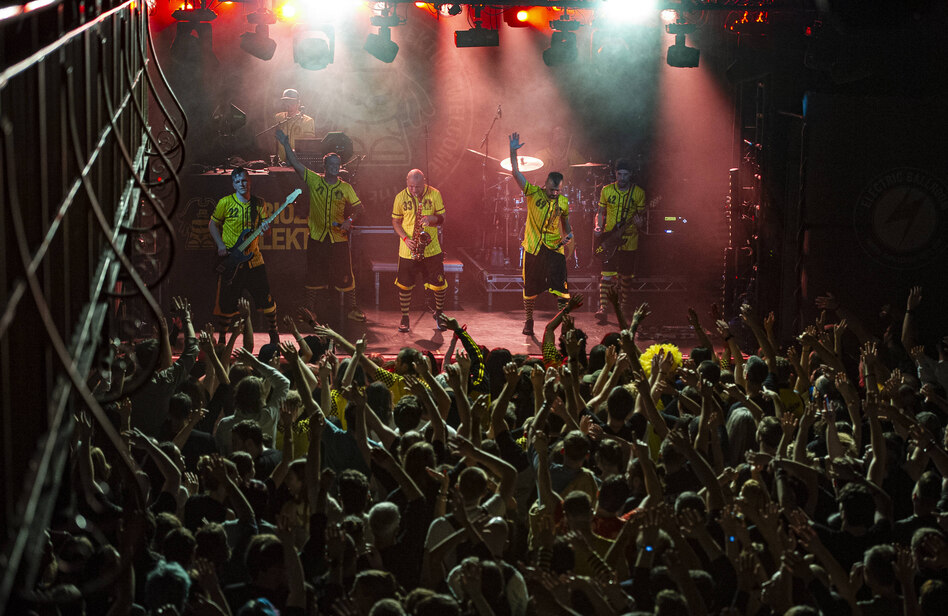
taz: Mr. Jakubović and Mr. Mujagić: The song “U.S.A.” is 15 years old and became the soundtrack of the World Cup in the summer. How did that happen?
Brano Jakubović: The whole thing was intended as a joke. The song has nothing to do with football and describes the desire to emigrate to the USA. In the end, the emigrant returns because the dream has not come true and he misses his home country. Many people who emigrated from Bosnia feel this way. But very few actually return. The song plays humorously with this longing for a better life abroad and the longing for the homeland of Bosnia.
Vedran Mujagić: A friend called us shortly before the first World Cup playoff game in Wales at the end of March. He said: "Watch the game too. The Bosnia fans have a surprise for you." Five minutes into the game, fans rolled out a large banner with the refrain: “I am from Bosnia, take me to America.” Hardly anyone really believed that the national team would qualify for the World Cup. But when Bosnia won on penalties, the whole thing took on a life of its own. The slogan gave people hope.
began his musical career in 1996 as bassist for the band Deceased in Sarajevo. He was the driving force behind the founding of Dubioza kolektiv in 2003.
taz: Three days later, Bosnia actually won the decisive game against four-time world champions Italy and qualified for the World Cup. What triggered that evening in Bosnia?
Mujagić: In Bosnia we usually expect things to go wrong. But that day the mood in the stadium and in the country was completely different. People believed in victory and after the game there was huge euphoria in all parts of the country. There is also a large Bosnian diaspora and many national players were born abroad. Since the war, around a million Bosnians have emigrated. With this victory, these people's longing for their homeland was satisfied.
At the turn of the millennium he was part of the band Adi Lukovac & Ornamenti, a pioneer of electronic music in Bosnia. He is also a founding member of Dubioza kolektiv.
Jakubović: I also have a political explanation for this joy. Bosnia has always been part of Europe. But for decades the European Union has given us the feeling that Bosnia does not belong. For us, Europe feels like a door with a big stop sign that says: Stop, no entry here! But with the World Cup qualification we were suddenly part of the world. For small countries like Bosnia-Herzegovina, this visibility is worth a lot. It's similar with the Eurovision Song Contest. You're only on stage for three minutes. But at this time you belong to Europe.
taz: Did this World Cup summer bring the ethnic groups in the country together?
Jakubović: I know this story about Bosnia as a country of Bosniaks, Serbs and Croats who can't get along. This story is often told abroad. I think it's too simple. If Bosnia were to become part of the European Union tomorrow, this story would no longer apply. People get along very well with each other in everyday life. In the first World Cup game against Canada, Jovo Lukić scored 1-0 for Bosnia. We watched the game at the public viewing in Sarajevo. 80 percent of the capital's population is Muslim. After the goal, people celebrated like crazy and shouted the name of the scorer. Lukić is a Serbian name, everyone knows that. And everyone shouted his name. People didn't care about his ethnic background.
taz: Lukić grew up in the Republika Srpska, the predominantly Serb part of Bosnia. He played for many years for Borac Banja Luka, whose ultra fans pay homage to war criminal Ratko Mladić.
Jakubović: I didn't even know that Lukić played for Banja Luka because it doesn't matter to me. I was there recently and met friends for dinner. They told me that a friend of theirs has a seven-year-old son who plays Banja Luka in Borac's youth team. This guy wanted to go to the first training session wearing the Bosnian national team jersey. His parents said he shouldn't do that. And what do his parents see at the first training session? Almost all the children came wearing the Bosnian jersey. Things are changing.
taz: According to the constitution, Bosnia has three presidents who represent all ethnic groups. But with Sergei Barbarez there is only one team boss for the national team. Does he represent the entire country?
Jakubović: Barbarez is easy-going and everyone in the country respects him. He comes from a mixed marriage, his father is Serbian and his mother is Croatian. But he always played for the national team of Bosnia-Herzegovina. Even if he was criticized by some in the country for it. It is an essential part of success and shows how it can be done together.
taz: Barbarez began his career before the war at the multi-ethnic club Velež Mostar. However, the politically charged hostility between Velež Mostar and the Croatian club Zrinjski Mostar shows how divided the country is to this day.
Mujagić: But it is only a minority that fuels this nationalist hatred in the stadiums. The hardcore fans are paid by politicians for the riots, and nationalists take advantage of this to maintain the conflict. Incidents are deliberately provoked, especially in an election year. That's why nationalist politicians remained silent during the World Cup summer. Because the team brought people together and the political conflict was not an issue.
taz: With the death of the war criminal Ratko Mladić at the end of August, tensions in Bosnia have increased shortly before the parliamentary elections. What do you expect from the election?
Jakubović: So far, after every election, politics has returned to its usual course and little has changed. This time there is greater hope that something will change for the better. There are also Nations League games around the election. If Bosnia is successful there, the good mood in the country will prevail and politics will have less room for division.
taz: What is actually left of the euphoria surrounding the World Cup?
Mujagić: I can already see a lot of positive things. We travel a lot as a band in other countries, and people perceived Bosnia-Herzegovina differently this summer. Some just got to know the country. People saw that Bosnia has great football players, positively crazy fans and wonderful cities. The number of tourists has exploded and many people wanted to discover the country for the first time. I feel like Bosnia is the next big thing. That's a nice effect of this World Cup summer.
taz: You wrote your song “U.S.A.” for the World Cup. equipped with a new text. Instead of the desire to emigrate, it's about mutual success in the host country. But Ćevapi and Burek also suddenly appear. What does that mean?
Jakubović: That is also meant to be humorous. Of all the countries of the former Yugoslavia, Bosnia is the only one where burek is made only with meat. If the dish is filled with spinach or cheese instead of meat, it is called pita in Bosnia. In the other Balkan countries it is still called Burek. It is similar with Ćevapi, the Bosnian national dish. In Bosnia, people eat Ćevapi with onions. But in other countries there are all sorts of variations and craziness. In Slovenia, for example, there is Ćevapi with cream cheese or with Ajvar. And if you're particularly crazy, treat yourself to Ćevapi with kaymak on your plate. This is a milk spread. An absolute no-go in Bosnia. We wanted to make that clear.
Read the full story at the source
Source: taz