
Germany taz
Important and controversial magazine: Ciao, “Emma”!
Almost 50 years ago, the first “Emma” – founded by Alice Schwarzer – was published – soon to be the last. Apparently there are no economic reasons behind it. more...
Deutsch (original) ·Auto-translated to English
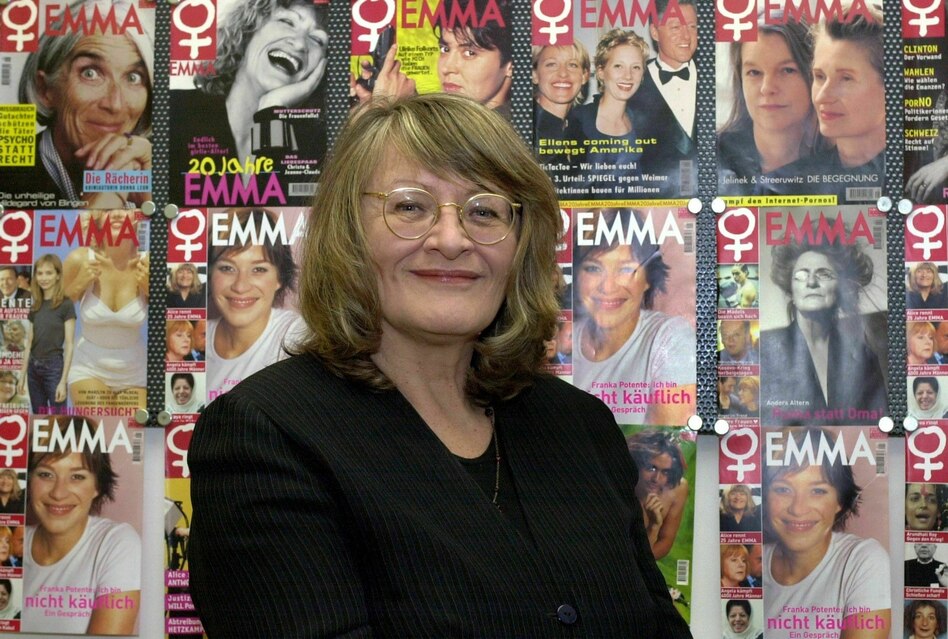
dpa/taz | Alice Schwarzer is discontinuing her feminist magazine Emma after 50 years. The issue of December 8th will be the last, the women's rights activist told the German Press Agency in Cologne. Economic reasons are not decisive. "Sure, our circulation is also falling. But our income still covers expenses," Schwarzer assured in a statement. “No, we’re leaving because we think it’s enough!”
Emma held her ground for three generations and took a stand “against some nonsense in the name of feminism”. “So allow me: now we are exhausted.”
Schwarzer is considered Germany's best-known feminist and is now highly controversial because of her position on the Russian war of aggression against Ukraine and her attitude towards trans people. Emma, which she founded, was first published on January 26, 1977. Schwarzer describes her motive today as follows: “It was the misogyny of what we feminists called the ‘men’s media’ that made me come to the conclusion that we journalists should have our own magazine, our own voice.”
Since the start of the Ukraine War in 2022, Schwarzer, sometimes together with Sahra Wagenknecht, has repeatedly spoken out in favor of quick peace negotiations with Russia. Critics accuse her of losing sight of who is the aggressor in this war and who is the country being attacked. In 2024 she admitted that her stance on the Ukraine war also had consequences for the number of Emma subscribers. There was a lot of approval from readers for “Emma’s Peace Course” in 2023. "But at least one in five readers canceled their subscription in protest. That's supposed to hurt - and it does." But she won't let that intimidate her.
Schwarzer also attracted protests with her stance towards trans people. In 2023, 33 authors and artists called for the cancellation of an event with her at the Literary Autumn in Leipzig because she repeatedly attracted attention through “transphobic, racist and misogynistic statements and publications”. Schwarzer reacted indignantly, she assured at the time that she had never attacked “transsexuals,” an outdated and incorrect term because it is not about sexuality. Nevertheless, she spoke of a “trans ideology” that she viewed critically. Right-wingers and trans haters often use the term “trans ideology” to insinuate that trans people want to seduce others – especially children and young people – into choosing transsexuality themselves. A representation that contradicts the fact that people do not choose to be trans, but rather: that's how they are.
The question arose again and again as to whether Schwarzer should hand over the management of Emma, which appears every two months, to younger hands. In 2008, the journalist Lisa Ortgies actually took over as editor-in-chief, but after a short time there was a falling out and Schwarzer took the reins back into his own hands.
In the penultimate issue of Emma, published on October 27th, Schwarzer assures us that over time she has tried to find “other colleagues in our spirit”, including a potential editor-in-chief. There are also female journalists who would have been considered for this, but these colleagues would have preferred other media. Reason: “The wind doesn’t blow quite so harshly from outside.”
Initially, the Emma editorial office was located on Kolpingplatz directly in downtown Cologne. On Weiberfastnacht, the editorial team always went to celebrate carnival at the Alter Markt. The editorial team later moved to the medieval Bayenturm in Cologne's Rheinauhafen. Here Schwarzer worked under an image of the French philosopher and women's rights activist Simone de Beauvoir, who had shown her the way in the 1960s.
Schwarzer is of the opinion that today it is hardly known what women had to endure back then and then struggle to achieve. On the other hand, what has also been forgotten is how free women were back then: "Those were years of departure, of arrogance! We didn't just fight, we also celebrated and danced. And: We had few constraints. We didn't have Instagram and didn't inject Botox. That's often difficult to convey."
In 2017, Schwarzer was still optimistic about Emma's future at the 40th anniversary. Feminist issues are more popular today than they were ten years ago, she said at the time. "In the 90s, people believed that they had already achieved everything. And now we see: It doesn't happen that quickly."
Schwarzer now emphasizes that Emma has changed Germany a bit in half a century. Two of the many topics that the magazine reported on for a long time “almost alone” were the sexual abuse of children and Islamism. Emma got involved in these topics in 1978 and 1979, long before the others. “The media often only became aware of numerous other topics – such as spousal splitting, breast cancer or genital mutilation – through publications in Emma.”
Schwarzer also claims that Emma was recently the “last and only professional consumer magazine on the kiosk in the world owned by feminists”.
The Emma archive, including boxes and cartons, correspondence and campaigns, will be completely included in the holdings of the German Literature Archive in Marbach and made available to interested parties there, says Schwarzer.