
World · taz · · 2h
Australia and the war in the Middle East: What a US military facility in the outback has to do with Gaza
Deutsch (original) · Auto-translated to English
It is an unusual place for a debate about Australia's relationship to the war in the Middle East: Alice Springs, more than 1,500 kilometers north of Adelaide, in the desert, in the red heart of the continent. There is Pine Gap, one of the most important American intelligence facilities outside the USA. Now a possible connection to Israeli military operations in Gaza is the subject of a court case.
Critics and Palestine activists in Australia claim that “Israel’s genocide in Gaza” is being controlled from Pine Gap. Two activists therefore blocked access to the facility in October 2025. They pleaded guilty in the Alice Springs Local Court on September 14. The court imposed a six-month conduct requirement and a fine of 223 Australian dollars in each case. During the trial, the defense also presented a comprehensive report from secret service expert Richard Tanter.
According to the online magazine Deepcut News, Tanter concludes that it is at least “likely” that Pine Gap was supporting Israeli military operations at the time of the blockade. His argument is based, among other things, on satellite coverage of the Gaza Strip, previous cases of information obtained from Pine Gap being passed on to Israel, and existing agreements between the US and Israeli intelligence services. Accordingly, raw data from the US National Security Agency (NSA), including information from Pine Gap, can also be passed on to Israel.
However, this does not prove that Pine Gap provided concrete targets for Israeli attacks in Gaza. This distinction is crucial. An investigation by the Australian broadcaster ABC found that there was evidence of long-standing American-Israeli intelligence cooperation, but at the same time there was no publicly available evidence as to which specific information from Pine Gap was used in Gaza. Former NSA analyst David Rosenberg says the facility monitors the Gaza Strip and the surrounding region and collects information that could be useful to Israel.
Pine Gap was created during the Cold War. Australia and the USA agreed to build it in 1966; The plant began operations in 1970. Originally it served primarily to investigate Soviet and Chinese missile programs. Today it processes signals and data from a global satellite network. The Australian government describes the facility as a common part of the national security architecture; around half of the staff are Australian.
But it is precisely this dual role that makes Pine Gap politically sensitive. Australia benefits from access to American intelligence and early warning, but at the same time has limited control over how the information gained is used. The Australian Parliament has explicitly identified the importance of the intelligence alliance with the US as central to Australian security.
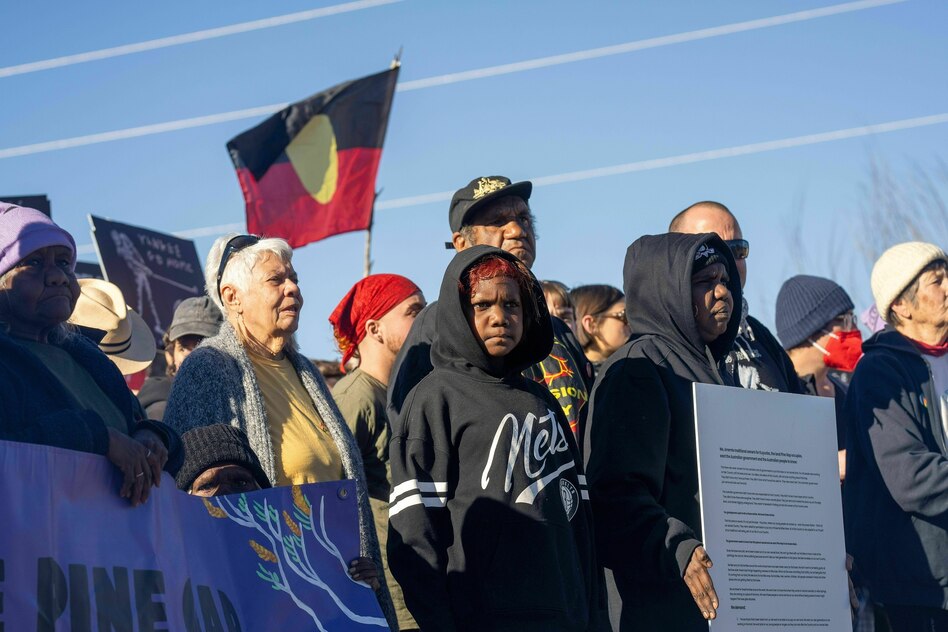
Since the beginning of the Gaza war there have been demonstrations in Alice Springs and beyond. In July, around 300 people gathered in front of the facility. Representatives of the local Arrente Aboriginal people demanded the return of traditional lands.
The new legal dispute does not fundamentally change the evidence. However, it makes clear what is essentially at stake: not just the question of what Pine Gap is used for, but also the extent to which a state becomes jointly responsible for an ally's military operations if it operates its intelligence infrastructure on its own territory. Various analysts warn that the facility - and therefore Australia - could become a target for Chinese long-range missiles in the context of a possible military conflict between the USA and China.
Read the full story at the source
Source: taz