
Germany taz
Exhibition honors photo artist: the woman takes the photos herself
Käthe Buchler, who was born 150 years ago, always saw herself as a professional photographer. Braunschweig is now dedicating an exhibition and symposium to her. more...
Deutsch (original) ·Auto-translated to English
The year 2026 offers an opportunity to celebrate several anniversaries in photography. The medium emerged 200 years ago, in an experimental stage: the oldest known and preserved photo in the world, the view from a window of his house in Saint-Loup-de-Varennes, was probably captured in a camera obscura by Joseph Nicéphore Niépce in 1826. The life and work of two German pioneers of photography are not quite as old, but can be dated exactly. Both August Sander from the Rhineland and Käthe Buchler, born in Wolfenbüttel, were born in 1876, 150 years ago.
Admittedly: Sander is the better-known personality. His portrait series “People of the 20th Century,” created in the 1920s and consisting of 619 individual images, reveals a photographer who (still) believed that a person's habitus can testify to their social status. His stern Cologne notary with his greyhound, the portly confectioner with the copper kettle or the secretary at West German Radio in 1931, smoking and wearing a fashionable pageboy head: they belong to the collective memory of social documentary photography.
Sanders' pictures were included in the worldwide traveling exhibition “The Family of Man,” which reached more than two million visitors from 1955 onwards. The Photographic Collection, Stiftung Kultur in Cologne is currently honoring the “photographer of the century,” according to WDR, who died in 1964, in an exhibition to mark his 150th birthday.
Exhibition “People and Pictures. Käthe Buchler on her 150th birthday”: Museum für Photography Braunschweig, until November 29th.
Panel discussion “Professionalization of female photographers” with Giulia Cramm and Nathalie Dimic: ibid, November 17th, 6 p.m
Conference “Käthe Buchler – a photographer of the early 20th century from Braunschweig”: November 19th and 20th, Braunschweig University of Fine Arts
Student project “Käthe Buchler today – turning waste into art”: Braunschweigische Landessparkasse, until the end of 2026
Meanwhile, the Braunschweig Museum of Photography is dedicating itself to Käthe Buchler, not for the first time. As early as 2003, the house had received the estate of those who died in 1930: over 1,000 glass negatives, around 250 autochromes (an early form of color slides), albums and original prints that survived the Second World War. For the current exhibition “People and Images”, new aspects were opened up through current research results, additions to the collection and loans. It is particularly important to the museum director, Barbara Hofmann-Johnson, to introduce Käthe Buchler as a professional photographer.
This is a reassessment: In the past, she was often dismissed as a well-heeled industrialist's wife who, at an undoubtedly recognized high level, came across as an amateur. But that doesn't correspond to her self-confident demeanor or her work: a public symposium on November 19th and 20th at Braunschweig's University of Fine Arts is intended to deepen this approach to Buchler's oeuvre.
Buchler's well-known series, such as her portraits, are also worth taking a closer look at: all of the photographs are carefully arranged, sometimes with a neutral background. However, this is not a format-filling illusion, but rather reveals itself as an artificial - or artistic - intervention. There are children peeking around the corner. Buchler also wrote a self-portrait with sophistication, probably between 1901 and 1904: she lets the upper edge of a light background run through the composition of the picture at such an angle that cropping would hardly have been possible without mutilating the picture.
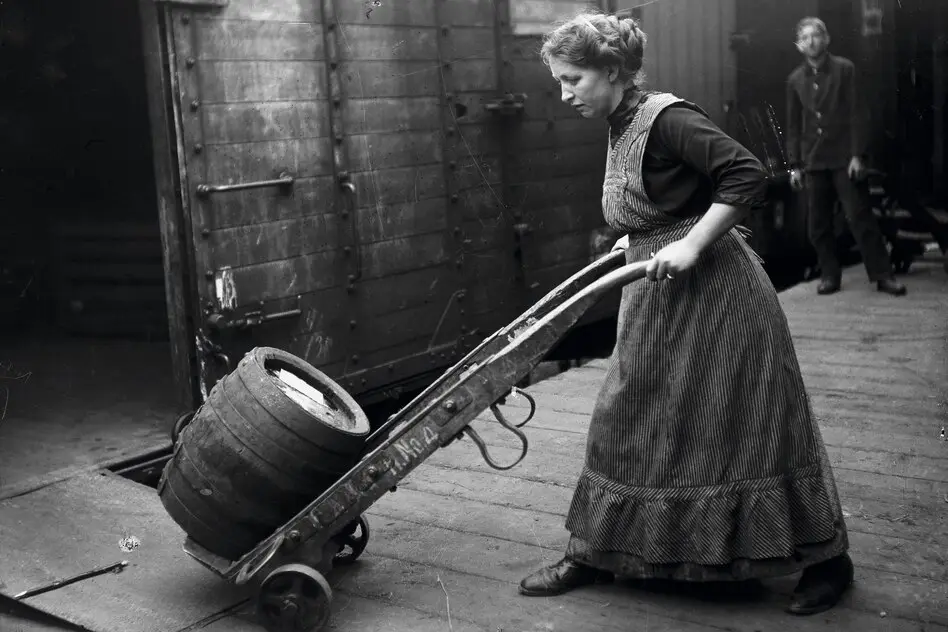
In this form she used it as a draft of a “Carte de Visite” with which she advertised her “Photographic Studio”: “Orders of all kinds are carried out promptly and safely” or “Real service, always by the owner herself”. Another self-portrait, around 1905, with a bellows camera, identifies her as a photographer. Buchler's series “Women in Men's Jobs” from the First World War also received international attention. Two female conductors, probably in the uniform of their colleagues at the front, three young milk drivers with horse-drawn carts and the loader at the hand truck seem like an anticipation of August Sander's typological portraits.
The Braunschweig exhibition contrasts them with four of his male working people: gas men, Berlin coal carriers, money postmen. Käthe Buchler was also an accomplished draftsman, as evidenced by a sketchbook on loan from her family: she recorded impressions as precisely as in a photo, probably during her honeymoon in 1895.
After the birth of two children, she began photography in 1901, encouraged by her brother-in-law from the Voigtländer dynasty, owner of one of the two once renowned camera factories in Braunschweig. From 1906 she took courses at the Berlin Lette Association's photography school, acquired a plate camera and set up a darkroom in her home. From 1913 onwards, conceptual series, lectures and exhibitions of her work followed, often in a charitable context.
As soon as it came into being around 1907, Buchler also used color photography using autochromes. One motif became flower still lifes of the seasons: technology-supported interpretations of the historical vanitas topos, which is intended to remind us of the transience of all life. For her birthday on October 11th, a bouquet of roses, modeled on one of her still lifes, decorated her gravesite. And the two gatehouses of the Museum of Photography now form a worthy address: Käthe-Buchler-Platz.