
Politics taz
Riots in Italy: Taking tough action against violent protests
The Italian government has passed a “security decree” that comes into force immediately. What this means for the protesting young people. more...
Deutsch (original) ·Auto-translated to English
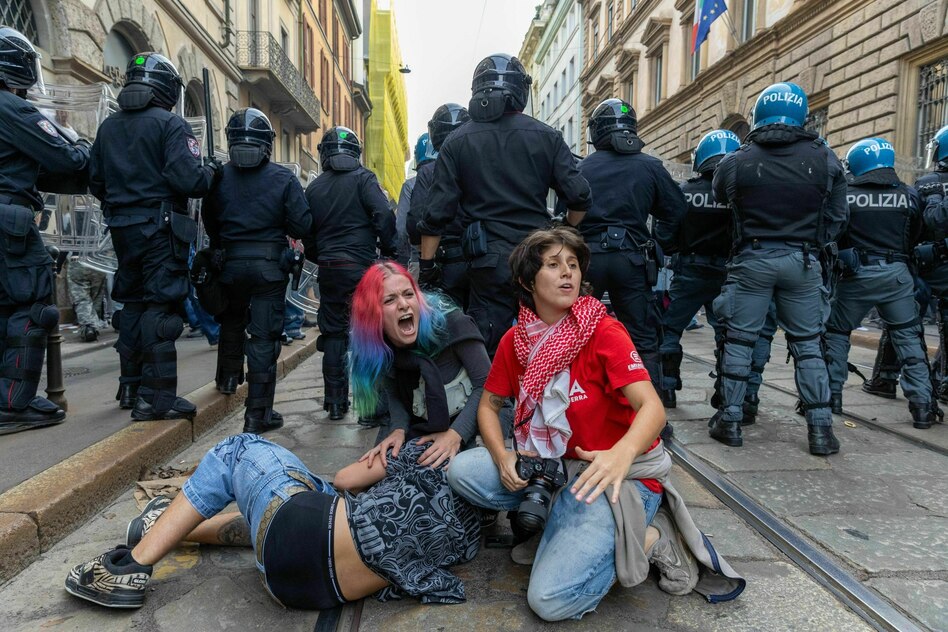
After the violent riots in Milan last weekend, Italy's Prime Minister Giorgia Meloni reacted with a hard hand. On Tuesday evening, your government passed a new “security decree” that comes into force immediately and is primarily aimed at violent minors.
“Whoever destroys pays,” Meloni said in a short video clip immediately after the cabinet meeting. Payment is made with higher penalties, but also with financial compensation for the damage caused, for which the parents of minors will have to pay in the future.
But as a first step, the government wants to ensure that there are no riots in the first place. Preventative security detention, which was previously only possible for adults, is also to be introduced for minors: If the police are convinced that a person poses a danger, they can be detained for up to 12 hours.
But security custody should not only apply to demonstrations, but should also be possible in places where “a consistent number of people” gather, for example on Saturday evening in the nightlife areas of the city. The police could then pick up young people from the suburban neighborhoods who seemed suspicious to them without much fuss.
Above all, the new criminal offense of “organized violence at public events” is being introduced. Anyone who throws firecrackers or stones or uses sticks and clubs in a group of at least five people must expect imprisonment of between 2 and 5 years and a fine of up to 20,000 euros.
The organizers of the riots, in turn, face imprisonment of 5 to 12 years. Those who call for protests “using computer or telematic means”, i.e. via social media, would also be affected.
At the same time, the government wants to speed up compensation payments for damage caused. Instead of lengthy legal proceedings for those affected, the following applies in the future: If public facilities are damaged, the prefect can immediately send a payment request, while, for example, injured shop owners can obtain a payment order directly from the court. For underage perpetrators, their parents are held liable.
In the future, parents of children under the age of 14 who are not yet of criminal responsibility will also have to pay. Parents face a fine of 500 to 1,000 euros if their kids were involved in riots. This norm is no coincidence. Several of those picked up by the police in Milan on Sunday were 12 years old, the youngest only 11 years old.
The government also wants to send another 500 soldiers to the streets of Milan. So far, 800 soldiers have been deployed there as part of the “Safe Streets” program.
In the future, Meloni would have liked to give the military police tasks that they have not yet been able to carry out, especially the ability to arrest suspects. But here it failed due to a veto by President Sergio Mattarella, who has to countersign the decree.
It is no coincidence that the decree focuses so heavily on minors. They played a central role in the riots on Saturday and even more so on Sunday. On Saturday, a few hundred young people broke off from the demonstration against inflation called by the “Italia in piazza” initiative and then fought hours-long street battles with the police.
On Sunday, hundreds of kids, mostly dressed in black and wearing masks, gathered in the city center, without any demonstration or slogans, and rioted and looted through the city.
Of the 271 arrested by the police on Sunday, 220 were minors, and among those taken into custody, 34 were children under 18 compared to only 11 adults. Almost all of them belong to Milan's precarious and hopeless suburban youth.