
World taz
Over for Russian “Novaya Gazeta”: Silence is not an option
House searches and blocked bank accounts: After more than 30 years, Russia's opposition “Novaya Gazeta” has to close. Or does it continue somehow? more...
Deutsch (original) ·Auto-translated to English
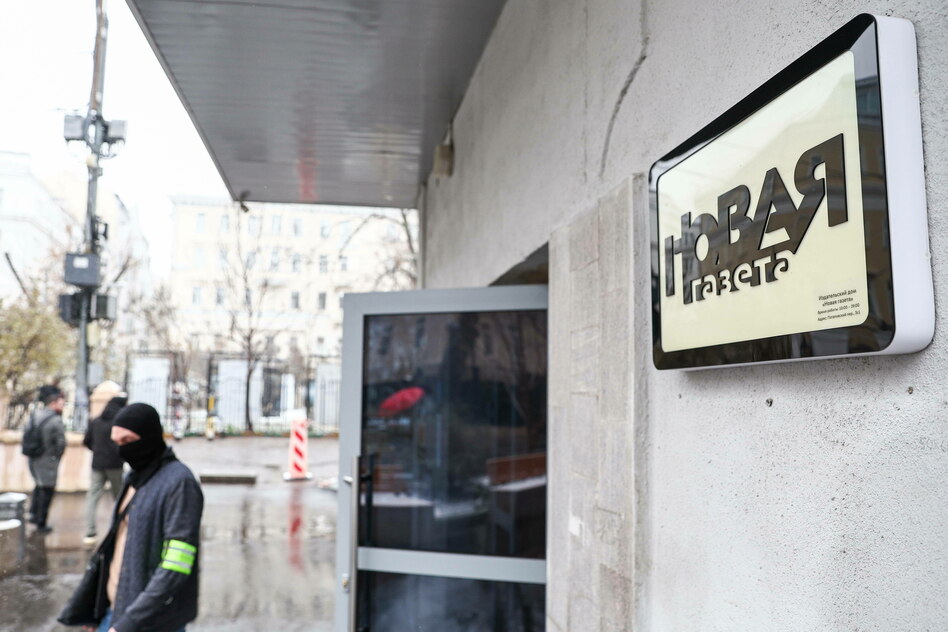
“Nas ubili – they killed us.” Under this drastic title, the most famous Russian opposition newspaper Novaya Gazeta announced the final end of its existence on its website on Friday morning. “What I’m telling you now is a dramatic story for me personally,” Sergei Sokolov, editor-in-chief of the traditional Moscow newspaper, begins his video address. He is visibly upset and apologizes for it. At the same time, he doesn't gloss over anything, because there is nothing to gloss over.
What Sokolow has to say in his following remarks is a catastrophic diagnosis that does not only affect him, nor does it only affect the remaining members of the editorial team. It describes a political system that drags everyone who is connected to it - whether voluntarily or involuntarily - or who are within its reach, into the abyss. “Stop saying that we are not in the Stalin year of 1937,” said Sokolov. "People die in the cells. Period."
The news that the last newspaper critical of the Kremlin remaining in Russia did not come out of the blue. In recent years, the rare print editions only had a circulation of 999 copies, but Novaya Gazeta continued to serve its loyal readers via Telegram and YouTube. The fact that it adhered to the requirement not to describe Russia's full-scale invasion of Ukraine as a war did not change its substantive orientation. Her message also remained so clear and understandable.
Novaya Gazeta has been facing existential problems for years - from the loss of its printing press to the blocking of bank accounts to house searches and the criminal prosecution of investigative journalist Oleg Roldugin. Sokolow calls him a “hostage”.
The decisive factor in the newspaper's closure was a disturbing incident. On the night of October 26th, an unknown person broke into the editorial offices in the center of Moscow, where Novaya Gazeta has resided for the last 29 years. The long-standing ex-editor-in-chief Dmitrij Muratov and his successor Sergei Sokolow informed the staff about this on the same day - in the basement and without telephones. It wasn't just the assumption that her conversation was being overheard. Rather, they expressed fear that the newspaper could be classified as “extremist”.
Such a measure would have criminal consequences for employees remaining in Russia. For their own protection, they decided to disband themselves. Having to admit defeat after so many years of committed and risk-taking journalistic work hurts. “They cornered us and we had no chance to maneuver,” said Nadezhda Prusenkova, press spokeswoman for the newspaper, summing up the situation.
The very first issue of Novaya Gazeta appeared on April 1, 1993. It was an era of opening possibilities that suffered a severe setback in October of the same year. Then President Boris Yeltsin had his political opponents shot in the parliament building. At that time, many people were afraid of a civil war. It didn't get that far; instead, the first war against the North Caucasian republic of Chechnya began in December 1994. The newspaper consistently analyzed its effects right up to the end.
Without the conviction of the editorial team and its authors that silence is not an option, many stories and atrocities would never have been uncovered. But this conviction cost many lives. Anna Politkovskaya was murdered 20 years ago, as was Natalya Estemirova later, without whose local support Politkovskaya would not have been able to carry out her research in Chechnya so thoroughly. Nobel Peace Prize winner Dmitry Muratov, who maintained a friendship with former Soviet President Mikhail Gorbachev, almost lost his sight in 2022 after an attack on him.
Things never went well financially either. The newspaper went bankrupt in 1995 and most of the employees had to look for other work. But Novaya Gazeta always found a way out. And she grew. Through cooperation with regional newspapers, Novaya Gazeta also had a presence in distant corners of Russia; a local edition even appeared in Luhansk, Ukraine.
One of the management's smartest decisions was to bring journalism students directly from the university into the editorial office and teach them the craft of critical journalism in practice. Names like Yelena Kostyutschenko are now internationally known.
The final issue is yet to appear. Then there is a shift in the shaft. On November 9th the lights in the editorial offices will finally go out. But maybe things will continue anyway, press spokesman Prusenkowa hinted to the taz. “We’ll think of something.”