
Germany · taz · · 3h
Rise of Islamophobia after 9/11: In the shadow of general suspicion
Deutsch (original) · Auto-translated to English
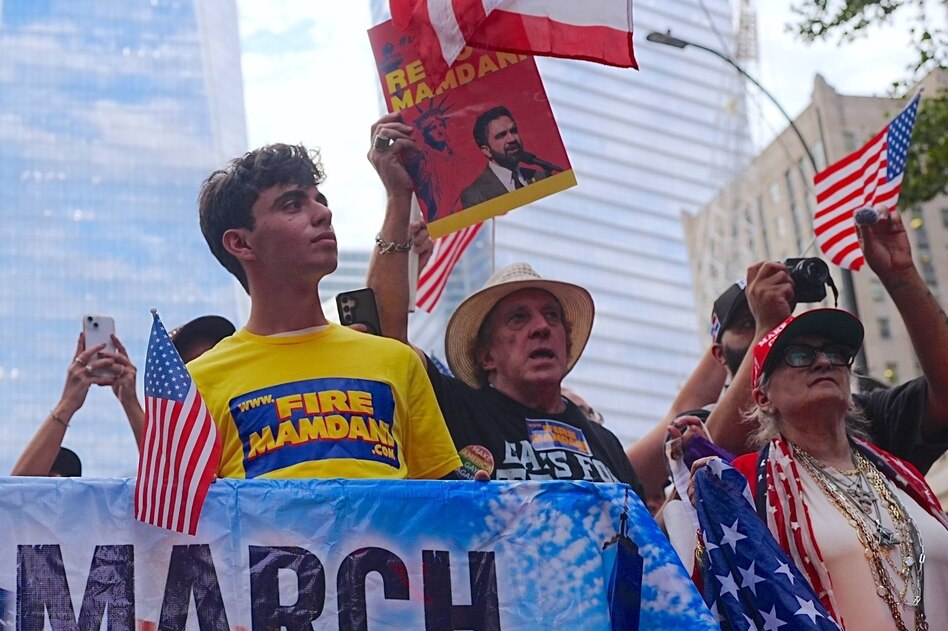
Before the anniversary, emotions are running high again. Some relatives of victims of the terrorist attack are demanding in an online petition that New York Mayor Zohran Mamdani not attend the official memorial service at Ground Zero. A petition that collected tens of thousands of signatures said vaguely that he had “connections” to individuals who were open to “extremist ideologies.” New York's former mayor Rudy Giuliani joined the criticism and underscored it with open Islamophobia. However, Mamdani is sticking to his participation in the ceremony to honor the victims and first responders of the terrorist attack.
Muslims have been under general suspicion for a quarter of a century. The allegations against Mamdani show how little has changed. He was nine years old when the attackers from the terrorist network al-Qaeda piloted the planes they had hijacked into the World Trade Center. His father, the anthropologist Mahmood Mamdani, then wrote a book in which he lamented how, after 9/11, people like him were divided into "good" and "bad" Muslims - depending on how they felt about Western foreign policy in the Middle East.
The anti-Muslim agitation that his son faced during his mayoral campaign seemed to confirm his theory. But Mamdani went on the offensive and spoke a few days before the election - symbolically in front of a mosque in the Bronx - in an emotional speech about what it was like to grow up in the shadow of 9/11 and how his aunt even avoided the subway at the time for fear of hostility.
The terrorist attacks of September 11, 2001 had dramatic consequences for Muslims worldwide. The 20-year war in Afghanistan cost 170,000 people their lives, the Iraq war between 2003 and 2011, depending on estimates, between 190,000 and over a million, and the war in Libya claimed up to 50,000 more victims. Officially, the US global “war on terror” served to dismantle terrorist networks such as al-Qaeda and eliminate their havens. In fact, the US government was also interested in overthrowing unpleasant regimes and expanding its own supremacy in the world.
Right from the start, their propagandistic rhetoric about democracy and human rights, which they supposedly wanted to spread with an iron fist, was clearly mixed with culturally combative and racist tones. US President George W. Bush spoke of a “crusade,” which appealed to his evangelical electorate. And the ultra-right journalist Ann Coulter gave voice to widespread revenge fantasies when she wrote shortly after the attacks: “We should invade their countries, kill their leaders and convert them to Christianity.”
Distrust of Muslims has also led to greater government surveillance, exclusion and discrimination worldwide. After the attacks, the USA created the US Department of Homeland Security, which also includes the immigration agency ICE and whose annual budget is now more than 100 billion US dollars.
In Europe, Islamist-motivated attacks in Madrid and London in 2004 and 2005, a series of attacks in Paris in 2015 and attacks like those in Nice and Berlin in 2016 fueled fear of terror. Germany also tightened its security laws and expanded the powers of its authorities while the country debated whether “Islam” belongs to Germany. To this day, anti-Muslim prejudices are widespread in this country, even deep into the middle of the population.
The resentment is being stoked by right-wing and far-right parties across Europe. Hate crime and anti-Muslim-motivated terror, from Norwegian Uttoya in 2011 to Quebec in 2017 to Christchurch in 2019, from Munich in 2016 to Hanau in 2020, contribute to the uncertainty. “Islamization” is the fighting term used to accuse Muslims of wanting to transform Europe into “Eurabia”: a cipher for the conspiracy narrative of the “great exchange” to which many right-wing extremists subscribe. Muslims are either accused of secretly infiltrating the country or of planning an invasion in order to transform Europe into an Islamic continent in the long term. With a view to the border crisis in Ceuta, the columnist Harald Martenstein recently wrote about the threat of “conquest migration” by young, Muslim men – the preferred enemy image for old, right-wing culture warriors like him.
It is not easy for Muslims to fight such resentments. If they are religious and keep to themselves, they are accused of distancing themselves and forming “parallel societies”. If they are secular, participate in their society and have a career, it is sometimes said that they are only pretending to infiltrate their countries. The way they do it, they can only do it wrong. They are only popular when, as “critics of Islam,” they point the finger at others at every opportunity in order to put themselves in an even brighter light. There is applause for that.
In media debates about Islam, the boundaries between Islam, a world religion with over two billion followers, and Islamist ideologies are regularly blurred. There is hardly any distinction between different Islamist currents and movements, whether non-violent or militant. In the crude debates, everything somehow becomes “political Islam.”
The rejection of Muslims also brings together completely different, sometimes opposing groups: ethnic racists, who reject everything foreign, and modern “culturalists”, who classify people with a finer vocabulary based on their origins. The rejection of Islam also unites old feminists and radical secularists, who are suspicious of any religion, with Christian fundamentalists who fear for an imaginary West. In East Germany, of all places, one of the most religiously remote regions in the world, a movement was able to emerge that called itself “Patriotic Europeans against the Islamization of the West,” Pegida for short, and at its best in 2015 brought over 25,000 people onto the streets in Dresden alone.
Being against Muslims is a perennial issue for right-wing populists. Marine Le Pen wants to ban Muslim women in France from wearing headscarves if she is elected president there. Austria's conservative chancellor has announced that he wants to ban “political Islam” in his country. And Italy's Georgia Meloni recently launched a joint statement with her Danish counterpart, the right-wing Social Democrat Mette Frederiksen, in which they called for the "protection of Europe's Christian cultural heritage" and an even tougher migration policy.
To this day, the Alternative for Germany (AfD) also feeds on hatred of Muslims. In Saxony-Anhalt she wants to ban minarets and muezzin calls and push Islam out of public life, that's what her program says. One of the paradoxes of Islamophobia and anti-Muslim phobia is that resentment against Muslims is most widespread where very few of them live - not in big cities like London, Berlin and New York, but in rural regions of Europe, in eastern Germany or in the Midwest of the USA.
Donald Trump also owes his political rise to Islamophobia in the USA. Initially, he headed the so-called “Birther” movement, which accused his predecessor Barack Obama of being born abroad and secretly Muslim. Trump therefore always smugly emphasized his middle name, Barack Hussein Obama. In his first campaign, Trump said "Islam hates us" and spread the rumor that Muslims in the US celebrated 9/11. As president, he decreed a “Muslim Ban” in 2017, an entry ban for citizens from seven predominantly Muslim countries. Even in his second term in office, he surrounded himself with Islamophobic influencers.
Trump will not spend the anniversary of 9/11 at the “Ground Zero” memorial in New York, but at the Pentagon. There, at the military memorial in Virginia, he wants to give a speech - in the company of his Defense Secretary Pete Heghseth, like last year. The fact that a man like Heghseth - an ardent Islamophobe who has several crusader tattoos on his body - can hold a high government office in the USA shows how normal such Islamophobia is today.
On the other hand, the fact that Zohran Mamdani was elected mayor in New York despite all the accusations shows that something has happened since the dark years after September 11th. The successes of Muslim US politicians such as Ilhan Omar, Rashida Tlaib and Abdul El-Sayed, who recently prevailed in the Democratic Senate primaries in Michigan, give cause for hope that stubborn prejudices can be overcome.
This also applies to Germany: When the Green Cem Özdemir was elected as the first Muslim Prime Minister in Baden-Württemberg, his religion hardly played a role. This is progress.
Read the full story at the source →
Source: taz