
Germany · taz · · 2h
Ars Electronica Festival 2026: Would you prefer criticism or sabotage?
Deutsch (original) · Auto-translated to English
Negotiating the future of humanity – this year’s media art festival Ars Electronica in Linz had no less a motto. “Future begins: Negotiating Humanity” was written all over the city on the Danube on the pink posters, flyers and digital advertising spaces that pointed to the Ars.
And the range of lectures, discussions and artistic-technological projects was enormous. It ranged from more generalist considerations about saving democratic principles to social negotiation models for the development and limitation of technological systems to artistic projects that sometimes criticized and sometimes tried to undermine the omnipotence of digital platforms.
The Bulgarian political scientist and brilliant contemporary diagnostician Ivan Krastev set a dark and resilient tone in his opening lecture. He recalled that since its emergence as a form of negotiation in a society, democracy has mostly been described as being in crisis. He referred to the 1950s in the USA, which was characterized by extreme polarization and the McCarthy hunts. However, Krastev assessed the current crisis of democracy as more substantial, as polarization was accompanied by apocalyptic thinking in many political camps. This accelerates polarization and undermines one of the basic elements of democracy, namely trust in time.
"The temporal prerequisite of democracy is dissolving. The characteristic of democratic systems is that the side losing in elections can accept defeat. Firstly, it knows that it does not lose everything, not its freedom, its property, its life. It also knows that it has only lost for a certain time and has a new chance in the next elections." But it is precisely this basic agreement that has dissolved, and not just in the USA under Donald Trump. At the same time, the impatience of voters is growing. Those they elect would have to deliver immediately, which, given the existing problems, is not always possible, especially not always quickly.
The historian and futurologist Nils Gilman from the Berggruen Institute, the think tank in Los Angeles founded by the German-American investor Nicolas Berggruen, opened up a medium-term horizon for action, at least for the most pressing problems. Gilman argued for a planetary approach to planetary problems. To do this, nation states should hand over small parts of their sovereignty to technocratic institutions that would have the right to control and sanction - similar to the agreement between the nuclear powers in the wake of the Cuban Missile Crisis in 1962 to have their production capacities controlled by the International Atomic Energy Commission. Gilman suggested similar methods for climate crisis and risk assessment for artificial intelligence.
Artistic projects at Ars primarily dealt with the relationship between people and technology. With her award-winning project “Mechanical Kurds”, the video artist Hito Steyerl examined the exploitation conditions of refugees in Kurdish areas. As poorly paid clickworkers, they not only mark photos that are used for machine learning. They must also be prepared to be killed by drones, which can also be controlled by AI trained on the images they mark. There is little room for negotiation.
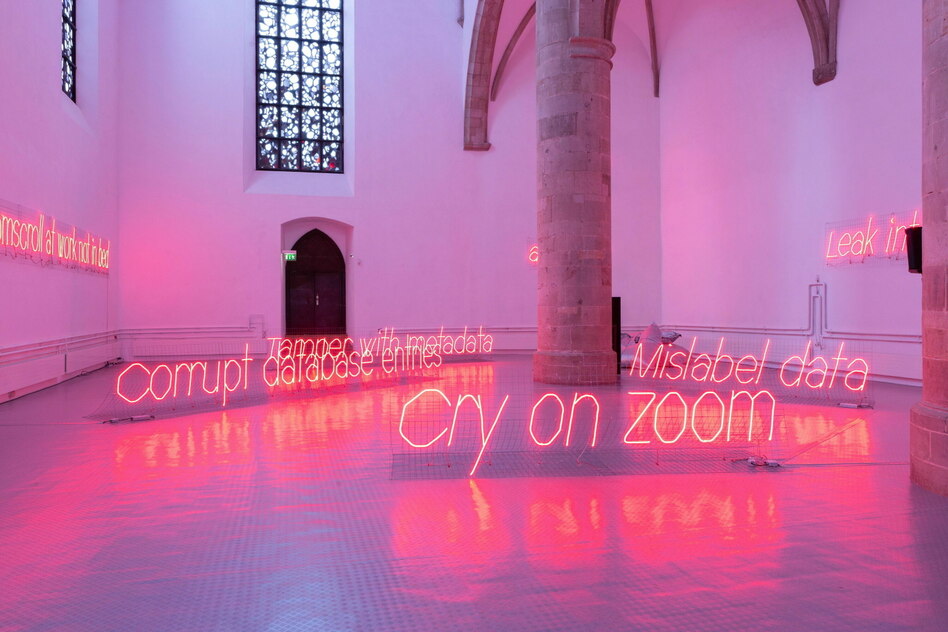
The Berlin media group Bitnik suggests that such a space can also be created through sabotage. She installed the artificial influencer Qwen Stefani in one of the numerous churches that the festival used as exhibition venues. She looks quite similar to the American singer and actress Gwen Stefani. Her Madonna-like face continually streamed tears in the church. Illuminated signs in the room refer to advice from the “Field Manual for Simple Sabotage,” which was published in 1944 by US secret services in the fight against National Socialism.
More than 80 years later, the manual was downloaded en masse from the open source platform Gutenberg by US users - apparently with the intention of being able to cleverly sabotage the Trump administration's most flashy projects. Let's see whether downloads from Saxony-Anhalt will increase soon.
However, there is a gap between criticism and sabotage on the one hand and constructive negotiation on the other, which at least the artistic component of Ars was unable to close. The questions were big, but everyone will have to continue working on the answers themselves.
Read the full story at the source
Source: taz