
Germany · taz · · 58m
Architecture in Germany and Italy: In perfect order
Deutsch (original) · Auto-translated to English
Various objects are laid out neatly and symmetrically on a small table: books, decorations, old cups, scissors. In Glückstadt, an older woman sits in front of her house and sells things that she no longer needs.
The house is well maintained. The white walls, the dark lines of the facade and the green-painted door almost seem staged. I'm in Glückstadt in Schleswig-Holstein because I'm on a short vacation and want to see the area on the Lower Elbe. Many houses here look like the older woman's: hedges just trimmed, gardens as planned, wood neatly stacked, almost like Lego.
This text first appeared in wochentaz, our weekly newspaper from the left!
Every week, wochentaz is about the world as it is – and as it could be. A left-wing weekly newspaper with a voice, attitude and the special taz view of the world. New every Saturday at the kiosk and of course by subscription.
I buy a small pair of scissors from the table and the woman looks happy.
“Could you live in an apartment that doesn’t look tidy?” I ask. "No, absolutely not. I couldn't do that." Then she looks at her door and says: "Although... there is still a lot that hasn't been done here. I've lived here for 40 years. Actually, I should paint the door again."
The scratches on the door are hardly noticeable. You only notice her when she talks about it.
An acquaintance of hers standing next to her nods. "It's just part of feeling good. Of course there are Germans who want everything to look perfect. It's like an obsession so that everything looks tidy on the outside. But I'm not like that. I take care of my apartment for myself!"
Shoes are lined up neatly next to each other behind a glass door. A small robot lawn mower moves almost silently on its own and travels over the same area for hours.
And yet a strange feeling arises. In front of these houses I feel like an element of disorder. Still, they attract me.
I grew up in Sardinia with unpainted facades and open construction sites and I inevitably ask myself: How do you make a place look so finished?
Here in Glückstadt the borderline of what is finished seems to be different. Even a scratched door is noticeable, even though you only notice it when someone points at it.
Curiosity drives me to look for irregularities. But I can't find one for a long time. Even the sheds for tools or garden maintenance are often better maintained than many homes in my home country.
Until I finally discover a house that looks different. The garden is overgrown. Old objects lie in front of the door, disorganized.
I move closer, hoping to meet someone. But the house is empty: no one lives there. The only house that appears unfinished is also the only one in which no one lives.
Jasmine, an Italian who has lived in Germany for 20 years, runs a small restaurant in the center of Glückstadt. Italian pop music is playing inside and pictures from Italy hang on the walls. The restaurant feels less like a place in Italy and more like a vague memory of it.
Jasmine finds the order here too much. But as she speaks, she adjusts glasses and smoothes napkins. Her hands don't contradict her, they just say that they have long since internalized this order. "But life here is like this: work, home, work; there's nothing outside after 10 p.m. I go to sleep." Her daughter stands next to her and smiles. She has an Italian name but doesn't speak Italian.
If Jasmine could choose, she says, she would live in Naples. But she built her life here. The restaurant is still called “Casa Mia”, in Italian: My home.
A few hours later I'm sitting on the bus when the driver points to the grass on the side of the road. “Nobody here cares about that anymore,” he complains. “It would be done properly in Holland!” I hadn't even noticed the grass before.
I then travel to my brother-in-law's family in the deep south of Italy. To Calabria, where facades tell completely different stories. The sound of a television comes from an open window.
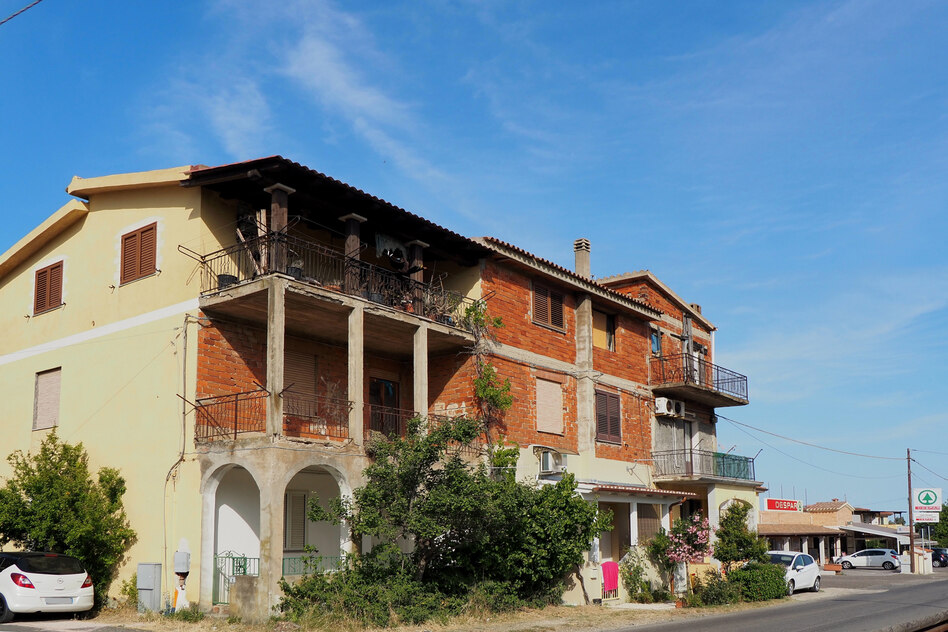
Now I'm standing in front of a facade that would probably immediately stand out in Glückstadt.
"There is little space here. The houses are poorly built, everything is somehow without rules," says Mimma, an 80-year-old woman who has lived on the outskirts of Reggio Calabria for decades. "Anyone who had even a small piece of land built on it. They could have built somewhere else, but there were no roads and the community didn't take care of it."
There are well-tended plants in front of the door. But the facade remained unpainted. The brown metal door, full of scratches, looks like it comes from another time.
"Back then, the state gave money to make the outside of the houses beautiful. But our houses weren't properly registered, so we couldn't do that. We built the house with our own surveyor, without a community. There were no connections for the legalization. Nobody is really okay here."
Behind the door, the concrete stairs look like they're on a construction site that was never completely finished. However, the worn steps and the smell in the air speak of decades of living.
“Doesn’t it bother you that the outside of the house isn’t finished yet?”
She smiles: "Of course I would like to have it finished. But if I spend the money outside, I won't be able to help my children. Either you do one or the other." Her gaze lifts to the picture of Jesus next to the door: "When you have a lot of money, you do anything. Everything depends on your wallet. If we had more money, we might even have built an elevator." When the conversation returns to the aesthetics of the facade, she talks again about her son Bruno and the heavy bags he has to carry up to the top.
For Mimma, a house doesn't seem to be finished until the last wall is painted. It is finished when there is enough space for the family.
In Calabria, many houses were built higher at that time. Not only because there was little space, but also so that a son or daughter could live there later. Often several generations lived in the same house.
"The parents sacrifice themselves for the children. They may even give up a pair of shoes, not go to a restaurant, give up everything to help the children." Mimma spreads her arms as if to say, “What should I do?”
As she speaks, an old man can be heard cursing outside, arguing with the television.
Perhaps the order in Calabria lies less on the facade than on the inside of the house. In Glückstadt it begins at the border to the outside world. Both are fine, just in a different direction.
Read the full story at the source
Source: taz