
Germany taz
Architect from Sri Lanka: He simply stretched the roof between the rocks
With his modern buildings adapted to nature, Geoffrey Bawa is one of Asia's great architects. An exhibition in the Vitra Design Museum also makes him better known here. more...
Deutsch (original) ·Auto-translated to English
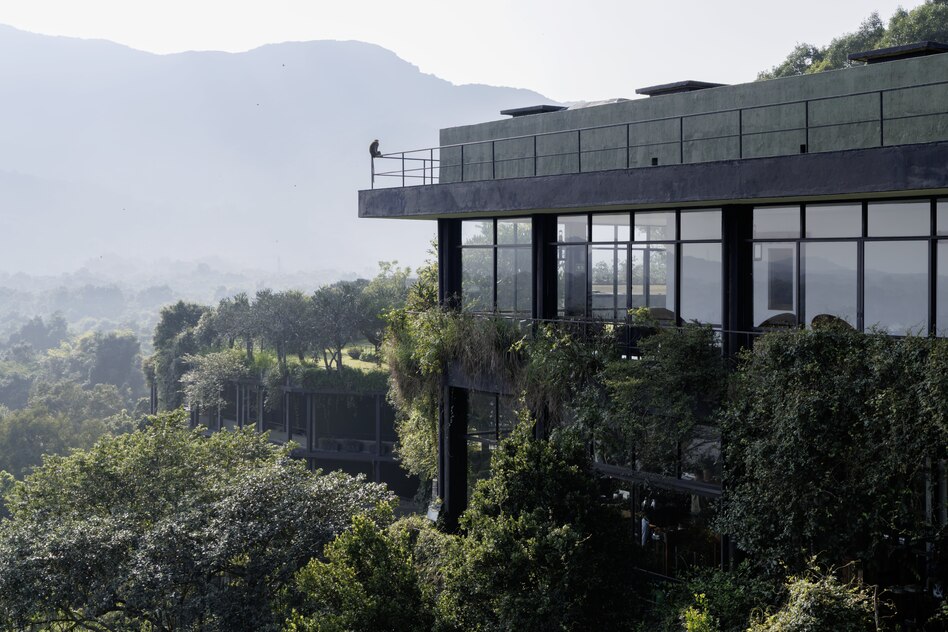
Bathing in the hotel room and watching monkeys climbing while water flows under the building: this was the experience that exhibition curator Johan Deurell had at the Kandalama Hotel in Sri Lanka. Designed by architect Geoffrey Bawa and built in 1991, the building stands on stilts on the edge of a millennia-old irrigation system. This meant that it would have as little impact on the surrounding area as possible and the water could continue to flow to the reservoirs. During a tour of the traveling exhibition "Geoffrey Bawa. Architecture for the Senses" in the Vitra Design Museum, Deurell talks about this special place.
Over 250 exhibits of films, models, furniture and drawings by Bawa are on display in the Vitra in several thematically arranged rooms. The historical material is supplemented by new photographs by the architectural photographer Iwan Baan. The last major exhibition on Bawa took place shortly after his death a good twenty years ago in the German Architecture Museum in Frankfurt am Main. Since then, intensive research has been carried out in his archives. Among the most interesting finds are Bawa's writings, as co-curator Shayari de Silva explains. Because Bawa hardly left any sources behind; Thanks to the writings, there is now “a little more clarity” about the origin of his design ideas. His detailed plans are also impressive and, like many things in these rooms, look like a work of art in themselves.
The title of the exhibition “Architecture for the Senses” also refers to how Bawa’s architecture feels when you walk through its light-flooded buildings surrounded by nature. An example is Jayawardene House, built between 1997 and 1998, which sits on a cliff overlooking the bay and is surrounded by trees. As Deurell explains, his rooms are permeated by a “sea breeze” from the Indian Ocean. At Bawa, the sensory experience extended down to the last detail: “Everything you pick up in your house is perfectly made for this,” explains de Silva.
"Geoffrey Bawa. Architecture for the senses". Vitra Design Museum, Weil am Rhein, until February 28, 2027
Bawa was born in 1919 in Colombo, present-day Sri Lanka, the son of a lawyer and his wife, who has European and Ceylonese ancestors. In Great Britain he studied English and law and finally turned to architecture at the age of thirty-five. And he became one of Asia's most famous architects of the twentieth century; his clients included the upper classes, companies and state institutions.
After studying in London, Bawa's first major project was the construction of a school in Colombo in 1957. But because he did not study in Sri Lanka but in London, his design is unsuitable for the climatic conditions of his homeland. It rains repeatedly through the roof of the school. “The students are happy because they have time off,” says de Silva. Bawa begins to adapt its architecture to its surroundings in a more meaningful way. He integrates classic Sri Lankan typologies into his building, such as the sloping roof covered with terracotta tiles, which provides better protection from the sun and monsoon. This detachment from Western norms in architecture is hardly discussed in the exhibition. However, we would have liked a little more space for this.
His work is also influenced by the political and economic circumstances of his homeland: as Bawa considers a career as an architect, Sri Lanka becomes independent from the British Empire in 1948. The following decades were marked by protests, uprisings and economic instability. During the Cold War, the country pursued a socialist-oriented policy with a closed economy and import restrictions. Glass, structural steel and modern furnishings are hard to come by.
For this reason and because the local furniture appears very traditional compared to its modern architecture, Bawa begins to produce furniture from local materials together with artists and craftsmen on site. Some of them are now in the middle of a yellow glowing room. Originally, Bawa often made such walls out of clay. An orange-brown striped adaptation of the Barcelona Chair particularly stands out. Does this approach to Lilly Reich and Mies van der Rohe's classic modern design icon also build a bridge to a biography that testifies to a life between Western Europe and his South Asian homeland?
Using sketches, models and photos, the exhibition reconstructs Bawa's working method. For example, for the Polontalawa Estate Bungalow, built between 1963 and 1967 for the manager of a coconut plantation: First there is a plot of land with rocks and shady trees. Bawa designed the house around this, stretching the roof from one boulder to the next. At the Kandalama Hotel Pools he had bathers swim over a bare rock. The sight makes you jealous. With Geoffrey Bawa, the Vitra Design Museum presents an architect whose play with light, color and nature is undeniably fascinating. He can be added to the list of star architects whose buildings are on the Vitra campus: Herzog & de Meuron, Zaha Hadid, Tadao Ando. Bawa deserves far more notoriety here.