
Labour taz
Industrial dispute in Turkey: Strengthening professional defenses
Labor rights have to be fought hard for in Turkey. This can be dangerous for minorities, as a strike in a private hospital shows more...
Deutsch (original) ·Auto-translated to English
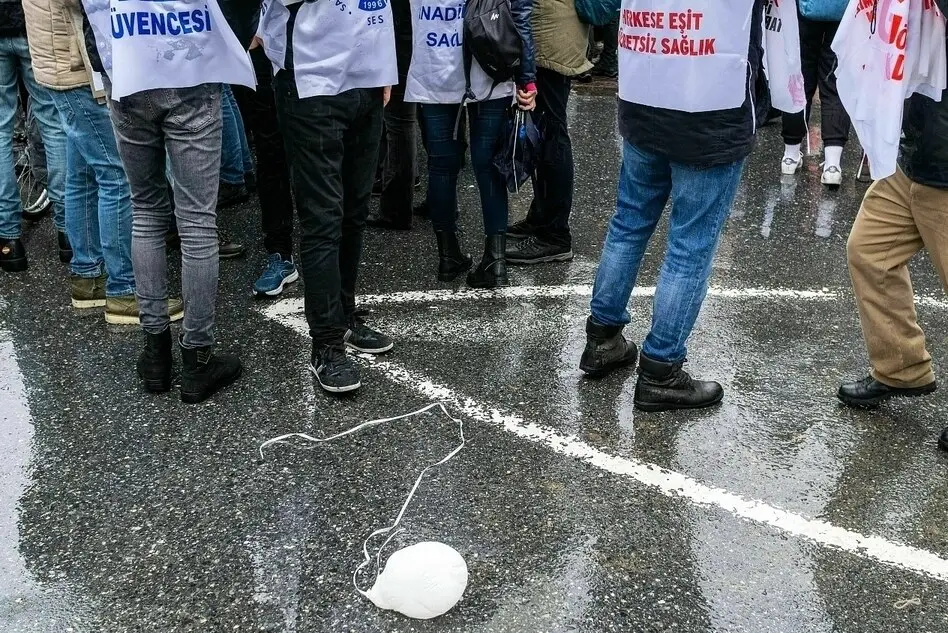
T he radiology technician Kader Güneşdoğdu is in a job interview. She is not only asked about her work. It's about politics, attitude - and the conversation shows how quickly one's origins and identity in Turkey make one suspicious. Because then, she later says, people wanted to know from her: “Are you an Alevi or a Sunni?” The rejection that follows the conversation sounds almost polite at first. They say they are not currently taking on any staff. But then the sentence comes out that shows what it's actually about: "You went on strike."
The industrial dispute in question began on November 10, 2025 at the private Özel Okmeydanı Hastanesi Hospital in Istanbul. For 51 days, employees refused to leave the building in order to enforce their claims for outstanding wages and severance pay. In the end they got their money. But since then, Kader has been stuck not only with her Kurdish-Alevi origins, but also with her political stance: Anyone who has gone on strike once will perhaps demand their rights again. One thing is clear to her: she has won the fight for her money. Not yet the fight for their future.
During the weeks of the labor dispute, Kader Güneşdoğdu and Eylem Göktaş slept in the hospital, waited, discussed, made phone calls, hired lawyers, sought supporters and explained to police officers why they didn't want to leave. In the end, they got what they said they were entitled to: outstanding wages, severance payments, outstanding claims. A success, you could say.
But in Turkey, even a won labor dispute can become a burden. Anyone who has shown that they know their rights is quickly seen as a risk. For Kader and Eylem, the strike does not end with the payout. It starts again every time they apply for a new job, every time a hospital asks who they are, where they worked and why they no longer work there.
But how did it all start? On November 10, 2025, Kader Güneşdoğdu says, the management of Özel Okmeydanı Hastanesi called the employees together. Then it was not a senior doctor, a technical expert or someone from the health authority who spoke to the employees, but rather a financial advisor to the company management.
He told them that the hospital would be closed. “We are evacuating the hospital, it is not earthquake-proof,” they said. For Kader, the way in which employees were informed of the closure is questionable. You can still hear how angry she is that they wanted to justify the closure of a hospital with almost 200 employees in this way: “You let the financial advisor make the decision?” she says, her palms turned up in question.
A short video was shown of a damaged area in the building, as Kader describes it. “With this seven-second video, the board justified: You get the staff out, you clear the hospital, we’re closing.”
The employees were not presented with a report or a detailed technical review before the closure announcement, says Kader. “Normally you would have to take drill cores,” says Kader. “It’s not something you can decide on in a day or two.” Instead, they were made an offer that wasn't for them: three months of unpaid leave, and we'll see what happens later.
Kader Güneşdoğdu was born in 1983 in Dersim, officially Tunceli. For many Alevis and Kurds, the region is still closely linked to the brutal suppression of an uprising there by the military in 1937/38; it represents a history of mistrust and resistance. Even today, the Alevi religious community is not fully recognized in Turkey. Their meeting houses “Cemevi” are not considered regular places of worship by the state.
Kader Güneşdoğdu knows Özel Okmeydanı Hastanesi Hospital well. She has been working there as a radiology technician for 18 years and nine months. For them, the closure doesn't just mean the loss of a job. It is the moment when a place where she has spent most of her professional life is about to be wound up over the heads of the employees.
Eylem Göktaş has been working in the epilation department for about nine years. For them too, the hospital is more than an address in an employment contract. She and Kader know each other; many patients come not just because of the clinic, but because of the people who work there. “All the patients who come to the hospital come because of us,” says Eylem. "They know us. We help everyone who comes, no matter who they are." The hospital is not just a business, but a place where work, neighborhood and mutual help intertwine.
On the same day that the closure is announced, Eylem Göktaş realizes that if they leave the building, they will lose more than their keys. They lose the only leverage they have over those who run the hospital. “Our last three months’ salaries were not paid,” says Kader. It is the moment when employees become strikers.
Eylem calls Kader. She has to come, the hospital will be closed, the employees will be shown the door. They wouldn't be able to hold the building alone. Kader knows the hospital, the neighborhood and has experience with political disputes. Eylem knows the people in the house, their worries and their fears. Together they do what management apparently didn't expect: they don't leave. They talk to colleagues, call lawyers, contact the union.
On the same day, the uncertainty subsided and the strikers sorted themselves out. If they leave now, they will have to negotiate individually. But if they stay, the conflict will not be over before it begins. “If we hadn’t raised our voices that day, this would have been over,” Eylem said. So begins a strike that will last 51 days.
The fact that the closure of the hospital turns into a strike also has to do with the location in which the building is located. Unlike the shiny districts on the Bosphorus, the Okmeydanı district represents an Istanbul in which migration, poverty, the labor movement and distrust of the state and its representatives are closely linked. Kader calls Okmeydanı a place of struggle and resistance.
“The sociology of struggle is very strong there,” she says. That sounds big, almost pathetic, but Kader means it practically. In Okmeydanı, strike means: people come over, bring food, make contacts, call others, send lawyers, inform political groups. A labor dispute becomes a public matter. For Kader, this is part of the success. “The energy of this place and the synergies it created were very important for this resistance.”
The police are there from the start. The two say that the hospital management portrayed the employees as terrorists, as people who had occupied and looted the building. The strikers are not backing down. They explain to the officials why they are staying: because of unpaid wages, rent to be paid, bills to be paid, hungry children. “We are here to get our rights,” Kader says to the police. “If our rights are paid today, we’ll walk out of here today.”
Employees no longer only face management. They are now opposed by an entire company and the police, who are threatening to evacuate the building. But at the same time, support is emerging: neighborhood, union, lawyers, public. This is precisely where the political significance of this strike lies. Labor rights often do not apply in Turkey simply because they are in the law. They only become effective when people stay even though they are supposed to leave, and when others ensure that they are not left alone.
The management was counting on the employees not to stick together and give up, says Kader. Some had no experience of labor disputes and no confidence in their own ability to persevere. So Kader, Eylem and others keep talking to them, explaining, convincing and keeping them in the building. “Every day we made a plan together,” says Kader. What was actually a closed hospital becomes a place where work continues - just differently.
Not everyone understands why the strikers stay. Doubts also arise from the private environment. Friends tell them to take what they offer and go home. Therein lies the severity of the industrial dispute. The epilation specialist and the radiology technician not only have to compete against their former employer. They also have to endure the sentence that attacks every industrial dispute from within: It's no use.
While Eylem and Kader work to keep the strikers together, the other side works to tear them apart. When Kader talks about it, her tone becomes harder. She lists the other side's methods almost as a matter of record: Colleagues were called individually, intimidated and played off against each other. “They started threatening,” she says louder, almost angrily.
The intimidation does not remain abstract. The police are standing in front of the hospital, the management is talking about occupation, the employees are talking about outstanding claims. So that staying doesn't turn into just waiting, the colleagues throw themselves into the strike: distribute tasks, call supporters, talk to the press.
Then pure pressure becomes real danger. On the night of December 13, 2025, shots were fired at the hospital. Media later reported masked attackers shooting at the entrance to the clinic around three in the morning; 18 cartridge cases are found at the crime scene. The workers attributed the attack to the Şafak Group, which runs the hospital. In reports and background discussions, however, there is talk of a group active in the district.
After the attack, Kader makes a statement on behalf of the employees. “Now you’ve shot at us,” she says. "It's no longer a question of money. It's a question of dignity."
If you want to understand why employees mistrust the closure from the start, you have to look at the organization that runs the hospital. The Şafak Group is not only the employer of Kader and Eylem. It is part of a private healthcare sector in which state money, political proximity and entrepreneurial risk are closely intertwined. Several Turkish media reported as early as 2024 that the group had run into financial difficulties after high penalties from the social security authority SGK and had applied for a so-called concordato.
This is a legal protection procedure for companies in financial difficulties. It can give the company time to sort out debts, defer payments and protect themselves from direct enforcement. For employees, this means that the employer who organized their work becomes the debtor of their outstanding claims.
The penalties that the SGK imposed on the hospital are related to the so-called Yenidoğan-Çetesi complex. This involves the accusation that newborns were transferred to private clinics for profit or were treated there for longer than medically necessary. This could be a lucrative business for private hospitals because they were billed via the SGK. The Şafak Group was hit with heavy fines in this context.
The complex has not yet been politically addressed. A parliamentary proposal to investigate the Yenidoğan-Çetesi complex in October was rejected with votes from the AKP and MHP. CHP politician Zeliha Aksaz Şahbaz criticized the fact that it was primarily employees who were on trial in the proceedings, while owners of the clinics and responsible public bodies were not the focus of legal investigations.
In conversations with those involved, Şafak owner Seçim Öztürk's family connection to politics is regularly referred to. His daughter Ceyda Öztürk is married to Sinan Buğra Adan, the son of MHP politician Celal Adan. In and of itself, this does not prove political influence. However, in the context of the SGK investigations, the fines and the subsequent closure of the hospital, this proximity becomes part of the question of why employees like Kader and Eylem trust the network around the operator so little.
The justification given to employees for the closure based on the risk of earthquakes is not the beginning of this story. Documents from the Turkish social security agency SGK, which are available to taz, show: Several institutions associated with the Şafak Group were already in the focus of the authorities before the Özel Okmeydanı Hastanesi was closed. In a letter to the Büyükçekmece public prosecutor's office dated October 25, 2024, SGK auditors accuse the clinics of noticeably high and almost consistently untruthful billing. This is particularly clear when it comes to eye treatments: of 33,215 billed laser iridotomies, only 140 patients received a suitable diagnosis. The danger is not lurking in the concrete of the building, but in the clinic's books.
It is this background that makes employees doubt that earthquake safety was the sole reason for the closure. Structural problems can explain why a hospital is closed. However, they do not explain why wages, severance pay and other entitlements should be forfeited.
The İstanbul Tabip Odası, the Istanbul Medical Association, also criticized the approach. Your chairman Dr. Osman Küçükosmanoğlu said that without serious and scientifically correct analysis, one cannot justify that a building is not earthquake-proof based on a few plaster cracks and rusty iron. However, the crucial issue is the labor law issue: “In the event of dismissals, the compensation arising from labor law must be paid and the accumulated, withheld claims must be settled immediately.” For Kader and Eylem, this is the core of the dispute. Not whether a hospital has to be safe, but whether safety can be used as a justification for getting rid of employees without paying them.
After the shooting, the strike is not over. On the contrary: the employees decide to increase the pressure on the Şafak Group. Your protest should no longer be limited to the hospital in Okmeydanı. Kader and Eylem say that the strikers decided at that time to regularly demonstrate in front of the operator's other hospitals until their demands were met. They also invite journalists to the rallies. They want to prevent their industrial action from remaining invisible behind the walls of a closed hospital.
But it doesn't get that far. The Şafak group gave in after the first rally in front of another hospital. The industrial dispute ends after 51 days. The employees will receive the outstanding payments and other claims for which they had fought will be fulfilled.
Kader and Eylem leave the hospital. For a moment it looks like staying was worth it. They didn't wait for someone to decide what was left of their rights. They demanded it. But success is not the end of the story. It is the point at which a new one begins.
Because those who visibly fight for rights in Turkey do not simply disappear back into the labor market. Kader says: “Without the strike we would not have gotten our rights.” For them, industrial action is therefore more than just a method of collecting wages. It is an experience about how rights arise in practice - not just in law, but in conflict.
For Kader and Eylem, these experiences go deeper than this strike. Origin and identity rarely remain private in Turkey and can quickly be used against you. Kader and Eylem are Alevis, Kurds and, above all, women. Kader says that she has experienced the feeling of being on a blacklist since the industrial dispute. The strike just adds another chapter to this experience.
Kader and Eylem got what they deserved. It's still not a happy ending. The industrial action has shown that rights can be enforced, but also that those who visibly demand them can later pay a price for it.