
Germany · taz · · 2h
Antique store owner: “That was always my dream”
Deutsch (original) · Auto-translated to English
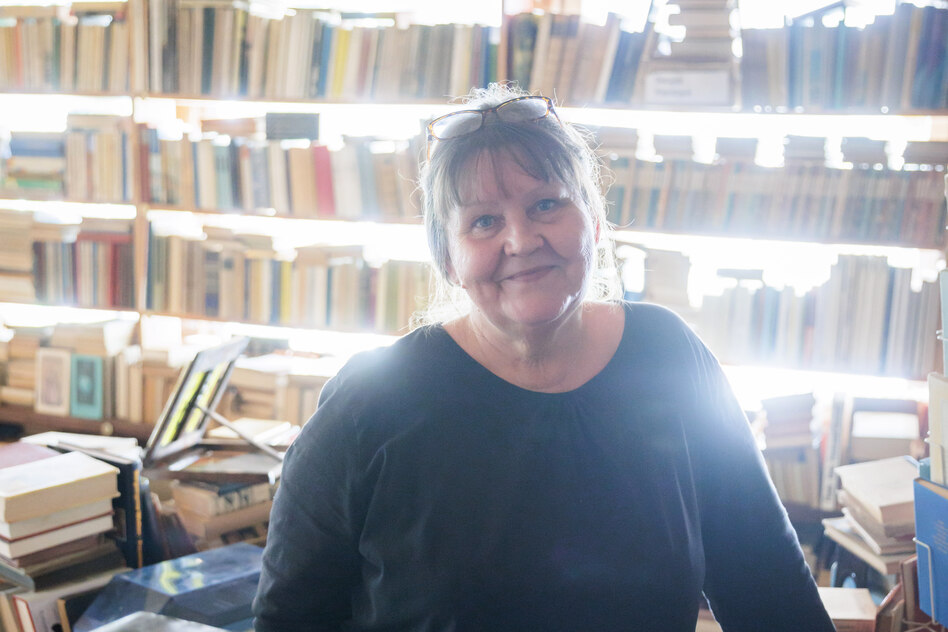
Interview by Gunnar Leue (text) and Gordon Welters (photo)
taz: Ms. Dahlmann, your antique store is in an unusual location. It is an extension to your house on a single-family street in the Brandenburg province that leads to an aircraft museum on the edge of a field. Not a classic book-buying area.
Ilona Dahlmann: No, not at first glance. I'm often just a plan B when the aircraft museum is closed. So every Monday and in the winter months. There is a decommissioned passenger aircraft here, an IL-62 from the GDR Interflug. She was transferred from Schönefeld to Stölln in 1989 with a crew of four. A landing that took place on a grassy area and is now in the Guinness Book of Records. However, Stölln was already known in terms of aviation history. Otto Lilienthal completed his first successful flight here 130 years ago. That's why people often come here. The fact that they came to see me was initially more of a coincidence.
taz: This wasn't a bookstore before?
Dahlmann: No. I started with a gift boutique. The museum aircraft was now standing here, and I noticed that mostly visitors were bored waiting for their partners because they weren't particularly interested in aircraft and technology. I thought to myself: Something has to be done, and that's how my boutique was born. There were travel souvenirs, toys, and rocking arches from the Ore Mountains. Gastronomy was added later.
Dahlmann: Yes, about 20 years ago. During our self-employment training through the Chamber of Commerce and Industry, they said: “You have to do something that no one else is doing.” I've always loved books. That was always my dream. But I thought: You'll never fill the place.
Dahlmann: Yes. The store was quickly filled with books and, through word of mouth, I slowly became known. People actually come because of Lilienthal and because they want to see the big GDR aircraft. But if they liked it with me, they often come back.
taz: That sounds more like random visitors than classic book nerds.
Dahlmann: Yes, many people initially come by chance. One encounter in particular remains in my heart. It was Mischka who got stranded with his bike near me. A young man with Russian-Finnish roots living in Paris. He was on a European bike tour with no money. He said that in Poland it was particularly difficult when he gave his name. As a farewell gift, I gave him a GDR Sandman. This is visible to all, riding on his luggage rack. He later said that the Sandman was very helpful and that people were happy to provide him with water and food. The Sandman is now on his bookshelf in Paris and is called Ilonoschka. We remain connected through social media.
taz: Do a number of customers now specifically come to you?
Dahlmann: Yes, most of them initially came from the surrounding area and now also come from all over Germany. Many people pick up the books they ordered in person. The Internet makes it possible for people to find each other. There I show my community of interests what I have new.
taz: How do people find you who have never been here?
Dahlmann: My antiquarian bookstore has become better known through recommendations and a few reports on the Internet. And on social media I have gathered a close-knit book family around me. Passionate readers and collectors. Everyone brings experiences and insights. A heartwarming conversation takes place there. Above all, there is a very respectful attitude towards one another.
taz: Is this some kind of extended online reading group?
Dahlmann: You can say that. When someone has finished reading a book, they say something about the author and how they liked the book. Others show their finds from the flea market - not all of the books were bought from me - and give book recommendations. It's also about improving your own inventory by replacing worn-out copies with better-preserved copies. Although I think that worn books are often the best.
Dahlmann: You can see that they were read a lot and yet weren't thrown away. In a sense, these books don't just tell a story that's on the cover. They talk about their previous owners. Dedications or small notes from booksellers show where the book came from, where it was bought and who it belonged to. My collection of found bookmarks alone speaks volumes.
taz: Where do you actually get your books from?
Dahlmann: Sometimes I don't know where from. People leave the boxes on the doorstep or send them to me. But a lot is also incurred when people in rural areas eventually give up their houses because they are downsizing. Some have libraries, that's what you dream about. A clearing of the attic of a teacher's household revealed a lot of local history and a cross-section of three generations of school history. Sometimes I also receive packages that don't have a return address on them. Later people call and say: "Ms. Dahlmann, we were afraid you would send it back to us. We are asking for our books to be saved."
taz: You call yourself a book saver with a heart.
Dahlmann: Other people gave me this name. I am also called the book fairy or the “Sodann des Havellands”.
taz: Because of Peter Sodann, the late actor who saved many GDR books from being disposed of after the fall of communism?
Dahlmann: Yes, exactly. I didn't know him personally. But I remember his slogan: “The knowledge of the East in the banana boxes of the West.” I have to admit, he influenced and impressed me. Like many people, I think that books don't belong in the bin. It's not just about books by GDR authors, the range is inexhaustible and I save what I can save. This has nothing to do with any Ostalgie.
taz: You are also researching forgotten female writers together with two women. How did this come about?
Dahlmann: We have a blog that is about women's literature. Women have always read a little differently than men. They sometimes look for and read other authors. At some point the impulse came from outside: Do you even know that female authors are often forgotten? That they are simply left out of dictionaries? Many CVs and dates of life have disappeared over the years. And now I'm seeing books by authors we hardly know anything about anymore. That's why we're researching. If vital data exists, this sometimes clears things up. But sometimes you don't find anything at all. Then we sadly have to accept that, but still publish the author's name and book title. It may be that these gaps can be filled again.
Dahlmann: We are three women from Berlin, East Frisia and Havelland. We met on social media, in a literature group. It was only then that I learned that female authors often fell through the cracks of time. They were often not taken seriously and dismissed as trivial. Vital records faded or were completely missing. Since then, we have been researching biographical data and sometimes we find that women have written under a male pseudonym. I find the books with me and then I provide samples of the first pages and photos of the book. We publish the results of our research on our blog, ideally with a short biography of the author.
taz: How many unknown female writers have you brought out of anonymity?
Dahlmann: I don't know, but there are more and more of them almost every day. We don't do it professionally, but we think it has to be done. These women only become visible again through our blog. An example would be Käthe Papke, who came to Wernigerode from America in 1916 and became a popular local writer with historical stories.
taz: Have you essentially become an amateur literary scholar?
Dahlmann: Yes, first by chance and now with passion. We grow from what we do. And it's not just about German writers. We are also interested in women from other countries and from all times.
Ilona Dahlmann was born in Havelland in Brandenburg and has been running the antiquarian bookshop Windlicht in Stölln since 2008. Her professional path began nearby in the GDR, as a skilled worker in communications technology on the Rhinow telecommunications tower. After reunification, she set up her own gift boutique. In 2008 it became the antiquarian bookshop. Ilona Dahlmann is also literary active herself and writes stories and poems about Havelland. She is also involved as a reading mentor at the primary school in Rhinow and, together with two friends, researches largely forgotten female writers. The research results are published on the blog schreibstellerinnen.blogspot.com.
Stölln is famous for its aviation stories. The aviation pioneer Otto Lilienthal made his first attempts to fly here at Gollenberg over 130 years ago, which is why the airfield there that still exists today is referred to as the “oldest airfield in the world”. In 1989, GDR Interflug aircraft pilots also wrote a special story: They brought a decommissioned IL-62 to Stölln and landed spectacularly on a grass runway. The wide-body aircraft is now within sight of the Windlicht antique shop, is a popular visitor attraction and even serves as a registry office.
taz: What else can you find in the books?
Dahlmann: That's a beloved side effect of the book rescue: I found family photos, bookplates, stamps, postcards, even a divorce decree, love letters, bottle labels, inflation money, once even a trillion Reichsmarks. Everything you can think of as a bookmark. Especially with old books there are these great bookplates, wonderful graphic works of art behind the book cover, which show me so beautifully which library a book once belonged to. Sometimes I have a little more time and do some research. For example, there was a dedication that came from Krakow and dated back to a certain period. It was clearly a Jewish name. Then you start researching because you feel like a hand is coming out of the book and pulling me in to tell me something.
Dahlmann: Yes. In November last year I found a hundred-year-old sheet of music with the “Nauener Telefunkenmarsch” in a box that had been in an attic for many years. Because I am a trained specialist in communications technology and Nauen is still called Funkstadt to this day, this interested me. I found out on the Internet that the composer Hermann Schiff was a Jewish citizen who had a music store in Nauen, gave piano lessons and wrote marches. His shop was destroyed during the pogrom night in 1938. He was deported and shot in a forest near Riga. I then contacted the “Funkstadt Nauen” group via Facebook. This is how I got in touch with a member of the Stolperstein e.V. Falkensee. There they were extremely happy about my find because the “Nauener Telefunkenmarsch” was considered lost. Hermann Schiff was the first Nauen citizen to receive a stumbling block. I was later invited when the Stolperstein association celebrated its 20th anniversary. A young woman at the keyboard performed the “Telefunken March” again for this event. Incredible. Hermann Schiff was suddenly present again and the guests listened in awe. I have come across stories like this several times in the form of books.
taz: You also write stories yourself. Since when?
Dahlmann: I actually started at school as a child. In the GDR there was the “Festival of the German Language” in the district culture center in Rathenow, where poems were recited and people’s own texts were read. Today I mostly write poems.
Dahlmann: I prefer to turn my everyday stories into poems. But I also turn Havelland and all the lovely things I encounter there into verses. My poem about the “Little House in Havelland” helped me get my first invitation to a vernissage. An artist friend put this old house on a canvas as a watercolor, and I was allowed to stand in front of this picture at the opening and recite my poem. It was very moving.
taz: How did you come across this house?
Dahlmann: I discovered it years ago when I went on car tours through Havelland with my father, who had dementia. We drove through Havelland for two or three hours, sometimes twice a week, until his death. I always wrote down what we saw and experienced. At that time I thought maybe I would make a family book out of it someday. But I then gave the stories to my friends in the Facebook group.
taz: Are you also a reading sponsor at a primary school?
Dahlmann: Yes, for three years. I'm there once a week. I started in first grade, where we had six or seven children, until only one child needed my help.
taz: Is it about getting children excited about literature or helping children with reading difficulties?
Dahlmann: Both. Literature is omnipresent for children in various forms, but why should you open a book when your cell phone beckons. Learning to read happens on its own if the books contain stories that captivate the children.
taz: And what are your experiences with the children?
Dahlmann: It is important that the children are fascinated by a story. At the beginning I read a lot, then passed the book on and let the children continue reading. Children's books, of course, but I also take books from my used bookstore if I find something interesting. And the children's progress is enormous.
taz: What is your personal favorite book?
Dahlmann: Oh, there are many. I love reading Strittmatter. Erwin, but also Eva Strittmatter. Your poetry is just amazing.
Read the full story at the source
Source: taz