
World taz
Alternative bakery in France: small rolls, great freedom
In the southern French village of Castelsagrat, an anarchist cooperative produces the bread. What is it like working in a company like this? more...
Deutsch (original) ·Auto-translated to English
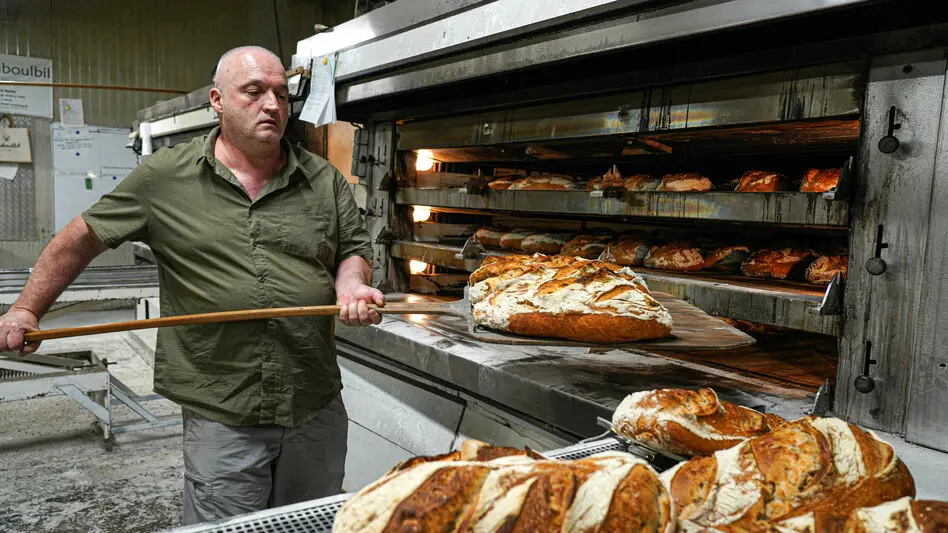
J ean-Pierre Delboulbe brushes some “white powder,” as he calls it, from his olive-colored shirt. The powder is flour, not cocaine. But the ambiguity leads the baker from the 550-person village of Castelsagrat in the Tarn-et-Garonne department in southern France to a different comparison: "For me, loans are like cocaine. The more you take out, the easier life as an entrepreneur becomes," he says, emphasizing: "at least at the beginning." But in the long term we need more: "enough customers to be able to repay loans for ovens, delivery vans, refrigerated trucks. If they don't come, you'll quickly go bankrupt."
The 63-year-old Frenchman wanted to escape this pressure. He calls his bakery a “social experimental laboratory with an anarchist basic idea”. With his parents, who were farmers, he saw the damage that debt can cause. Delboulbe is sitting at the kitchen table in his parents' house, which is only 50 meters from the company premises and a little away from the small town center.
It would have taken them 20 years to repay a loan. "My mother said, 'We're still paying off the tobacco dryer.' But we haven't produced tobacco for years," he says. Many would break under this pressure, says Delboulbe. According to the Agricultural Social Security (MSA), an average of 300 farmers take their own lives every year. A bill to protect their mental health was passed last June.
29 years ago, the engineer founded his bakery, which is known for its bread made from natural sourdough from wheat from surrounding fields. His entrepreneurial leitmotif: keep stress as low as possible. The backbone of the craft business is the employees. Only then would material things come. “I believe more in people than in machines,” he says.
In fact, the working conditions for the cooperative's 32 employees - 20 of whom work full-time - are more pleasant than usual in the sector. With four working days per week, ten weeks of vacation per year and a starting salary of 2,000 euros net - including bonuses - and 3,000 euros net after three years of service, Louboulbil stands out in the industry in France.
Despite the hard physical work in the bakery, sickness rates are low and employees stay, says Delboulbe. The employees confirm this; several of them have been there for over a decade. Hierarchies are reduced to a minimum here. “I'm doing well here, I don't feel under pressure,” summarizes Christine. The woman in her mid-sixties, who has been a saleswoman in the company for 17 years, is one of the longest-serving employees and is responsible for the market in Montauban.
In total, the baked goods are sold at 17 markets within a 60-kilometer radius. There are stalls in medium-sized towns such as Cahors and in the suburbs of Toulouse. The market with the highest sales is in Montauban: there the company sells up to almost a ton of bread on a market day. In just a few hours, several thousand euros are collected there. In total, the bakery produces and sells 300 tons of bread per year.
However, the flourishing company cannot switch to organic farming, explains the managing director. "The region is one of the poorer in France. We wouldn't have enough customers," he believes. In fact, the rejection of organic products is relatively strong, especially in rural regions of France - and that doesn't just have to do with prices. Organic is something for “woke ecos” goes the narrative, which is also often spread by right-wingers who defend conventional, “traditional” agriculture.
Louboulbil currently has around 6,000 customers a week. In order to satisfy them, the employees in the company get up at dawn. In this French province, as in many places in France, bread must be available early in the morning.
Nathalie is also up early in the morning, at 4:30 a.m. “I’m used to going to bed early,” she says. Her T-shirt says “chocolatine,” which is what “pain au chocolat” is called in the south of France. Baskets of bread are piled up behind Nathalie. With that she loads the delivery truck one piece at a time, then jumps in herself. She checks again whether the cash register is there - and gets ready to leave. Nathalie says it was a midlife crisis that led her to Louboulbil. That was 14 years ago now. “Never again in the restaurant industry,” she said to herself at the time. She is happy that she has left behind the time constraints and hierarchies that she experienced as a waitress. Her current work is based on personal responsibility and trust, she says.
What that means in concrete terms: Delboulbe doesn't stop by the market stall for small checks, and he doesn't count the cash register after the market closes. The women say they have experienced this with other employers.
At first, Nathalie admits, it was difficult for her to believe that this model would actually work. “But over time you realize that we are not being controlled – and that we are, so to speak, our own little boss at the stand,” she adds. Changing careers at the age of 40 and getting a better salary without training is impossible elsewhere.
Natasha, in her mid-30s, has three children and is also a saleswoman. She appreciates the three days off she has to spend time with her sons. Karine, in her mid-40s, right next to her, sees it the same way: "And then we still have the afternoons. Free time for the children is essential!" she says, and turns away to get something from the van.
Despite the many advantages, the work should not be underestimated, as all the employees that taz spoke to agreed: "Be there at four in the morning, regardless of whether it is raining or snowing, to load the truck. That is not without its consequences." Natasha tells an anecdote about a colleague who always had heating pads in her trouser pockets last winter when it was minus 12 degrees. “And the weight we have to carry,” Christine adds, panting. Then she continues. The 12 meter long sales table in Montauban needs to be stocked.
In the early hours of the morning, Julien lifts a tray full of bread to put into the preheated oven. He repeats this movement in a chord. Beads of sweat stand on his forehead. He's been standing at the stove since 1 a.m. He has been doing this work since he was 18. He almost broke up a year ago, he says, wiping the sweat from his forehead with the back of his hand. "I was at a point in my life where I said to myself: I'm quitting the bakery, it's too hard. Even though I was now earning relatively well as a baker with 2,000 euros net."
A local newspaper published a video on the Internet and reported on the Louboulbil model, which is the name of the bakery. That piqued his curiosity. He then searched for open job advertisements on the bakery's website. “They were looking for a baker, I was taken,” says the young man. It takes him 50 minutes to get to work. In return, he receives 2,200 euros net plus occasional bonuses, which is slightly more than with his previous employers. The hard work and the back pain remained. But: Ten weeks of vacation and a four-day week are still more relaxing than anything he has experienced at other employers.
Several employees say it's great how much they can come up with suggestions to make the hard work easier. In the past, this meant purchasing an infeed conveyor that automatically raised baked goods to oven height. A stove is currently being tested to see how helpful the purchase is - so that back pain will soon be a thing of the past. A forklift truck was also purchased for the bread baskets - saving the employees from having to laboriously push them around on their own.
And yet: Julien swears that he won't do this job all his life. He kneads dough together with four other colleagues. The four of them hired the young people themselves. Jean Pierre Delboulbe has long since stopped looking after the staff himself. “I did that at the beginning, but then I realized that it’s much smarter if people choose their work colleagues themselves,” he explains.
Aurore, who has worked in various industries - in a factory, at a fast food chain, in a supermarket and as a graphic designer - now looks after three areas. About accounting, direct sales at the workshops in Castelsagrat and sales at markets. “This flat hierarchy works because we all chose each other,” says the 30-year-old.
Mireille Bruyère, economist and researcher at the National Center for Scientific Research (CNRS) and specialist in the social and solidarity economy, which includes cooperatives, puts into perspective the idea that this form of organization is inspired by anarchy: "In a truly libertarian cooperative, the decision is made collectively whether to hire someone. It is not the case that the manager grants the others the freedom to do so. Rather, it is a collective that creates its own rules from the ground up determines.”
She adds: "The narrative is more reminiscent of the 'liberated company' model, which suggests that the boss frees the employees from their constraints and everyone can do whatever they want." On one of the desks in the bakery, among other books, is the work “L’entreprise libérée” (in German: “The Liberated Leadership”) by Jean-François Zobrist, which deals with this very model.
For Bruyère, who planned to invite the cooperative to give a talk to her master's students, what makes Louboulbil special, in addition to the generous paid vacation days, is the "low-tech" approach.
In fact, the mechanical department in the company, which Delboulbe looks after himself, plays a key role with its two full-time mechanics. 80 machines, including ovens, cold rooms and kneading machines keep the business running - most of which were bought used. The most expensive oven cost 3,000 euros. The new purchase price would be between 40,000 and 70,000 euros, says Delboulbe. “There’s nothing new for us,” laughs Christine at the market stall. Instead, there is a lot of ingenuity.
“The rule here is simple: we don’t commission tradesmen,” emphasizes the managing director. For over 20 years, old delivery vans were used that were bought second hand for 1,500 euros and already had over 300,000 kilometers on the clock. It was operated with frying oil. They have since been replaced by new cars. “When I came to the market, I could smell the frying oil from 10 kilometers away,” says Christine, remembering it. “We were constantly repairing them,” remembers Jean-Pierre Delboulbe, who learned early on to be an “all-rounder” on his parents’ farm. "When we have a problem installing a clutch, we look on YouTube. There is always someone who explains how to do it."
Although the cost of frying oil, rapeseed or sunflower oil purchased in 1,000 liter tanks has exploded in recent years due to competition from Spanish biodiesel plants, the cooperative's financial cushion allows it to cushion these cost increases. This cushion has been created over the years. Favored by the fact that few investments were made. Even the buildings, which today have a total area of 1,500 square meters, were built and continually expanded by the managing director and the employed mechanics themselves.
“It cost us ten times less than if we had had it built,” argues Jean-Pierre Delboulbe. He calculated 225,000 euros instead of 2.25 million euros. "Well, it may not look particularly nice, but it's functional. We're not building an Egyptian pyramid or the Eiffel Tower."
Jean-Pierre recalls that the bakery industry is a very profitable business and the profit margin is around 65 percent. A ton of wheat currently costs him 200 euros, which can be used to sell bread worth 6,000 euros. He further explains: Because many entrepreneurs want to make money as quickly as possible and only pay themselves off at the end, savings are made on personnel costs - and every cent saved ultimately benefits them.
With Leboulbil the principle works exactly the opposite. “I’m the first to get paid,” says Jean-Pierre Delboulbe. The question of how he could ultimately make the profit margin as large as possible for himself at the expense of others does not arise for him. “It’s a way of turning the boss into an employee.” At the same time, this model means that employees also take on more responsibility and, in a sense, become “entrepreneurs” themselves, said the managing director.
For the researcher, there is nothing revolutionary about it: "Many cooperatives function according to this model. It corresponds to the basic principle of worker associationism, which emerged in the 1830s, and the cooperative principle. In a cooperative, it is only logical that there is no boss - even if power is still distributed unequally."
The bakery achieves a turnover of 2 million euros per year. 15 percent flows directly into the company to secure its financial basis, i.e. to increase the cooperative's equity. Delboulbe's salary is also paid from this share. 50 percent is earmarked for employee pay. But that also means: If something breaks, the employees have to dig into their own pockets. For example, if a motor needs to be replaced and employees want to buy a new one. If the engine costs 4,000 euros, 200 euros are deducted from each individual salary. “If the profit margin was higher – like in 2024 – they received 54 percent of sales,” says the managing director.
The co-determination of employees also means that they take on an extremely large amount of responsibility. For example when it comes to new hires. You then have to weigh up whether the company really needs a new person. Because: An additional employee means a pay cut for you.
The latter explains: “You have a choice: you can ruin the company, but you will also lose a lot.” Ultimately, however, legally Jean-Pierre Delboulbe is responsible if there is a problem. That's why all freedom has its limits. Ultimately, he is also responsible for the physical and mental health of his employees. For example, when it comes to occupational safety measures on the machines.
Many companies would get in their own way. In France, Delboulbe likes to remind us of the current study, only 8 to 12 percent of employees really identify with their company. “That’s almost nothing – and it reduces the profitability of many companies!” he says, visibly annoyed. "France is considered a country in which the management style is quite authoritarian and not very participatory. This means that employees identify less with their work and are less committed to it than in other countries," analyzes Mireille Bruyère.
For Jean-Pierre Delboulbe, it is obvious: entrepreneurs have a financial interest in better distributing the wealth they generate and involving employees more closely in the company.
Cooperative expert Mireille Bruyère puts it into perspective at this point: "If the boss distributes the wealth generated more fairly, it is initially less profitable for him because this reduces profits. It is a class relationship in which the interests are structurally opposed." However, says the scientist, many small companies do not only have profit in mind and would like to involve their employees more. “This can actually have a positive impact on efficiency and productivity,” says Bruyère. However, this is rarely accompanied by an increase in wages.
While Jean-Pierre is talking about this aspect of the cooperative model, an employee tries to talk to him. He briefly reports to the “boss” what he has done that afternoon. When the employee is out the door again, Jean-Pierre says: "See? He still thinks hierarchically."
Some employees left the company precisely because of the flat hierarchies. They couldn't cope with the fact that he didn't give constant instructions about what to do next, says Delboulbe.
In their private lives, employees are always met with skepticism when they report on their work. Several employees say that relatives and friends can hardly believe that such a model actually works. Without the boss using tricks at one point or another – or simply being crazy.
And yet: Many people are now interested in the model. There are also imitators - such as a milk cooperative in the north of the department that follows a similar approach. A little over a year ago, an influential French business family even called him. It was about recruiting staff and a four-day week. "They think that's the solution. But not if you don't want to increase pay despite longer working days." And then there is the issue of profit sharing: “At that point, at the latest, things get stuck on the other end of the line.”