
Germany taz
Alcohol abstinence: My true colors
As a 14-year-old, our author had her first high, and from then on alcohol played a big role. She quit in her early 30s – and has been getting to know each other ever since. more...
Deutsch (original) ·Auto-translated to English
It's pounding. Not like someone hammering a nail into the wall. The feeling is like a jackhammer drilling through concrete and hitting steel. It's booming, maybe it's better. The eyes don't want to open or are they already? Regardless of whether it is closed or open, it is too bright. The curtains are drawn.
I'd like to take out the eyeballs. Maybe then the pain that begins behind them and seems to cover the entire inside of their skull like thin ice would stop. Or at least become less.
With my eyes closed, I fumble for the cell phone on the bedside table and squint at the screen. It takes a moment before I can place the numbers, before they become more than a series of pixels.
9:06 a.m., my eyes open on their own. FUCK!
We're supposed to be in the hotel foyer in nine minutes. Departure 9:20 a.m. My body shoots up and the ice in my skull cracks. Toilet, now!, says the breaking center, even before the ice cover can crack. Before my stomach quickly returns everything I drank yesterday.
Since this diary entry, written in a hotel room in Barcelona in April 2022, I have stopped drinking alcohol. I keep trying to write about it. I can never find words that adequately summarize what connected me to alcohol.
In 2023 I'll write: It's been a year since I stopped. Stopped kidding myself, stopped criticizing everything about myself, stopped trying to be someone I may never have been. I've been feeling better since then. Not always good, but noticeably better, and that's something.
This is actually something, a significant advance in fact. And yet it is fragile, this feeling that gives me a new and yet not unshakable self-confidence. This condition is called “Pink Cloud”. It occurs when you stop consuming what has made you addicted. For me it's mostly alcohol, I think at the time. It wasn't until much later that I learned that my addiction shows up in so many more places: relationships, marijuana, cigarettes, shopping - it's something I always carry with me.
The author Daniel Schreiber describes the so-called “Pink Cloud” as “misleading and at the same time” in his literary experience report “Sober”. In most cases, these early days of sobriety were surprisingly pleasant, he notes in retrospect. In reality, you are going through a long phase of extreme mood swings. Characterized by confusion, people don't want to drink at all during these weeks and months, "but the neural connections, formed over years, continue to function and cause a kind of mental withdrawal symptoms."
In fact, when alcohol is consumed regularly, the brain adapts to its depressant effect: the balance between inhibitory and stimulating messenger substances shifts and the reward system changes. If the alcohol is stopped, the brain has to regulate itself again. Another reason for the initial euphoria may be the contrast: the head becomes clearer, sleep and energy improve, and the fact of actually being able to stop drinking alcohol provides a strong feeling of relief and control. Unfortunately, the feeling usually doesn't last, for me it lasts a few months.
During this time I feel light and strong at the same time. I didn't know that anymore. The last time I felt light and strong at the same time was as a child: when learning to swim, when the training wheels fell away, or when riding, where becoming one with the horse inspired me while still maintaining a certain amount of control. Without alcohol, this feeling comes back. I'm swimming again, in lakes and through life, and I'm running because the movement helps me hold back my fears.
In August 2024 I write in my diary: There are 16 months between these and the last lines and I have gotten closer to myself. Not everything was positive during this time, many things were even very painful.
In the beginning I was very vulnerable without feeling it. Repressed fears and feelings of happiness want to surface at the same time, and even though I feel light, I cry a lot.
I get to know someone, we arrange to meet at my place. But something is wrong. When I was still drinking alcohol, and it was often quite a bit when I was getting to know each other, a veil always fell over such nights, a soft focus that made everything seem a little lighter, a little less real.
Now there is nothing. Every touch comes to me clearly, unfiltered, and with it comes a question that I never asked myself when I was drunk: Do I want this? I no longer know the answer as soon as he's there, in my apartment, in my bed - and that's exactly what frightens me more than anything else: that all these years I've never felt whether I wanted something, only whether it fit the person I wanted to be.
He doesn't stay long; he probably notices my discomfort. When the door closes behind him, I feel one thing above all else: relief. Being sober apparently also means no longer being able to avoid yourself.
The morning in Barcelona - I was almost 31 years old at the time - is a first and important step. I am on a press trip with a group of journalists from different media, all of whom are a lot older than me. Her advantage in professional and life experience inspires the kind of respect that inevitably turns to fear when I am confronted with my own ignorance.
The resulting stress has been my constant companion since I took my first steps into journalism in 2019. Since then, he's been breathing down my neck like a little monster and keeps whispering in my ear: "Fake it, 'til you make it." I have done well with this mantra so far and yet I am of the opinion that my supposed success can in no way have anything to do with any qualifications I may have. “Impostor Syndrome” describes this feeling of inadequacy where you are always afraid that it will be exposed. “And how can this fear of failure be cured so wonderfully?” asks the journalist Eva Biringer in her book “Independent” and promptly provides the answer: “With a full glass.”
I have overcome many moments like this. I started doing this as a teenager. My body was growing up while I didn't quite find myself in it yet. In order to be cool, to fit in, or simply to be able to interact with the older boys who were more interesting than their peers at an early age, I consume without knowing whether I even like it.
"I want to be drunk from the start. I drink myself to this point where everything becomes indifferent," writes Lena Schätte in her novel "The Black on My Father's Hands." My relationship with alcohol is similar: from the very beginning, as the saying goes? Toxic.
The first time gets out of hand right away, I'm about 14 years old. I remember the room smelling of deodorant and chips, music playing through a computer speaker, and someone handing me a bottle, which I accepted as if it were a special gift. It must have been something highly mixed that I drank from a classmate that evening, hoping to look as cool as possible while trying hard not to grimace. It burns. I swallow anyway, even smile as if there was nothing there.
In between a few “girl beers” that were so popular back then. This taste of artificial fruit - green lemon, chilled orange, strawberry - tastes like nothing I know, and that's exactly why it tastes like freedom. A sip or two of beer, then something clear on Ex. I feel it running down, spreading inside me, warm and heavy at the same time. And then, somewhere between the second and third glass, something tips over. I'm louder. I am lighter. Suddenly I'm someone else. Someone who no longer creates children's worlds with plastic horses with their best friend on weekends, but is part of something bigger. It doesn't matter that the evening ends for me with my cheek on the porcelain of the toilet bowl while my friend P. holds my hair.
The real escapades began when I was around 16, in the noughties, where I was constantly at parties in Berlin, which was already popular but still edgy at the time: Cookies, Picnic, Rodeo, Bar25, Berghain - somehow you get in everywhere, despite (or perhaps because of) your youthfulness. I usually spend the weekends in the Rodeo cloakroom, which was then located in the old post office on Auguststrasse. N. works there, and between dance performances we rest at her place, between coats and coat tags, the music only muffled by the wall.
Tuesdays and Thursdays are cookies time, where S. reliably lets us in and I don't just get to know someone for the night. At 18, I only show up at school sporadically and when I do, I party hard, which almost cost me admission to the Abitur. I'm sitting in the second lesson - I rarely make it to the first - with my head resting on the scribbled table, my eyes too heavy to keep them open. When the teacher reprimands me, I start up, defiant, with a sharpness in my voice that, in retrospect, must be due to all the substances I was consuming at the time without question.
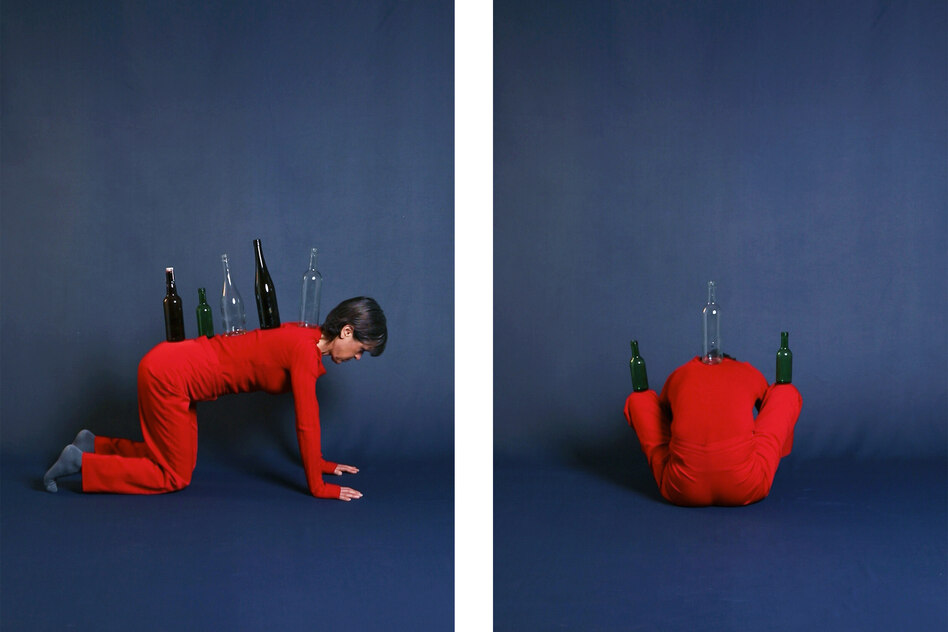
In her work “Each Poison, A Pillow,” the Austrian artist Stefanie Moshamer deals with female alcoholism, based on her own family history. The images are video stills from her installation “Mother, Task I–IV,” in which Moshammer’s mother balances bottles in various positions, symbolizing her addiction. “Each Poison, A Pillow” has been published as a book by Éditions Images and can be seen at Galerie Saalbau in Berlin until November 22, 2026.
In my twenties I study outside of Berlin and commute. My fellow students and I often spend the journeys back to the city with at least two bottles of beer on the train. Afterwards, we usually go to a bar, someone's house or the park to continue consuming.
Since I never start drinking in the morning, can take longer breaks (days, sometimes weeks, up to the “Dry January” that is so popularly celebrated on social media) and rarely consume anything harder than beer, wine or champagne, the term alcoholic doesn't really fit me. I try it on, but it hangs from my shoulders, slips down my arms, and only gets stuck on my tummy, which I don't know when it came into being. I just know that I hate it. “Hate is a really hard word,” a friend once taught me. But that's exactly how I feel. Not just for my stomach, but for me in general: hate. Hatred and contempt. For my body, my being. That also has something to do with how I grew up.
At the beginning of 2020 I wrote in my diary: As soon as I take the first sip, everything is easier. Feeling more carefree, I lock up the scared child inside me and go out. I love how easy it is for me to have a conversation, no matter who it is. Whether in the club or at events; I am entertaining and liked. Nothing else matters. I ignore the fact that the mood can change quickly. Shame overcomes me the morning after, embarrassingly I think about what I said or did the night before and with whom. But none of that matters at the moment.
“Especially in the vintages from 1980 and especially from 1990 onwards, it became clear that women tend to get drunk almost as often as men,” writes Eva Biringer. In fact, alcohol consumption among women and men in Germany has significantly converged over the past few decades. The psychologist Jürgen Rehm, who researches alcohol and addiction, also sees a connection with the increasing emancipation of women: the more women participate in social life, are professionally successful and have the same freedom as men, the more similar their drinking behavior apparently becomes. According to Rehm in the SZ magazine, alcohol is a cultural asset in Germany, it is “part of the good life” – and this now also applies to women, especially if they are successful.
But perhaps emancipation only explains part of this development. Because with the freedoms that women have gained, not all insecurities have automatically disappeared. On the contrary: In addition to the demand to be independent, successful and self-determined, for many women there is still pressure to conform to a certain idea of femininity. Be strong, function, be attractive, assert yourself - and just don't be too much. Perhaps that is why alcohol is not only a symbol of freedom gained, but sometimes also a means of enduring uncertainty about how one should actually fulfill this freedom. I know this feeling. I didn't drink because I felt free. I drank to feel free.
My diary says: With one glass of wine, then two, then three, I am who I always wanted to be. Only after the fifth or sixth drink do I become the person I don't want to be.
“Almost all of us have the feeling that we are not enough,” writes Biringer. Many have tried to drink against it. Films and series show female characters who embody a “work hard, play hard” attitude - the drink as a characterizing accessory for the “strong woman”. The Cosmopolitan in “Sex and the City” is seen as a symbol of sexuality and independence – as a female counterpart to James Bond and his martini. If you want to imitate the lifestyle of the protagonists, you may not be able to afford Manolo Blahniks, but you can afford a Cosmopolitan.
My role model for this lifestyle was my mother. In her twenties in the early 1990s, a single parent, first studying and then working in the cultural sector, she gets around a lot. For me she is sophisticated even before I know the word. Also and especially because she wears this picture out of the house just like she wears her miniskirts. Compared to my mom, who only occasionally manages to take me to school or pick me up and who relies on childcare in the afternoon and often in the evening, other mothers seem bland to me.
A constant memory is waking up because the TV is too loud. Mom is lying on the sofa, one leg hanging down, she is snoring under the blue flickering. I sit down in front of the bowl of peanuts, the ones with the crunchy, salty crust, cracking them as quietly as I can while I watch TV for a bit before I wake her up. The bottle of wine stands next to her, sometimes more, sometimes less empty. I have to be over 30 to understand where I was actually watching.
Children of addicted parents feel responsible for them and take on tasks at an early age that they are far too small for, according to the website of the advocacy group for children from addicted families, NACOA. I learn early that my mother's mood is better in the morning when she drinks coffee, so I learn to make it the way she likes it and bring it to her in bed. Waking her up on the weekend is a bad idea, but during the week it's better to set her own alarm as she tends to ignore hers.
The risk of becoming addicted is three to six times higher for children from families with addiction problems. Around a third develop their own material dependency, and another third develop psychological and social disorders, from anxiety and depression to eating disorders and difficulties trusting others. The two groups overlap because it is often alcohol that is supposed to numb tension and emptiness.
There are several reasons why these children in particular choose to drink: On the one hand, the predisposition is partly hereditary, for example how strongly the reward system responds to alcohol. On the other hand, they experience from an early age that alcohol is the normal response to stress, grief and exhaustion. Even the last third, which apparently remains unscathed, often suffers the consequences: those who have learned early on to read moods and put their own needs aside often later struggle with perfectionism, the need for control and over-commitment in the job, with boundaries that are difficult to draw, and with closeness that is both longed for and feared.
Somehow I fit into each of these thirds, because my relationship to what is declared to be a luxury food was many things, but never enjoyment. Dependence has shaped my consumption from the very beginning. Excessiveness becomes my constant companion. After many years of therapy, a psychoanalysis that not only cost me a lot of time but also energy, and a burnout, I now know that I was compensating for what I didn't get as a child from addicted parents.
“When affection and attention are dependent on whether and how much the alcoholic parent has drunk, insecurity often becomes the only constant in children’s lives,” NACOA says. Violence - physical and psychological - is therefore not uncommon in such families, and it wasn't in mine either.
At some point I can't do it anymore. Are the boundaries pushed too far? I felt like this for years before I finally stopped drinking. What all the authors quoted here have in common is that at some point they try to adapt their drinking behavior and impose rules on themselves. Only drink on weekends, only on special occasions (how quickly these can be created!), only wine or beer, never mixing or before a certain time. I too try to follow these self-imposed rules and fail every time. The shame that comes with it is huge because I just can't manage not to drink.
Because of my consumer behavior, I lost one or two friends in my twenties. No one ever tells me this outright, but I know that it's because I become unpredictable when I'm drunk, I'm always starting dramas, hitting on taken men and generally misbehaving. Instead of stopping, my consumption only increases and I start drinking alone more and more often, probably because very few people want to drink with me anymore.
The pandemic and the home office that comes with it have benefited me greatly. Living alone, no one notices when I open a second bottle of red wine after the first. Only my body notices and punishes me in the days afterwards until I can no longer keep anything down.
Drunkorexia is the combination of being drunk (drunk) and anorexia – anorexia. It wasn't until much later that I found out that I was suffering from the latter in the same way that I was suffering from alcohol addiction. When I drink, I usually eat little or nothing. Biringer shows how paradoxical the interaction of drunkorexia is by quoting the French journalist Claire Touzard: It often happens that one first becomes anorexic and then becomes an alcoholic. First of all, it's about harming yourself, an attack on your self-esteem. Then it's about a kind of control: If you're anorexic, you have a lot of control over your body, and if you drink to the limit, it's often about losing that control - "the exact opposite way."
Biringer further writes that 40 percent of bulimics are alcohol dependent. Many would also save on food because then you get drunk quicker. That's how it is with me. I see food as an annoying necessity that I can happily do without. Alcohol is the best catalyst for this because after consuming it I no longer feel hungry. I also start puking more and more often when I drink too much, which helps with my desire to be thin.
My diary says about the morning in Barcelona: I feel exhausted and empty. I didn't make it to the meeting in the lobby. Instead, I lie motionless on the bed and look at the two bottles of red wine that I want to bring with me in the evening. I have an appointment with P., with whom I spent the night in Barcelona yesterday. We want to meet for dinner at his place. When I was buying the bottles, I thought about whether one would be enough, and I knew: definitely not. But now, at this moment, I can't imagine taking even a sip of the red liquid. My head is tearing up and something bigger inside me with it. I can not anymore.
“I cut the drink out of my life and left an entire identity behind me,” writes author Mia Gatow in her book “Intoxication and Clarity.” And it's true. When I finally stop drinking after that morning in Barcelona - something that has long seemed impossible to me - I also lose the person I had been until then. It's a loss that hurts. I don't know myself anymore, I have to get to know myself completely new and in the process give up some of my wishful thinking: "Sobriety doesn't bring you anything except sobriety. Productivity, inner peace and self-love are not part of the package. The only promise that sobriety always keeps: you come to yourself," says Gatow.
This feeling of arriving at yourself is incredibly beautiful, but equally painful. Sobriety brings to light what was previously drowned in alcohol: I only become fully aware of my anorexia in retrospect, and I still struggle with the constant thought of wanting to be thin. Overall, you realize what you've missed all these years, who you could have been, for yourself, for others. Therapy helps me with my plans, as does the process of coming to terms with it within my family. I never went to self-help organizations like Alcoholics Anonymous, but the authors mentioned helped me to come to terms with it. Basically, it's shame that finally makes me stop. I have long been ashamed of others, but especially of myself.
Once, I'm in Chile, I accidentally buy regular beer, only realize it after a few sips and drink the small bottle. The next day I have a terrible headache. Another time the innkeeper at a hut serves me a shandy after a long hike and I briefly forget that the drink contains alcohol. I don't have any desire to drink more, which seems like a good sign at first. But the fear that I will knowingly drink “just one glass” for this reason has accompanied me ever since. Because I know: sooner or later one glass will become several. Sometimes I dream about it. Then I keep trying to imagine how miserable I felt at the end, how my body reacted, what those around me would say. That always helps so far. I've become pretty consistent, but I still have one vice: smoking. Maybe I'm making up for everything I've left behind.
Sometimes I ask myself what part of the old life was alcohol and what was life itself. The partying, the people, the long evenings, getting up the next morning and functioning at work. A lot of this can be done without alcohol. But it doesn't feel the same anymore and is often more tiring. Maybe that's what I find most difficult to separate: what I miss - and what I actually wanted to leave behind.
This text first appeared in wochentaz, our weekly newspaper from the left!
Every week, wochentaz is about the world as it is – and as it could be. A left-wing weekly newspaper with a voice, attitude and the special taz view of the world. New every Saturday at the kiosk and of course by subscription.
What I've learned in the four years I've been sober: You're not a better person just because you don't drink. You can safely bury the misconception that drinkers are people of weak character. When I was drunk, I was more sensitive, even when it came to other people's problems. But everything always came back to me, because the drinker can never leave himself out. He: She is always involved, suffers with us and is quite self-centered.
Without alcohol, I can separate myself better and give others their space. But I find it harder to truly empathize, am more controlled and less accessible in conversations than before. Laugh less. Mia Gatow is of the opinion that “only when we are sober do we show our true colors”. Mine are perhaps a little faded, more pastel than glowing. No longer a dark red wine red or a bright alcopop color. Maybe that's why I'm increasingly turning to strong primary colors for clothing and furnishings. To give my life some color back.
At the author's request, we are publishing the article under a pseudonym.