
Politics · taz · 1h
AfD before Berlin election: provocation and fundamental opposition
Deutsch (original) · Auto-translated to English
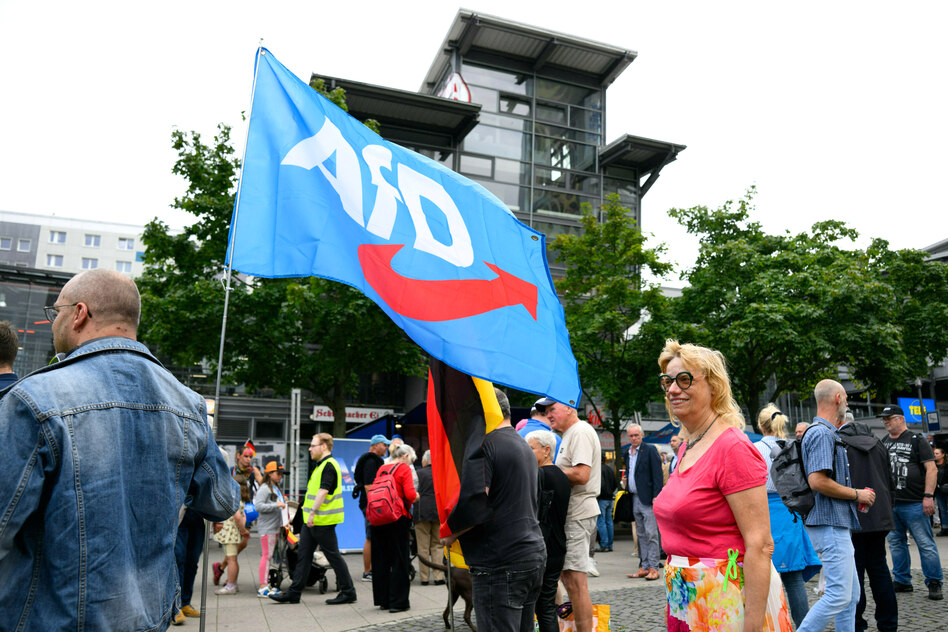
The aim was provocation. And so it is no wonder that the “walk” of the Berlin AfD agitator Thorsten Weiß with party colleagues and an FPÖ delegation through northern Neukölln this afternoon at the beginning of September turns into a gauntlet. “The whole of Berlin hates the AfD,” shout passers-by at Hermannplatz. Later, on Karl-Marx-Straße, a raw egg flies towards the police, who are shielding the AfD-FPÖ crowd from the demonstrators.
Weiß and his companions - including the Neukölln MP Robert Eschricht and the head of the Berlin party youth, Martin Kohler - did not bat an eye. To make a statement, they stop at a drug consumption room in front of which several clients are sitting, eating soup and drinking tea. Weiss fantasizes about a “reconquest” of North Neukölln, calling for “consistent remigration” as well as the “repression of the open drug scene” and “compulsory therapy” for people suffering from addiction.
Even if the AfD can only announce its theses in Neukölln with loud shouts of “Off to you,” it is receiving a lot of support across Berlin. In the end, the party could even double its result in the House of Representatives election in just under two weeks: surveys currently estimate the party at 17 to 19 percent. In the repeat election in 2023 it achieved 9 percent, and in the federal election in 2025 it already achieved 15 percent. This time it could even become the strongest force. The competition, the CDU and the Left, are currently only a few points ahead of her.
Almost unnoticed, in the shadow of the attention for the state elections in Saxony-Anhalt, a political shift is also emerging in Berlin. But how could this happen: an AfD fighting for first place in the metropolis of Berlin, which is considered liberal, cosmopolitan and left-wing?
There is a political constellation in Berlin that favors the success of the AfD, says political scientist Aiko Wagner from the Free University, where he researches voting behavior and voter potential. On the one hand, that is the national trend. “In state elections we always see an influence from federal politics,” says Wagner. This is particularly true for the AfD: “I assume that the voters do not evaluate the work of the Berlin AfD, but of the federal AfD.” Ultimately, the AfD's political demands are primarily federal, for example on migration or the European Union.
On the other hand, there is the weakness of the incumbent black-red Senate. "The state government did not give a good impression. It is not difficult for parties like the AfD, which present themselves as a fundamental opposition, to be successful," explains Wagner. In Berlin, the AfD could claim: Everyone has tried government and failed. Now it's our turn. And the third, new factor is the tailwind from the election victory in Saxony-Anhalt, emphasizes Aiko Wagner: "People like to bet on the winners. The AfD is now seen as popular and successful, that can mobilize."
Expropriation as a solution – or the end of red-red-green?
Tue., September 15, 2026, 7:00 p.m., taz canteen: Registration
The rent crisis is shaping the election campaign, but the question of socialization is dividing the parties. Almost a week before the Berlin elections on September 20th, we are looking into the questions: How can the SPD, the Left and the Greens pull together without ignoring the democratic mission of Berliners? Does the question of expropriation lead Berlin into a political dead end from which only the conservatives ultimately benefit? And what does expropriation actually bring?
Sebastian Schlüsselburg is a member of the House of Representatives, formerly for the Left, since 2025 for the SPD.
Katrin Schmidberger is a member of the House of Representatives and spokesperson for rent policy for the Alliance 90/The Greens faction.
Rouzbeh Taheri is the Neukölln direct candidate of the Left for the House of Representatives. He was co-founder and spokesman for the Deutsche Wohnen & Co Expropriate initiative.
Admission free. Seat reservation required
Participation in the taz canteen (Friedrichstraße 21) is only possible with a ticket booked in advance. We therefore ask you to register. Places are limited, entry is free. Access to the event is barrier-free. In addition, the event will be broadcast live.
In terms of content, the Berlin AfD is relying on the well-known foreigners-out policy, law and order and discipline in schools in the election campaign. At the same time, the AfD strategists are trying to reinterpret the most important issue of the election according to surveys - the housing crisis - and thus use it to their advantage. The campaign “Apartments are not asylum homes” has been running since June, and during her election campaign appearances, state leader Brinker tirelessly spreads the unsubstantiated claim that refugees are taking away living space from “normal Berliners”.
Whether it is the dissatisfaction with the federal government and the Senate that is driving people to the AfD, or whether the election program is actually wrong in terms of content - it is difficult to say. But one thing is clear: the AfD is opening up new voter milieus and urban areas in Berlin. “The AfD reliably mobilizes its potential voters,” says Aiko Wagner. “Almost everyone who can imagine voting for the AfD does so.”
This should also show up on the electoral map after September 20th. While the AfD has so far had its strongholds primarily in Lichtenberg and Marzahn-Hellersdorf, this time it is also hoping for a good performance in Reinickendorf, in parts of Spandau, in the southern districts of Neukölln, in the north of Pankow and also in the south of Tempelhof-Schöneberg.
Aiko Wagner emphasizes that the image of Berlin as a left-wing stronghold is wrong anyway. "People who are not eligible to vote make up a large part of the city. They shape the diverse life in the city center - but are not allowed to vote." The electorate is significantly more influenced by the more conservative outlying districts.
And so the AfD is concentrating on exactly these areas in the election campaign. The recipe: Sell a radical program with a bourgeois facade. Top candidate Brinker always presents herself as moderate - but thanks to a pact with the nationalistic current in her party, she is firmly in the saddle.
But at an AfD election rally in Lichtenberg at the end of August, the facade threatens to crumble. Brinker stands on stage, talks about government failure, chaos, loss of control, receives cheers and applause. There are also several obvious neo-Nazis who came to the rally and are listening undisturbed: tattoos show swastikas and the scene code “88,” and a man is wearing a T-shirt with “ENSDAPE” printed on it.
The regional association later said that they knew nothing about it and would not tolerate something like that. But the incident shows how far to the right the AfD is mobilizing. Other right-wing extremist parties such as “Heimat” and “Third Way” no longer have a chance in their former strongholds.
The future AfD parliamentary group will also be anything but moderate. The previous right-wing keyword Thorsten Weiß will no longer be a member of parliament - he is moving to the Höcke regional association in Thuringia.
But the state list with 35 places is still tough. In addition to Brinker, there is the Berlin “Generation Germany” boss Martin Kohler, who comes from the fraternity milieu and always attracts attention with his sharp “remigration” rhetoric. There is the Höcke supporter Jeannette Auricht and the Trump fan Julien Adrat, who regularly agitates against trans people. Many of them are likely to succeed in entering parliament. The group currently has twelve members, soon there could be twice as many.
In the end, the AfD in Berlin will probably remain without an option for power - unlike in Saxony-Anhalt. Nobody wants to form a coalition with her. The Greens also demand that the Berlin Office for the Protection of the Constitution monitor the regional association. To support this demand, the party took the analysis into its own hands and wrote a supplementary chapter to the report for the protection of the constitution. She wants to hand it over to the interior administration on Tuesday.
Read the full story at the source →
Source: taz