
Politics · taz · · 1h
AfD Mecklenburg-Western Pomerania: Mr. Holm and the radical men
Deutsch (original) · Auto-translated to English
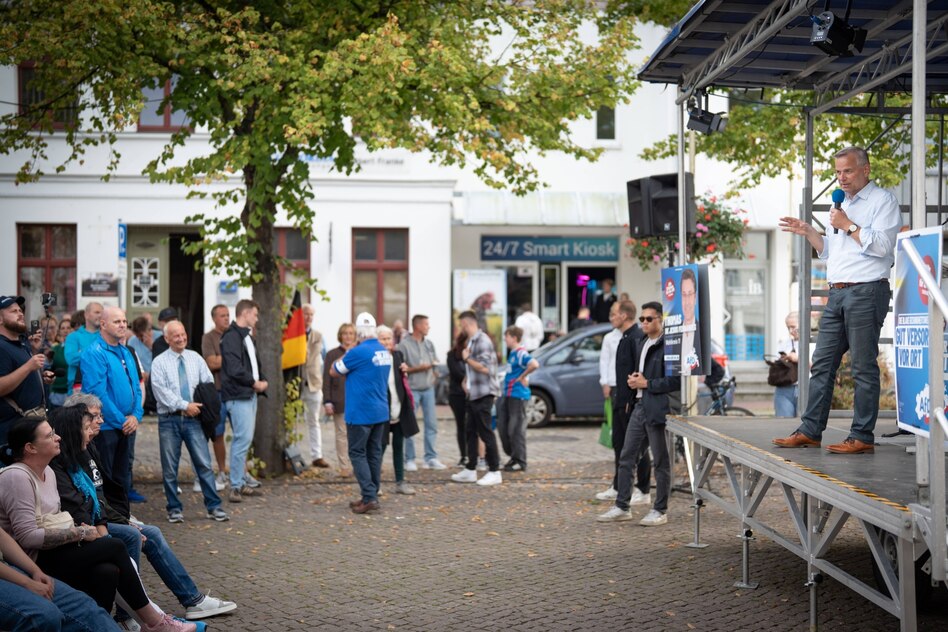
A Tuesday afternoon in the climatic health resort of Bad Doberan, a few kilometers from the Baltic Sea coast. The spa steam locomotive Molli drives tourists past the small market square. A large rainbow is painted on its floor. Around 40 mostly young people have lined up in front of it and are holding up signs with slogans: “No interest in old naive people”, “The AfD is against rent caps, labor rights and minimum wage”. They are protesting quietly, peacefully, without chants or police barriers, against the AfD rally that is taking place here today shortly before the state elections in Mecklenburg-Western Pomerania on September 20th.
Among the participants in the AfD event are a few usual village neo-Nazis in trendy clothes as well as right-wing extremist YouTubers. The local AfD candidate Thomas de Jesus Fernandes (“Make your cross with Jesus”) whispers that in the West there is only one white person per school class. Otherwise, however, the AfD appears significantly less radical here than the Saxony-Anhalt regional association recently did.
Nevertheless, his top candidate Leif-Erik Holm, a member of the Bundestag and former radio presenter with the charm of a savings bank official, seems a bit out of place between all the Lonsdale clothes and a few rocker outfits. During the election campaign, he tried to import elements of his party colleague Ulrich Siegmund's recently very successful campaign event from Saxony-Anhalt: he posed smiling in videos and invited people to go on a "moped ride" - which, however, took off in the rain.
In the surveys it is still enough for 37 percent, which puts the extreme right-wing party slightly ahead of the SPD, which is currently the Prime Minister. Forming a government bypassing the right-wing extremists is likely to be very complicated. The AfD is probably guaranteed a blocking minority, and an absolute majority is not that far away - especially since several parties, including the Greens, the BSW and even the CDU, are hovering around the five percent threshold.
During the election campaign, Holm is not calling for “millions of remigration”, “armaments for the deportation offensive” or that Germany can only live with 60 million people, as his party colleagues have done in the past few weeks. Even on the market square in Bad Doberan there is no agitation against “culturally alien skilled workers”, no whispers about alleged fraudulent postal votes and only two ridiculous German flags.
The spark doesn't really fly among the around 150 grizzled visitors who wait on beer benches in Camp David clothes, film cell phone videos in vests and eat streusel cake with “Alice for Germany” caps. There was more spectacle in Saxony-Anhalt.
In his speech, Holm is also visibly concerned with a civil demeanor and trivialization. He doesn't promise a "vision", just half a percent less property transfer tax. There is initially nothing more in the state budget. On the other hand, his call for a “repatriation police” seems radical, which is inevitably reminiscent of the American immigration agency ICE, which recently took violent action against immigrants. The market place then briefly goes into a frenzy.
And what about the rest of the AfD staff in Mecklenburg-Western Pomerania?
Already in second place on the state list is Thore Stein, agricultural scientist and parliamentary director of the AfD and son-in-law of the far-right networker Gernot Möring, the initiator of the infamous “remigration meeting” in Potsdam. Stein has been active in the right-wing extremist scene for a long time. During his time as a student, he joined the far-right “Old Breslau Fraternity of Raczeks in Bonn”. A photo available to the taz shows him at a meeting of the ethnic petrel in Mecklenburg-Western Pomerania in 2009. When it was founded, the association described itself as a “people-loyal German” who stood against the current “evil spirit” that “is currently polluting our people’s every breath.”
Later, Stein sought proximity to the Identitarians, the pioneers of the “remigration” fighting concept. “Remigration” refers to the mass expulsion of migrants. In 2022, Stein spoke in the podcast of the identity project “One Percent” about the concept of the environment and homeland and called for a “renationalization” of agriculture. And the racism clearly shone through when he recently declared that he was concerned with a “healthy breed of people”.
Stein is also not averse to revisionism. In an internal chat of the AfD Mecklenburg-Western Pomerania this spring, excerpts of which are available to the taz, several AfD officials discussed the commemoration of May 8, 1945, the liberation of Germany from fascism - and criticized the fact that an AfD representative was present at such an event in Lalendorf, at a Soviet memorial. In view of the Red Army's actions against the German civilian population in 1945, "any participation in victory celebrations on May 8th/9th is prohibited," wrote Stein. The Soviet army was “not an anti-fascist liberator.” Stein left a taz query about all of this unanswered.
Others also represent the position in the chat. David Jenniches from Schwerin, number 11 on the list, called May 8th “our catastrophic defeat” and participation in the commemoration “inappropriate”. Daniel Fiß, once a leading Identitarian - and today a consultant for the AfD parliamentary group leader Enrico Schult and on the board of the AfD party youth in Mecklenburg-Western Pomerania, expressed himself even more sharply. “What have you lost there as an AfD member of a German-sovereign party with a positive identity connection to your own history?” said Fiß about his party colleague. The May 8 commemoration is an “anti-German subjugation event”. When asked by taz, Fiß explained that he was not interested in general commemoration, but rather in participating in a Soviet memorial.
Fiß shouldn't actually be involved in the AfD: the Identitarians are explicitly on the party's incompatibility list. Not to mention his previous activities in the NPD youth, including participation in demos with the “National Socialists Rostock”. His employer Enrico Schult, parliamentary group leader since June, left a taz query about it unanswered. Like Holm, Schult usually appears sober, but has sometimes dismissed political education as “democratic talk” and warned refugees of an “invasion.”
Nikolaus Kramer, Schult's predecessor as parliamentary group leader and now a direct candidate in Western Pomerania, was even harsher. The former police officer made headlines in 2017 because he shared a photo of SS Leibstandarte Adolf Hitler in an AfD chat with the slogan: “A black bloc is not fundamentally shit.” Most recently, Kramer described himself as the AfD's “remigration officer,” railed against knife violence as an “imported pattern of violence” or complained about a German “cult of guilt.” And he also seeks proximity to the Identitarians, inviting their thought leader Martin Sellner and “One Percent” boss Philipp Stein to his podcast.
Tommy Thormann, AfD direct candidate from Rügen, is also known for his strong sayings in the regional association. He also talks about a “cult of guilt” and threatened left-wing counter-demonstrators at a rally in the spring that they would be “banned to the ground” if the AfD came to power. He's looking forward to "the police ringing their doorbell at six in the morning."
Curious: The AfD is also running with a convicted bank robber, Sascha Glasses from Rostock. He robbed a bank in Duisburg in 2012 and was sentenced to several years in prison. Local media reports recently made this public. The AfD then stated that it knew nothing about it. And Glasses stated that he would not accept the mandate if he won it.
There are also other radicals in the AfD ranks with whom the party has no problems. Haik Jäger, for example, is a police officer and a district council member for the AfD in northwest Mecklenburg. He used to belong to the Nordkreuz network, whose members prepared for Day X, a coup, by creating lists of enemies and getting body bags. Investigators found 3,000 rounds of ammunition on Jäger. The network also included Maik Flemming, who was already promoting the AfD in an internal chat. Today he is a city councilor in Schwerin for the party.
Or Christoph Grimm, AfD member of the Bundestag, who distributed identity comics to primary schools and also declared on May 8th that this date was “a day of destruction” and that there had to be “an end to self-humiliation”. Or Dario Seifert from Stralsund, who used to be active in the NPD youth and also stated that one had to free oneself from the “anti-German perpetrator myth of the left mainstream”.
Seifert's personality makes it particularly clear what makes the regional association tick. The man from the NPD youth was banned from holding office in the AfD for two years, also due to pressure from Holm. This May, Seifert was elected general secretary of the AfD in Mecklenburg-Western Pomerania, while Holm was powerless against it - while he had previously wanted to throw Seifert out of the party. The new Secretary General received 92 percent when elected. This clearly shows who is actually in charge in the regional association. Holm is considered a presentable but also replaceable figurehead.
A taz query to top candidate Holm about all these people was left unanswered. Elsewhere he criticized some of their choice of words, but also explained that the people had gone through political development processes. But even Holm recently defended the “remigration concept” or declared that Islam is primarily a political ideology and therefore “absolutely incompatible” with “our ideas”.
Right-wing extremism expert and left-wing politician Daniel Trepsdorf calls the AfD in Mecklenburg-Western Pomerania a “particularly dense pool of violent right-wing extremists and dubious characters.” This has a system and is also “benevolently supported” by the top leadership around Holm.
In the AfD environment, this is no longer made a secret. Unlike in the past, “one percent” leader Philip Stein rejoiced after the Saxony-Anhalt election. This is a breakthrough for the “growing together of the patriotic movement”.
Holm, on the other hand, tries not to publicly discuss the radicals behind him and recently stated that he would shake hands with all parties after the election. So far they have unanimously rejected this. SPD top candidate and Prime Minister Manuela Schwesig explicitly said: “Our country must never fall into the hands of extremists.”
Read the full story at the source
Source: taz