Germany · taz · · 44m
House of Representatives election on September 20th: Do you even want to?
Deutsch (original) · Auto-translated to English
Just a few words were enough and Berlin was once again debating the left's ability to govern. Immediately after the words “Intifada” and “Death to the IDF” were rapped on a Neukölln election campaign stage on the last weekend in August, the SPD and the Greens expressed doubts about a new red-green-red government alliance. “The Left in Berlin must now make it clear whether they can and want to govern at all,” said Green Party lead candidate Werner Graf.
But the attacks on the left's only option for power did not just come from political competition. There was also renewed agitation within the party's own ranks against participation in the government after the party leadership distanced itself from the appearance of the rapper Dahabflex. In the scene media “Class Against Class” it was said that there could only be “consistent Palestine solidarity” “against the government”.
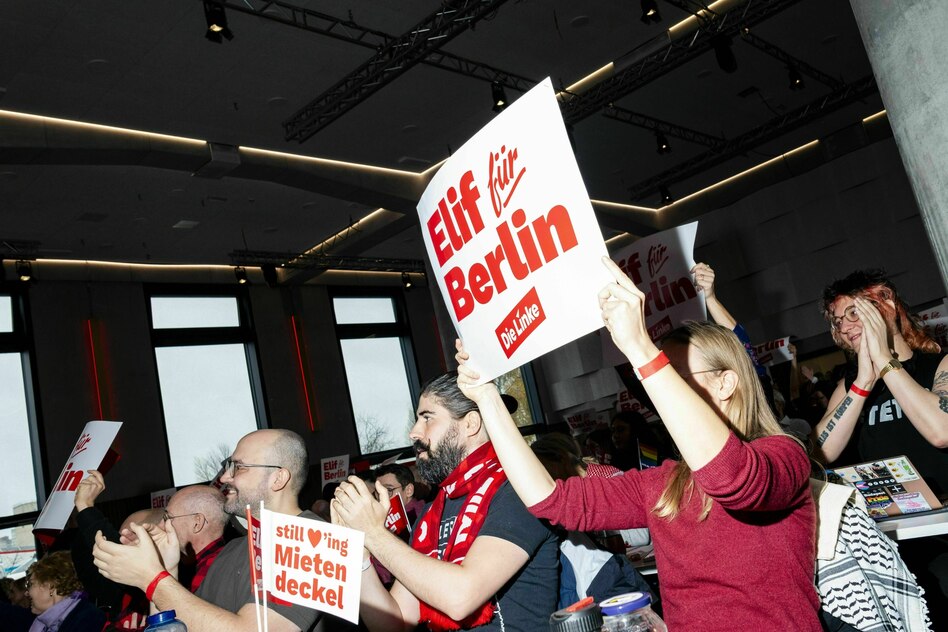
The situation seems paradoxical: On the one hand, shortly before the election it becomes clear that the Left Party has the chance to become the strongest force. For the first time in its history, the party could fill the office of governing mayor with top candidate Elif Eralp. But what is rarely a question in other parties - whether people actually want political power - is controversial in the Berlin regional association, which now has over 18,000 members.
However, the reasons for left-wing government skepticism go deeper than the dispute over a position on Palestine. If you ask around, you will instead come across a party that is changing rapidly and struggling with the mistakes of its past. Many comrades are afraid that the current high could fizzle out again - and are therefore discussing whether the Left can actually deliver what it promises under the given conditions.
The word that keeps coming up is “household”. All forecasts assume that Berlin is heading for a significant financing gap. The black-red budget already has a deficit of up to 6 billion euros for 2027, which can still be offset through reserves and loans. By 2028 at the latest, a left-wing government would have to deal with a budget hole that is no longer so easy to fill.
This threatens to turn the Left into a party of austerity. This brings back traumas that go back to the early 2000s, when Berlin was on the verge of bankruptcy because of the banking scandal caused by the CDU. In 2002, the party, then called PDS, joined the SPD in a government that announced that it would “save until it squeaks”. The result was wage dumping, job cuts, austerity policies and the mass sell-off of the state's own real estate portfolio - with the participation of the PDS.
It took the party years to recover. But we also learned something, Katrin Lompscher tells the taz. From 2006 to 2011 she was Senator for Health, Environment and Consumer Protection, and from 2016 again for Urban Development and Housing. “Between 2012 and 2016, we really became a party of social movements in opposition,” she says. Only in this way, through laborious work of building trust, did the party find its roots in urban society again.
During this time, a wing that felt closely linked to the extra-parliamentary left increasingly gained influence. In contrast to the more state-supporting reform wing, the party is seen here more as an alliance partner of urban society, which politically implements its demands. Therefore, their success is also measured by how well they succeed in pushing through left-wing demands, even against their coalition partners. This is what the party calls “rebellious governance”.
One person who helped develop this concept around 2016 is Moritz Warnke. Until then, the reform wing had dominated the party with its idea of “good governance,” he says: “That politics is about trust and good professional work, that you have to be indulgent and seek compromises.” That's all important, but it's not enough, says Warnke. “Political conflicts are part of political activity.” A left-wing party cannot go along with everything if the demands of social movements are jeopardized.
In this wing, participation in government from 2021 to 2023 is seen as a mistake - because of the soft position that the left agreed to at the time with a view to the referendum to expropriate Deutsche Wohnen & Co. The coalition agreement simply said that they would respect the outcome and “handle it responsibly”. The decision was outsourced to a commission of experts. When they presented a positive result for the referendum, the coalition had already collapsed.
The fact that the movement wing is now so adamantly insisting on implementing DW expropriate also has to do with this experience. In addition, thousands of people from the extra-parliamentary movement milieu joined the party as a result of the rise of the AfD. In 2025 alone, the party's membership will have doubled. As a result, the Left has not only become the party with the largest number of members in Berlin, but also younger, more migrant and more female. And more left-wing, as many say.
A communist-oriented wing has also gained strength, which is particularly located in the Neukölln district association and which relies on the long-term development of counter-power - which here also includes a rejection of raison d'état and solidarity with Israel. Meanwhile, the reform wing was further weakened when Klaus Lederer, Elke Breitenbach and other prominent left-wing politicians left the party in October 2024.
Since then, the SPD and the Greens have also been at odds with the Left, and their political style is perceived as unpredictable. But that's not necessarily a disadvantage, says Jorinde Schulz from the Neukölln district association. The reform wing ultimately cost the left a lot of compromises, she says. In order to get more out of negotiations, it must be clear that you are ready to go. For example, if “the other parties oppose the referendum, continue the police policy of repression or want to further shrink the city,” says Schulz.
For the coming election, the question is “where we can achieve more for Berliners,” says Schulz: “As a strong voice in the opposition or as the manager of the budget gap.” In her opinion, it is the left's chance to be “the only opposition to the dismantling of the welfare state, rearmament and militarization.” You shouldn't jeopardize this by making cuts yourself. Government participation is only an option if “our clear red lines hold, especially the socialization of large real estate groups,” says Schulz.
Former Senator Lompscher, on the other hand, says: “Avoiding responsibility is not an option.” She is confident that the tight budget situation will allow enough scope for left-wing government projects. Of course, social clear-cutting would have to be prevented, but to do this one would have to “become creative” in terms of budgeting, says Lompscher.
But what options are there to deal with cash-strapped finances? It is obvious for a left-wing party to increase income. But most taxes are a federal matter. According to the Left, what could be done at the state level would be an increase in property taxes and trade taxes as well as a tax on villas and luxury properties. The party wants to raise an additional 350 million euros. That would be a start, but it won't fill the budget hole.
In addition, the party wants to forego expensive prestige projects such as the Olympic Games. Other tricks are being discussed within the party, such as circumventing the debt brake through so-called transaction loans to public companies. The periods for loan repayments should also be extended. What also gives some people hope is that the city's economy - unlike in the 2000s - is by no means in recession.
Moritz Warnke believes that “everything possible needs to be tested” when it comes to financing. For him, it's about whether enough “lighthouse projects” will ultimately be pushed through in the coalition negotiations that will make a real difference in the lives of Berliners - in tenant protection, medical care, mobility and climate protection. "I'm in favor of trying it. But whether I ultimately agree to a coalition agreement depends on the content," says Warnke.
The planned procedure shows how sensitive the question is for the party as to whether there will actually be a majority for a coalition agreement in the end: a resolution at the last state party conference stipulates that a party conference convened specifically for this purpose after the election must decide on whether to start exploring. And at the end there is a member decision as to whether a corresponding coalition agreement will be concluded - or not.
The resolution also sets out substantive guidelines for possible coalition negotiations, such as the immediate implementation of Deutsche Wohnen & Co's expropriation, a rejection of austerity policies and a move away from police repression. “These are high hurdles for the SPD,” admits Schulz. But anything less than that is simply not enough. Above all, she is certain: “If DW’s expropriation is weakened, there will be great resistance.”
Others in the party, especially from the movement wing, also see the handling of DW's expropriation as a crucial litmus test for the party's credibility. Otherwise, the party base is by no means against participating in the government, it is said, but on this issue the fronts have hardened. SPD top candidate Steffen Krach has already ruled out the implementation of DW's expropriation. Whether there will be a new edition of red-green-red does not only depend on the left.
Read the full story at the source →
Source: taz