
War & Militarism taz
1,721 days of war in Ukraine: strikers and defenders
Many Ukrainian football players have volunteered for the army, including national player Roman Maksymyuk. But some are fighting on the Russian side. more...
Deutsch (original) ·Auto-translated to English
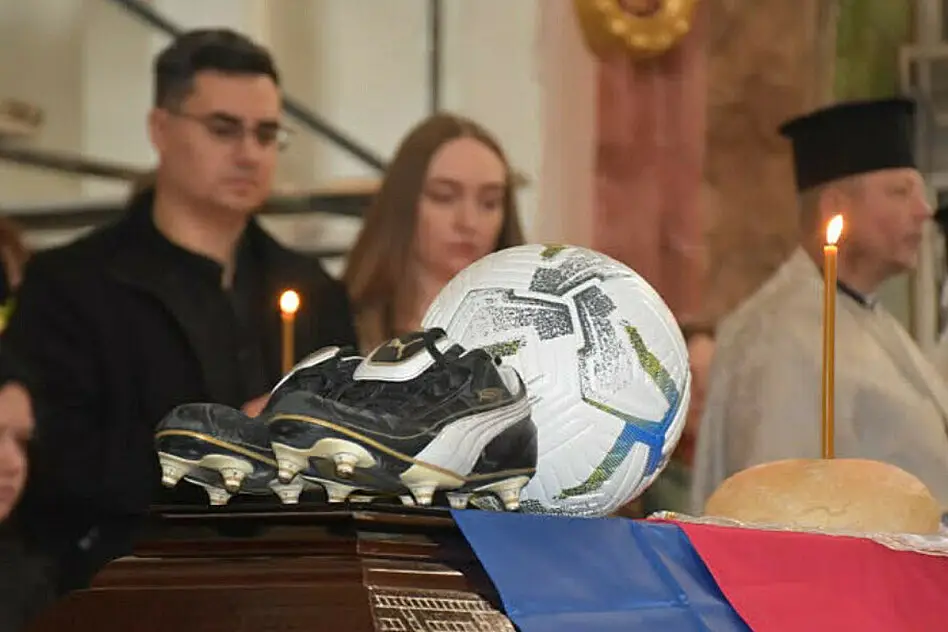
Football boots, a ball and a jersey lay on the coffin. From the portrait photo next to it, a man with a courageous, sincere look looked at the guests at the funeral service, which took place in the largest Orthodox cathedral in the western Ukrainian city of Lutsk. Roman Maksymyuk, a former national soccer player, volunteered for the war against the Russian occupiers. He was killed.
For the people of Ukraine, war has become part of everyday life. Despite the mortal fear of air raids and fighting, life goes on: people go to work, school and university. They love, laugh, get married, have children, go on vacation. They mourn, worry - and hope for peace. ➝ to the column
Just as the coffin was being carried out of the church, there was an air raid alarm. Shortly afterwards, Ukrainian air defenses could be heard in the distance fighting Russian drones.
Roman and I met while working for FC Volyn. Roman used to play here himself, then he became a coach. His football career was impressive: the best clubs, goals, titles and participation in European cup competitions, then national team.
reports as a freelance journalist from Ukraine. He lives in Lutsk, western Ukraine, and was a participant in an Eastern Europe workshop organized by the taz Panter Foundation.
In the fall of 2022, Roman became a soldier in the 25th Airborne Brigade. He also didn't shy away from dangerous tasks. He couldn't do anything else - even on the football field, he always went into duels and fought until the last minute. Maksymyuk's comrades describe how exceptionally heroic he was in repelling attacks by the occupiers. Once, at a critical moment, Roman ran into the street and not only killed the opponents, but also cleared away the bodies afterwards so as not to give away the position.
In January he was reported missing from a sector of the front near the city of Pokrovsk in the eastern Ukrainian region of Donetsk. Since then, every time I have looked for his name in the lists of Ukrainian soldiers released in exchange for Russian soldiers. I never found it. Roman Maksymyuk was missing for more than twenty months. It was not until October 2026 that his death was officially confirmed using the results of a DNA test.
This article was made possible through the financial support of the Forschungsfonds Ausland e. V. You can support the research fund through a donation or membership.
In June 2025, when Roman's fate was still uncertain, the Ukrainian national football team organized a moving memorial and solidarity event for him. Before the game against Canada, the players posed for a team photo while holding Roman Maksymyuk's army jacket.
Roman is not the first former player of my football club who did not return from the war. Roman Hodowanyj died in November 2023. He was a defender – on the pitch and in the army.
In a photo on the FC Volyn club website he can be seen next to striker Serhiy Petrov. Serhiy Petrov was killed near Pokrovsk in 2025, where he had fought on the Russian side. Petrov came from Crimea. However, he began his football career in Volhynia in western Ukraine. On the eve of the major Russian invasion, he came to Crimea, which had been occupied by Russia since 2014. There he volunteered for the army of the Russian Federation. His wife and children fled the war from Ukraine to Germany.
Three other footballers I worked with at the club decided to live in Russian-occupied Crimea. In contrast to Petrov, they remain as quiet as a mouse and apparently just want to wait out the war there.
Maksymyuk, Godovanyj and Dmytro Zaderetskyj (who defended his hometown Chernihiv with weapons in hand), the club officials and the club's medical supervisors, however, joined the Ukrainian army. They became role models for the children and young people who now come to football training in Lutsk. And the stadium in which Roman Maksymyuk played hundreds of games will bear his name in the future.