
War & Militarism taz
On a rafting tour in the Poltava region, our author gets to know completely new sides of Ukraine. And numerous civil society initiatives. more...
Deutsch (original) ·Auto-translated to English
It is about 300 kilometers from Kyiv to Hadjach. At the beginning the bus whizzes over the slippery road, but for the last 30 kilometers it rocks like it's on an air mattress because of the countless potholes. I feel a little seasick when we finally get there.
Hadjach is a small town in the Poltava region with a population of just over 22,000. The family of the well-known Ukrainian writer Lesja Ukrayinka (1871–1913) once lived nearby; the place was once a hetman's residence and today it is a place of pilgrimage for Hasidic Jews from all over the world.
I was in Hadjach with a group of tourists: kayak trips, excursions and overnight stays in a tent were on the program. I was hoping for beautiful places and historical information. Instead, we encountered local initiatives everywhere. The tour was led by Volodymyr, a local entrepreneur.
At first I thought tourism was just one of his business areas. But the longer he talked about these places, the clearer it became that it wasn't primarily about the money for him. Volodymyr had studied at the Kyiv School of Economics to learn how to build a business. He wrote his thesis on a cultural project to develop Hadjatsch.
Ukrainian journalist and producer from the Kherson region. Lives in Kyiv. Master in Cultural Studies. Since 2022, she has been working on a news and analysis project about the lives of people in the south of Ukraine during the war. As a producer, she created the history project “Deokupowana istoriia” (Liberated History) about Russian myths in southern Ukraine.
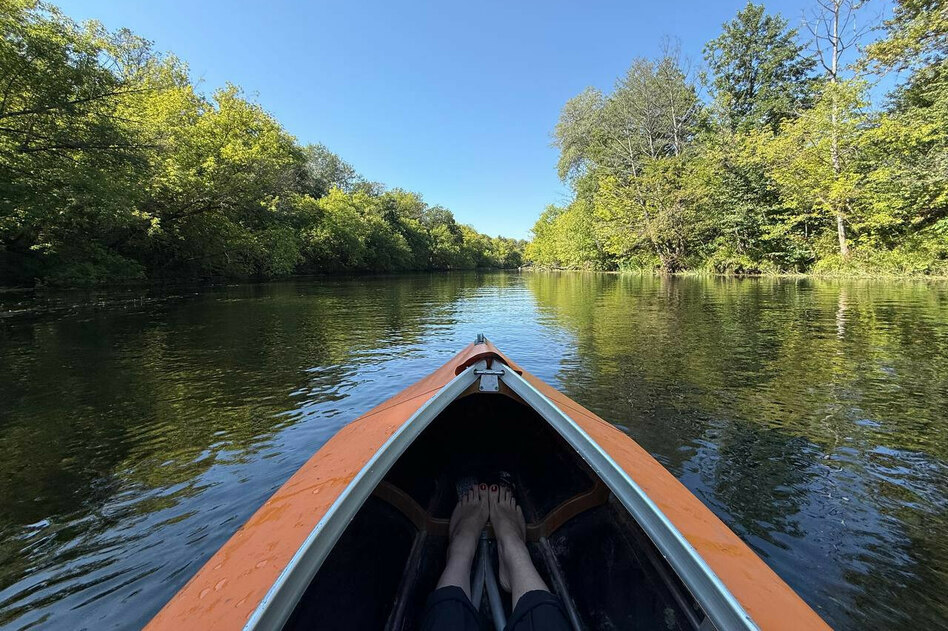
We took the kayaks along the Psel River. I have been to many places in Ukraine and I did not expect that this river would impress me so much. In the clear water you could see fish and aquatic plants that looked like long hair. The water shimmered golden in the sunshine - a river trip on the Psel is like meditation.
Only now and then the silence was broken by the whirring of drones. We didn't know who started it - locals or the military. The Poltava Oblast is relatively close to the border with Russia. That's why the war is always felt here, in the silence of nature.
At one stop we were welcomed by locals around a campfire: they had cooked borscht and roasted meat. The 22-year-old primary school teacher Sascha was among the organizers. For me he destroyed the cliché that this was primarily a woman's job.
The local excursion was also led by locals. Iryna only began to study regional history when she was older. Walentyna used to be a hobby beekeeper, but today she gives courses in beekeeping. Volodymyr develops cultural tourism, Sascha teaches children, Iryna gives the place back its past and Walentyna passes on local knowledge. Together they have implemented their love for their home region - not abstractly, but practically.
Small Ukrainian towns often seem inconspicuous until you meet the people who keep them alive. Perhaps Hajach lacks major roads, money or the attention of the rest of the country. And yet here they organize rafting tours, research history and show guests the places that they consider particularly lovely.
I bought a watercolor with a view of Psel at the local museum. This not only reminds me of my journey, but also of the fact that history doesn't just preserve itself. But someone's daily work requires it.