
Germany taz
150 years of portrait photographer August Sander: You come from Dada
August Sander, the epoch-making portrait photographer, would be 150 years old on November 17th. An anniversary show in Cologne shows its little-known side. more...
Deutsch (original) ·Auto-translated to English
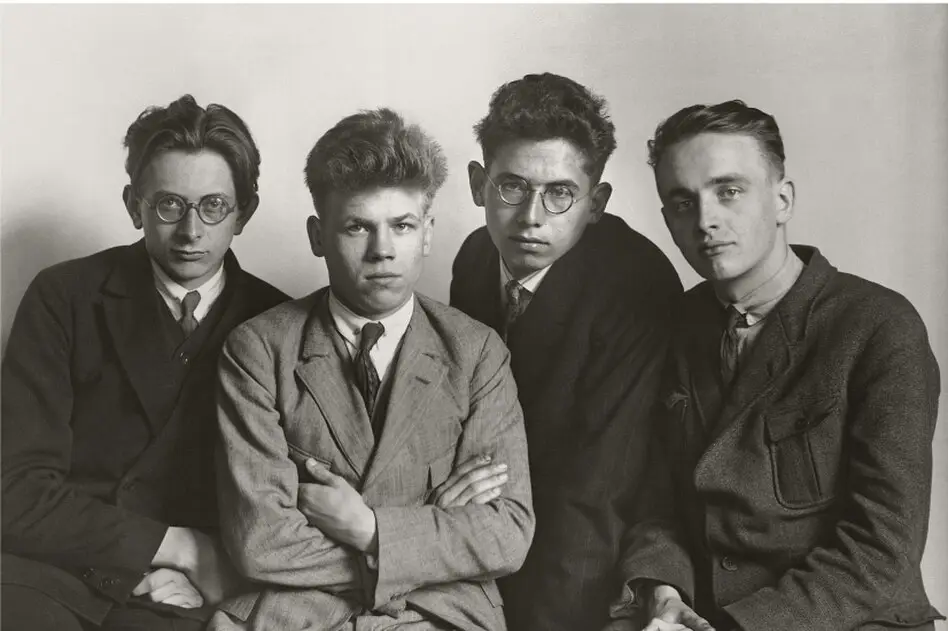
“August Sander – On his 150th birthday” is the somewhat unadorned motto of the big party. This November 17th would be his 150th birthday, at least mathematically. One could therefore expect a guaranteed Sander best-off from the anniversary show with this title, which the Kulturstiftung der Sparkasse KölnBonn is currently organizing. Since 1992, she has not only managed August Sander's estate, but also researched it and repeatedly introduced the master's photographic work of strict and clear documentary portraits in her exhibition rooms in Cologne.
But you will be surprised if you have completed a first tour of the exhibition in Cologne: many classics are missing. Missing are the three young farmers, each with their walking stick and the white, starched shirt collars that shine so brightly thanks to the dark suits. The two boxers standing next to each other are missing, looking so good-naturedly at the world that it's hard to believe they could compete against each other. The burly pastry chef from 1928 with the bald head and the mixing bowl in his hand and his strangely polished shoes is also missing.
So many of the expected images are missing from Sander's large portfolio project “People of the 20th Century,” which he pursued throughout his life and ultimately consisted of 45 parts. Its aesthetic rigor still fascinates today and in which the word “iconic” cannot be used. Instead, the exhibition takes us on fresh, new tracks. And that's where art comes in. We don't just look at portraits of avant-garde artists like Raoul Hausmann and Gottfried Brockmann, but we also learn a lot about Sander's anchoring in the Cologne art scene of the 1920s and 1930s and especially the “Cologne Progressive Group”.
“August Sander – On his 150th birthday”. The Photographic Collection/Foundation Culture of Sparkasse KölnBonn, Cologne, until January 24, 2027
Sander, born in 1876, a miner's son who, as a heap boy, almost accidentally crossed paths with a professional photographer, with life-shaping consequences, settled in Cologne-Lindenthal from 1910 after years of apprenticeship in Berlin, Magdeburg, Leipzig and finally Dresden and almost a decade of studio work in Linz, Austria. He quickly established himself, was with the Landsturm from 1914 to 1918, at least not at the front, while his wife Anna, whose role in Sanders' work remains underexposed in this exhibition, continued the photography business at home.
He found an artistic home with the “Progressives”; whose members come from Dada. They paint on canvases and want to give their art a political orientation, so they publish two newspapers, stupid and a to z - and that's where August Sander comes into play with his knowledge of photographic reproduction. The exhibition features reproductions of paintings by his artist friends, whose originals are now often lost; But Sander's own artistic works are also on display, because the photographer initially painted himself and - as we know from Dada art - made collages: "Coellen from Rand und Band em 1929" is the title of such a collage in which faces, bodies and even groups of people tumble wildly around each other, garnished with newspaper headlines.
And then follows a kind of exhibition within an exhibition, spatially cleverly housed in its own cabinet: Sander's photographs of the Cologne artist festivals such as the “Mamukuba”, an acronym for painter-musician-artist ball, or the “Em dekke Tommes”. Above all, his pictures from the Cologne carnival world of the 1920s and early 1930s are particularly striking: couples and groups not only show themselves carefully dressed up in the civilized bourgeois carnival in the large ballroom, but they also show off with joy in the bright, the exaggerated, the excessive in small, intimate constellations.
Because Sander was particularly fond of the anarchic rag balls on a small scale, in private: "The rag balls were anti-bourgeois, intellectual, exclusive, but without snobbery; we selected the visitors and only admitted those we liked," wrote the Cologne painter, "progressive" and Sander's friend Antonräderschmidt, later looking back; whom Sander also portrayed for his people portfolio project; once solo and then as a couple portrait with the painter Marta Hegemann,räderschmidt's wife.
In the back area of the exhibition it finally goes into the years just before and then after 1945, it is superficially factual and sober, here you can see previously rarely shown and therefore less well-known Sander photos of the destroyed Cologne; sees the cathedral rising between mountains of rubble, sees the destroyed exhibition grounds, looks at the shattered town hall.
And finally it goes into even more detail and looks at previously unseen documentary footage of his own photography workshop at Dürener Straße 201. Sander has lived here with his family for almost 30 years; He welcomes his artist friends on the first floor, where they debate. The next morning he works again on the ground floor, where he has his laboratory, his darkroom and his archive.
The representative reception room, the retouching table, the view from the studio room of the chestnut tree in the courtyard can be viewed, and the study with the corner oven and sleeping cat is shown to you. And if you look at the photos again, if you look more closely, if you look at the room walls, you will see a lot of art hanging on them: for example the cubist painting “Mural for a Photographer” by Franz Wilhelm Seiwert. In the end, Sander probably had a considerable art collection, donations from his friends.
As the air raids on Cologne steadily increased from the winter of 1942 onwards and Sander had to fear the loss not only of his apartment and studio, but also of his archive of quickly combustible photographic material, he and his family gradually moved from Dürener Straße to narrow accommodation in the village of Kuchenhausen in the Westerwald.
It goes back to where he grew up. His headquarters in Cologne will also be completely destroyed; 30,000 negatives alone are lost. Back then, Sander bundled the photos from Dürener Strasse into a 71-part portfolio; Photographs as convincingly composed as his well-known farming groups, his familiar craftsman portraits in the Eifel, in the Siebengebirge, along the Rhine; where nothing is missing visually and nothing is too much.
He also wanted to prepare himself for a possible claim for compensation after the end of the war and the regime; His quite successful photo book “Antlitz der Zeit” with excerpts from his “People of the 20th Century” work, which his publisher Kurt Wolff praised effusively in a letter on display, was soon banned by the National Socialists; his son Erich, a photographer like him and in the socialist resistance, will die in prison; Home pictures, so to speak, also serve as evidence of its ownership and existence, as well as its artistic significance.
He immediately tried to contact the authorities in the immediate post-war years, and in 1954 he was only provisionally granted 1,000 D-Mark compensation for household goods; Four years later, his application for compensation was finally rejected, when August Sander was 82 years old. He dies in 1964.