
World · taz · · 3h
15 years of Occupy Wall Street: When Wall Street was sealed off
Deutsch (original) · Auto-translated to English
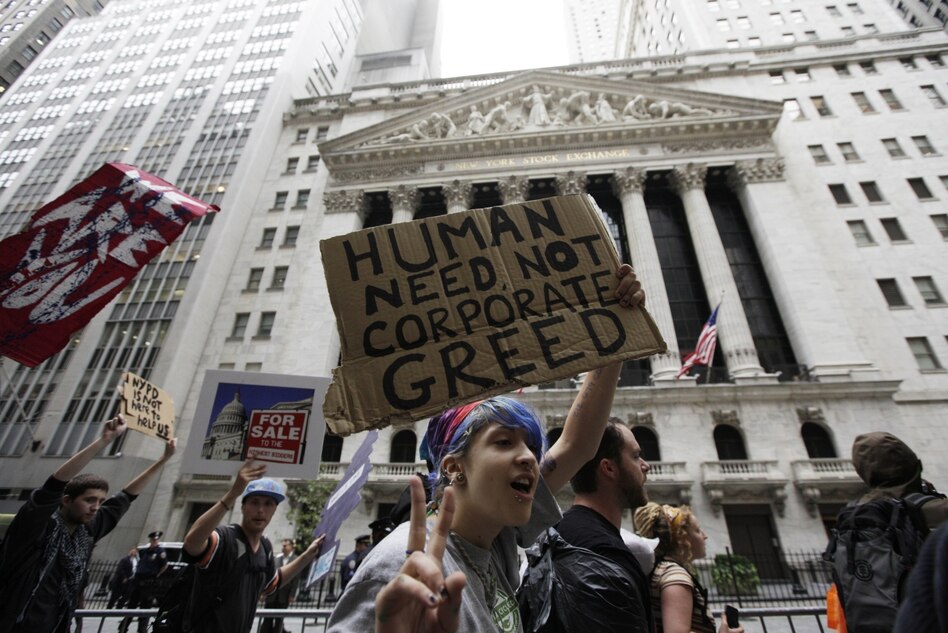
If you think back today to the afternoon of September 17, 2011 in New York, it seems unreal that the events of those hours gave rise to a global movement with lasting impact. Occupy Wall Street seemingly came out of nowhere. There had only been something vague in the air in New York over the summer. Leftist and anarchist groups had met regularly and with some urgency in Tompkins Square Park. The memory of the street fights of the 1990s over the right to public space for everyone was still there.
The disappointment that nothing new emerged from the financial crisis of 2008, but only an even more powerful and irrefutable version of the neoliberal economic and social order, had hardened into deep frustration.
At the same time, the vague idea of Occupy Wall Street as a situationist spectacle, born of Kalle Lasn and his subversive magazine Adbusters, was circulating on social media and chat groups. At some point someone randomly set a date for it.
So in the afternoon, groups and curious people gathered in the financial district to see whether anything would actually happen. Something was happening, but it was not remotely in the nature of an organized protest. Small groups of demonstrators played cat and mouse with the police. Some made their way to Wall Street, where they were mocked and sarcastically cheered on by grinning financiers from the balcony of a fancy restaurant.
An almost humorous back and forth ensued until the police sealed off Wall Street. The crowd retreated to nearby Zuccotti Park, a nondescript concrete plaza. Because it didn't have an official closing time, some people spent the night there.
A week later, 500 squatters had transformed the park into a camp complete with a grassroots democratic utopia. Thousands attended the two daily general meetings. Anyone could take the floor; topics ranging from taxes on the rich to corruption in politics, banking regulation, free education and the complete reform of US democracy were addressed.
The “People’s Mic” turned the events into an almost spiritual ritual. Working groups and discussion groups were formed, ranging from reading Marx to help with creating CVs. An infrastructure was created with food banks, sanitary facilities, medical care and a library.
When celebrities from Slavoj Zizek to Sean Penn to Michael Moore, Susan Sarandon and Judith Butler appeared, as Occupy spread to cities around the world and there were sympathy rallies from a wide variety of political corners, there was more and more euphoria. Sociologist Mark Greif said they would continue to occupy Zuccotti Park until US democracy was repaired.
Of course it didn't come to that. The conservative mayor Michael Bloomberg had held back for a long time, but it was clear that the city would not tolerate public space appropriated by grassroots democracy and used in an unregulated manner in the long term. On November 15, police cleared Zuccotti Park. A mass demonstration followed, the likes of which New York had not seen for a long time.
But a major hangover soon struck the global left. The energy of Occupy had not been translated into programs, demands or even concrete political successes. This was chalked up to the movement as a failure.
Slavoj Žižek, of all people, defended the Occupy movement in New York. It was not their job to format demands and programs in such a way that they achieve conventionally measurable progress within the existing institutions, which were criticized. Rather, says Žižek, Occupy was an answer to which a question now needs to be found.
15 years later, questions are emerging. During ICE's invasion of Minneapolis, for example, there was effective resistance from disparate but well-organized left-wing and civic groups. Their horizontal form of organization went back directly to Occupy, refined through new digital tools and tested during the mass protests of the Black Lives Matter movement.
These forms of organization now play a major role in US institutional politics. The Indivisible network, for example, which is linked to dozens of others, can mobilize thousands or even hundreds of thousands at any time, anywhere in the country. The non-hierarchical horizontal left, the direct heirs of Occupy, can put candidates into office. They can spread information about the activities of ICE troops at lightning speed and thus put pressure on a repressive regime.
Perhaps this is one of the questions that Occupy answers: How can one exert grassroots influence and power within entrenched political structures? Leaderlessness and the plurality of the movement, which go back directly to Occupy, seem to be strengths. As in Minneapolis, they empower people to do something without being constrained by predetermined institutional paths. At the moment, this is the most powerful thing the USA has to counter the Trump regime.
Read the full story at the source
Source: taz