
World taz
10 years of Calais jungle: “There are fences everywhere”
Ten years ago, French authorities cleared the refugee camp on the English Channel known as the Jungle. It has left its mark to this day. And new camps are constantly being created. more...
Deutsch (original) ·Auto-translated to English
O n a windless midday at the end of September, Calais Ville train station seems to have fallen out of time. Groups of people with sleeping bags and plastic bags have sat down on the benches - women, men and even some children. Others sit on the floor or the forecourt. Police and security guards patrol the small station hall and purposefully disappear down one of the stairs down to the tracks. You could feel like you've been transported back to the mid-10s if it weren't for the orange life jackets lying next to other pieces of luggage.
Migrants who make their way to England in public: scenes like this in Calais should actually be a thing of the past. More precisely, since the end of October 2016, when the French authorities cleared the “jungle” in an industrial area on the outskirts of the city. This is what the unofficial refugee camp was called locally, in which over 10,000 people lived who wanted to cross the English Channel to England at its narrowest point. The images of the bulldozers went around the world and made the “jungle” a symbol of the European migration crisis. But at least with the route over the canal, according to the authorities, the evacuation should have taken care of it.
Today there is a wasteland where the camp once was. A statue of grassy hills and bushes, with wildflowers in front of a red Accès interdi (No Trespassing) sign. Nothing reminds us of the tents and crooked huts made of tarpaulins and tree trunks that were lined up here. Nothing of roaring generators, garbage-lined paths, the acrid smell of fire burning damp wood and plastic waste. And nothing reminds us of the blue police lights that flickered from the motorway bridge over the area all night long. The police advanced into the jungle with tear gas to stop the migrants from climbing onto the England-bound trucks that were heading to the island through the Channel Tunnel. In the morning the gas cartridges were found in the mud.
Myth UK: Migrants have been trying to get from northern France to England since the late 1990s. Initially from Kosovo, their origins soon reflect global war and crisis areas. The hope of a secure life and work in England feeds a myth that is far removed from the British reality with its economic problems and massive anti-immigration sentiment.
Jungles: After the original Red Cross camp near Calais was closed in 2002, refugees settled in unofficial camps in the surrounding area. In 2009, one such jungle, in which around 1,000 people were previously staying, was cleared. After the evacuation of the world-famous 'Great Jungle' in 2016, the French government housed thousands of residents in reception camps in the interior of the country. Sooner or later they returned to the English Channel.
Internationalization of the border: The Le Touquet Agreement has been in force since 2004, moving the British border, including security and controls, to northern France. Since then, the government in London has transferred hundreds of millions of euros to Paris in return for “stopping the boats,” which replaced trucks as the main means of canal migration in 2019. A three-year border protection contract agreed in April 2026 alone is worth 760 million euros. Since 2021, Great Britain, France, Belgium, Germany and the Netherlands as well as the EU Commission, the EU border protection organization Frontex and Europol have been cooperating as the 'Calais Group' to combat the smuggling organizations.
Death toll: Bruno Retailleau, conservative presidential candidate in 2027 and then French Interior Minister, admitted in 2024 that the massive rearmament and militarization of the border had “detrimental consequences with an increase in fatalities”. Since 1999, more than 500 refugees have died here. In 2025 there were 41, in 2026 there were significantly fewer boats so far 31. Tobias Müller
The fact that the destruction of the “jungle” will also close the migration route to Great Britain is of course a mistake. “As long as England is on the other side of the Channel, migration there will continue,” is a common saying on this coast. And so in recent years there have been clusters of tents on the outskirts of Calais, which are regularly cleared by the police and then rebuilt a few meters away. This is not a solution, but rather a strategy that fits with the repressive misery management that has always prevailed here. Since 2016, the maxim of the authorities in Calais has been: no more permanent settlements.
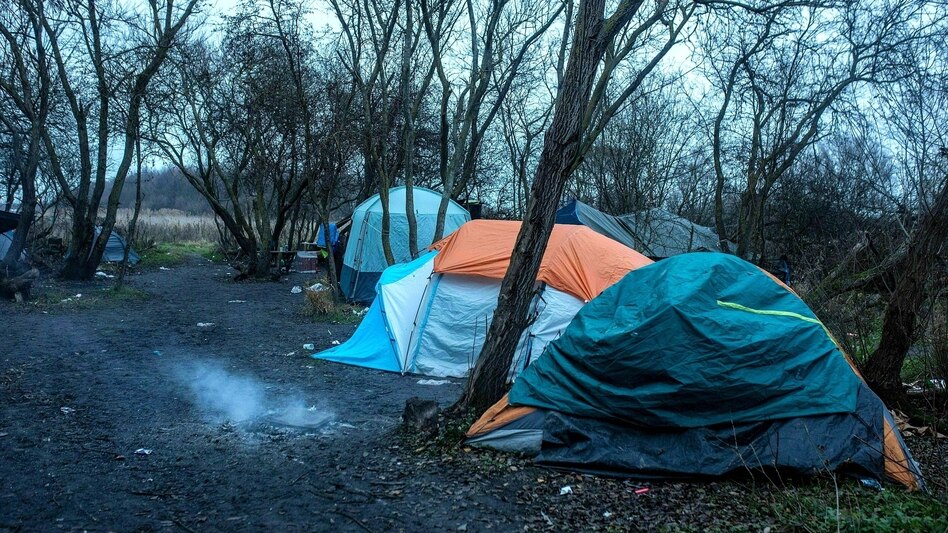
Of course, there is still a “jungle” and that is exactly where the people who are waiting in the train station today for their onward journey come from. It is located 30 kilometers further east, just before the Belgian border near Dunkerque, and is strikingly reminiscent of the old one. From a nearby bridge you can see no man's land between the foothills of an industrial area. There are small tents everywhere between bushes and narrow strips of deciduous forest. The camp, which has existed here for several years now, has expanded significantly over the summer. Local aid organizations estimate the number of residents at 2,500 in September. At the back, at the edge of the large open area where food and clothing is sometimes distributed, there is a long row of toilet blocks.
This article was made possible through the financial support of the Forschungsfonds Ausland e. V. You can support the research fund through a donation or membership.
Already on the bridge you notice all the life jackets that transport individuals, small groups, couples or young families with strollers back to camp. Since inflatable boats replaced trucks as the main means of transport across the canal in 2019, the orange of the West can be seen at train stations, bus stops and along country roads in calm weather. Here, across the bridge, the source is the Decathlon branch in the shopping center, which sells them for 29.99 euros. They can also be purchased at some of the makeshift stands that have been set up away from the open space. Even a traveling salesman has a few vests spread out in the dust in front of him. “Good quality,” he says, and when asked about the price, he spreads all ten fingers three times.
A merciless wind has been whipping across the region for 24 hours, but it is, if you will, the storm before the calm that everyone here is waiting for. After a long, changeable period, the weather is expected to calm down the next day, a stable high is expected over the English Channel, hardly any wind, low waves, best crossing conditions. There is a sense of optimism in the “jungle”.
He tells his story on the edge of the open space, which is a kind of village square in the camp. Volunteers from an NGO are currently handing out food: It's a scene that has been part of everyday life in the region for 25 years - ever since the migration crisis existed in northern France (see info box). Along with Ethiopians, Kurds, Somalis and Afghans, people from Eritrea form one of the largest groups in the camp. Jonas fled war, dictatorship and the lifelong military service for which the East African country is known.
He has tried to come to England three times so far, three times in vain. “The police intercepted us, destroyed the boats with knives and sprayed us with tear gas.” Because Jonas, like many people here, cannot swim, he bought a life jacket. He lost that too. "Now I don't have any money anymore. Maybe I can wash dishes or make tea and coffee somewhere here to earn some money. They also sell food here."
In fact, there are not only makeshift stalls or shops on the edge of the village square, which usually represent the first level of permanent structures in a refugee camp and offer sweets, snacks, food, drink cans, gas cartridges and mobile phones. In addition, several tea and snack bars have been built: simple wooden shacks where you can sit down, eat and drink. As you walk past you can hear the rhythmic chopping of knives on boards. Fresh ingredients are draped in plastic containers, just like in a snack bar. It smells like grilled kebab skewers.
All of this is very reminiscent of the old “Jungle”. Hooded figures, shoulders hunched, shuffling alone, in pairs or threes, through the grasslands, to a food bank, to their tents, or simply to kill time until the next attempt to get to England. The charging stations for telephones. The minimal sanitary facilities that the authorities had to build after a successful lawsuit by NGOs last winter. And the meter-high fences that have been built around the camp between the foothills of an industrial area.
“It looks like Calais here.” This sentence is said by many who come to Grande-Synthe and know the conditions in Calais in the 2010s. And it's not just here that it looks like a time machine: hundreds of kilometers of high-security fences run through the entire coastal hinterland. Barriers topped with barbed wire have become a characteristic element of this landscape. Anyone traveling to London with the Eurostar can get an idea of this around the Calais-Fréthun TGV station.
For Benoît Landesmann, this is exactly the legacy of “Jungle”. The 47-year-old, who works as a primary school teacher in Calais, is a child of the area he describes this way. “Fences, there are fences everywhere, and there are boulders lying around in the middle of the city.” It refers to barriers, which often only serve the purpose of making a certain place inaccessible to migrants, and large stones that are intended to prevent tents from being set up in public spaces. To this day this is a common sight in Calais. “Plus, my children are used to seeing police everywhere.”
When the migration crisis began on the English Channel, Landesmann and his wife got involved with Salam, one of the associations from the very beginning. Later, his wife in particular gave French lessons at the school, which was next to mosques and an Eritrean Orthodox church in the “big, mighty jungle,” as the countryman calls it. “It was so big that you couldn’t see all the way from the top of the bridge,” he remembers. From the days when the camp was evacuated, he still has images of “big machines crushing everything” in his head. One thing is definitely certain, says Landesmann: “Tearing down the ‘Jungle’ didn’t solve anything.”
Many a night he can see it for himself ten years later. As a passionate water sports enthusiast, Landesmann lives with his family in a small house on a country road outside the city, behind which the dunes begin. When the weather is clear, the view from the bedroom window on the first floor extends as far as the English coast. "At night we can see the lights. Sometimes England seems so close you can touch it."
If weather conditions only allow crossings for a short time, boats still leave from the Calais or Dunkerque area, where the beaches are more easily accessible. However, because this part of the coast is very heavily policed, the police are often on the scene, tearing up the inflatable boats and holding back the passengers, often with tear gas and violence. "Sometimes late in the evening I sit in the garden and smoke a joint. Then I witness how the police make a hundred or more migrants who they caught on the beach walk in a bizarre procession to Calais. I then take photos of them, even though the police don't like it."
Significantly more boats set off a good 50 kilometers to the southwest, weather permitting. Places like Equihen-Plage, Hardelot-Plage or Sainte-Cécile-Plage, but also Berck-sur-mer and even beaches in Normandy have appeared on the map of Channel migration. The distances from there are longer - around 50 to 80 kilometers, instead of the 33 kilometers if you start at Calais. The risk of the crossing increases accordingly, even if the inflatable boats initially travel along the coast and only really set course for England at the narrowest point. The cheap products imported from China are anything but seaworthy.
The coordinated deployment of canal neighbors against smuggling gangs (see info box) has recently visibly affected their business. Several key actors were convicted, materials seized in raids and supply chains disrupted, meaning the number of crossings fell significantly this year. That's why the smugglers are now overloading their boats with even more passengers. Several had over 100 people on board in the summer, and one particularly long boat in August even had 230. In 2024 there were an average of 60 people, and last year 70 people who were put on the boats by the smugglers.
The period of good weather at the end of September is stable enough for an impressive trek from the “jungle” of Grande-Synthe to the beaches in the south. Trains or buses take you via Calais to Boulogne-sur-mer, from where you walk for hours through coastal forests and dune foothills. How important the area has become can be seen in two aspects: On the one hand, the first temporary camps are being built in which passengers wait for a boat to leave; on the other hand, an initial, sparse infrastructure of associations whose volunteers step in with food, blankets and dry clothing or look after shipwrecked people.
Brigitte Duhen is one of them. She belongs to the organization Opal'Exile, which has been active for a year and a half. On a sunny autumn morning she stands with three colleagues on the beach in Hardelot. It's low tide. They observe two groups of around twelve people each, a good half of whom are wearing life jackets and walking towards the waterline. Then they quicken their pace, run into the white foaming water and are soon up to their waists in the sea. Three police officers follow them but do not intervene. They are only allowed to hold back boat refugees while they are on land.
To prevent this and because too many boats were intercepted and cut open, the smugglers have developed a new technology: so-called taxi boats, which drive up the coast from the south and take people on board at various points. One of these was just about 200 meters from the beach and is now approaching the waiting people who have formed a queue. When it reaches them, everyone crowds around to climb aboard as quickly as they can. Around 15 other passengers are already on board.
In the following days, the bodies of two boat refugees were found on the beach in Hardelot. Further south, in Sainte Cécile, the gendarmerie also encountered a lifeless body on the beach after only half of a group of 70 people managed to board a taxi boat. The next week, two women and a child are crushed to death in an overcrowded boat at sea. In early October, two men died of cardiac arrest in another.
This afternoon, Brigitte Duhen said that if she experienced something bad on the beach, she needed a few days before she could go there again. The images constantly come back to her: “Of the migrants on their boats, the police, the rescuers from the fire department who are standing by.” Unlike other people, the beach is no longer a place of relaxation for Duhen.